How ‘flying boats’ are bringing EVs to the ocean — with the help of LeBron James and Tom Brady


By browsing water on thin hydrofoils, they look more like low -flying UFOs than boats.
But the “racing birds” of the E1 series – electric engine boats with 6,000 volts that can reach speeds up to 50 knots (58 miles per hour or 93 kilometers per hour) – are far from extraterrestrial. Instead, they are part of a fast growing sport that hopes to bring electric vehicles to water.
It’s the ground behind the UIM E1 World Championship. Nicknamed the “One of the SEA Formula”, he already has the support of celebrity team owners such as Will Smith, LeBron James, Tom Brady, Rafael Nadal, Sergio Pérez and Virat Kohli.
The 2025 championship, the second round of the series, takes place on seven locations: Jeddah, Saudi Arabia; Doha, Qatar; Dubrovnik, Croatia; Lago Maggiore, Italy; Monaco; Lagos, Nigeria; and Miami. It is a scene for its nine teams to run to become water champions. However, for the founders of the competition, it is not only the competition. They want to prove that electric motors can jump to the ocean.
“Water mobility contributes to pollution in the wrong direction”, ” Rodi BassoA former NASA scientist and F1 engineer who is co-founder and CEO of E1, told Live Science. “Sustainability now becomes almost a delicate word. It started from communication and consciousness, which was necessary; we have a problem. But now we cannot continue to feed this anxiety; we need a solution. The boat is a solution.”
A new sport was born
Basso’s inspiration for E1 occurred at the start of the COVID -19 COVID -19 pandemic, when he and Alejandro Agag – the president and co -founder of the E1 and the pioneer of the Electric Formula E and the extreme e – were walking by the Thames of London.
In relation: The 1st electricity ship in the world could “revolutionize the way we travel on the water”
After Basso offered the spark of an idea for an electric championship of engine boats, Agag provided the investment and motorsport expertise necessary to make development – or the surface of the water. Inspired by the way the birds slide on the aquatic surfaces, the 24-foot long boat (7.3 meters) was designed by the founder of Seabird Sophi Horne to lift his shell at more than 3 feet (1 m) above the surface at 19.5 MPH (31 km / h).
“It’s a bit like going back on the sticks of an airplane, where, while you ride, it will plunge, so you get some sort of,” Sam ColemanA pilot from the Brady team who won the first E1 world championship in 2024, told Live Science. “It is much closer to flying than driving a boat.”

The feat means that boats produce far fewer waves when balanced at the top of their three wing -shaped sheets, thus reducing coastal erosion. It also lowers friction with water to speed up the speeds of boats. These design elements combine with 20 seconds of boost to overeat the battery outlet from 95 to 140 kilowatts, allowing boats to reach 50 knots.
But the improved speed is delivered with major drawbacks. Bringing the racing birds to their leaves can make them faster, but that also makes them incapable of making treble turns. It also introduces the risk of cavitation – the formation of air bubbles – in the water below.
“About 50 knots, they become unstable,” said Basso. “The water around aluminum foil begins to boil, so you have less pressure and less force pushing the boat up, then the boat can collapse. And it does it with very little warning.”
“So now, the pilots are building incredible sensitivity and understanding, finding where this moment is, and driving on the edge of this moment,” he added.
This means that the pilots must manage carefully when using their boosts and when lifting their boats on their leaves during the races, in which they participate in a series of time trial to qualify for a last battle of five boats on the finish line.
To beat the competition, they have to find the right race line in the corners. This could mean mounting a wider arc perched at the top of their leaves or crushing the water near the buoys, before zipping on their boost, while sailing in the agitated waters generated by other boats.
To watch
It requires enormous concentration and fractional decision -making, which are both tense further by cockpit temperatures which can increase to 167 degrees Fahrenheit (75 degrees Celsius).
“It’s exhausting; it’s like sitting in a sauna and trying to drive a racing simulator that bounces from top to bottom,” said Coleman. “The window is so small, you can absolutely nail it, then suddenly, you are at a point of a degree on your finish setting and that is enough to induce a porpoise or an oscillation, which takes ages to recover.”
To help pilots do their best, engineering teams on earth analyze the data taken in all parts of the boat before advising them by radio. Team owners also closely follow the results of the races.
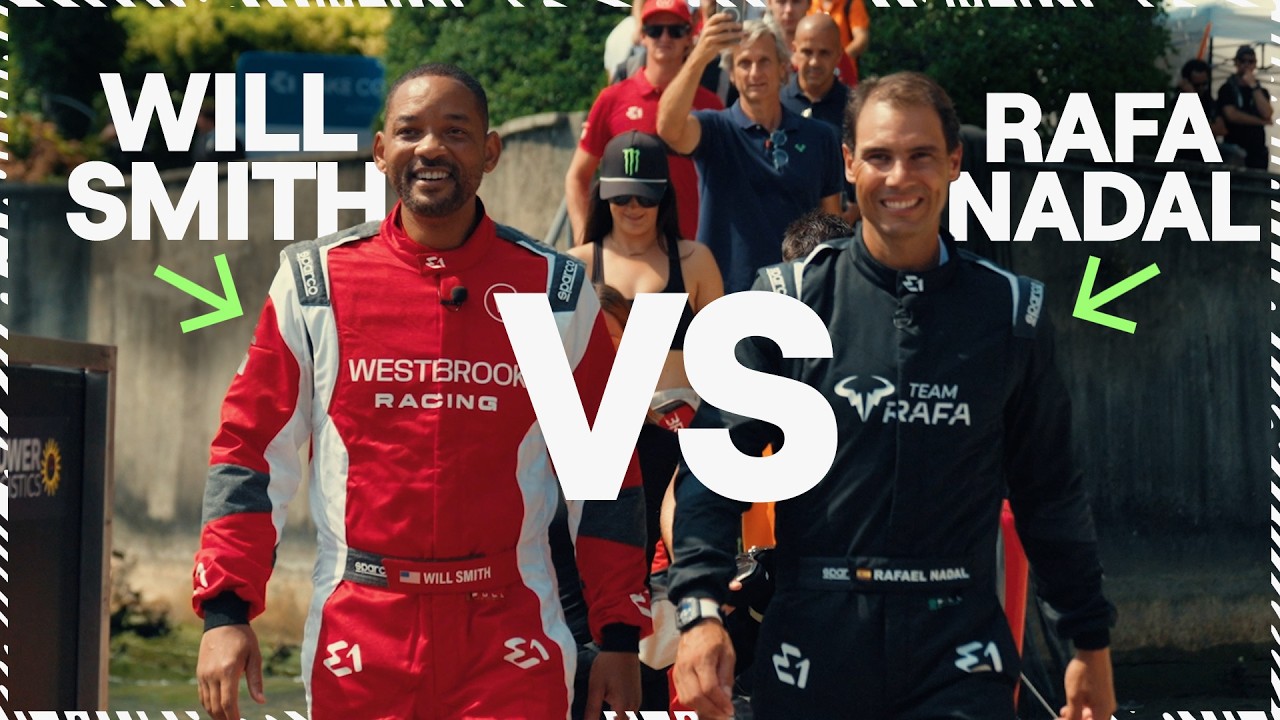
“Tom Brady is the owner of the team of our team, and for me to say that it is very surreal. But the most important thing is that it is inside,” said Coleman. “He follows it. It’s like when Rafa and Will Smith were in Lake Como: They had a good time, they appreciated it, they understand it, and you can see that they are super competitive, and they have an excellent opportunity to bring eye globes to a new sport, then help to raise it. I think it’s a truly exciting journey on which we are. “”
Move in silence
Keeping the fresh and competitive races means that changes are constantly made to the engines and propellers of the racing birds. Design adjustments are not only to improve performance and manipulation, but also to minimize the impact of zero emission crafts, practically silent on its environment.
The result is an electric ship which is about 50 times quieter than traditional combustion engine boats, according to Carlos DuarteChief scientist of E1. Duarte, marine biologist who won the Japan 2025 Prize For its contributions to research on marine and coastal ecology, works on E1 on voluntary regimes with industry to make ships quieter.

“As we have seen during the covers locking, with only a 20% reduction in [ships’] Noise, there were reports from around the world of large marine animals reported in areas that they had not been seen for decades, “said Duarte to Live Science.” It is therefore a low fruit, very easy to solve. And in fact, the fight against noise creates advantages for boat operators, because the electric boats are not only silent, but they are more profitable than the combustion engine boats. “”
Duarte also oversees efforts to improve browsing and ecosystems in e1 breed cities. These measures include aquatic restoration and conservation efforts, as well as stages to compensate for the environmental impact of the breeds themselves.
He considers the creation of stakeholder partnerships via E1 as a vital avenue for environmental catering-in particular, far from the stretched political conferences where, he said, “despite my scientific references in marine space”, “him and scientists in general, lack influence.
“The reality is that I have no voice, but I want to help those who have a voice to communicate the messages which, in my opinion, must be communicated to the company,” said Duarte. “So, it is also a platform that the approach of the E1 team leader, celebrities with voices, can help me.”
The 2025 E1 season presents itself from January 25 to November 8, with upcoming races in Lagos on October 5 and Miami on November 8.


