‘Our hearts stopped’: Scientists find baby pterosaurs died in violent Jurassic storm 150 million years ago


A superb fossil discovery revealed two pterosaurs babies that were struck in mid-volume in a “catastrophic” tropical storm 150 million years ago.
The researchers produced a post-mortem animal (necropsy) on two skeletons of Pterosaurus Jurassiques d’Ar Germany and concluded that violent winds probably led the flying reptiles in a lagoon, where they were drowned under the stormy waves.
Pterosaurs, called informally “Pterodactyls“Setted the sky at the time of dinosaurs. The fossilized skeletons documented in the new study belonged to the first kind of pterosaurus ever discovered, Antiquus pterodactylwhich generated the nickname of pterodactyl.
Newborns are two of the smallest P. Antiquus The specimens never discovered, with a wingspan of about 8 inches (20 centimeters) – around the size of a small bat. The analysis of researchers of these fossils, published on September 5 in the journal Current biologysuggests that they were probably two of the many baby pterosaurs who died in mass mortality events linked to the storm in the region. Adult P. Antiquus had an estimated wingspan of about 3.5 feet (1.1 meters), which means that he probably had a better chance of resisting the winds that condemned young people.
Pterosaurs babies are nicknamed “Lucky” and “Lucky II”, according to a statement published by researchers. Although they may have bored to perish in a storm, scientists were lucky that their delicate and delicate skeletons were discovered.
“Pterosaurs had incredibly light skeletons”, principal author of the study Rab SmythWho conducted research as part of his doctoral studies at the University of Leicester in the United Kingdom, in the press release. “The hollow and thin walls are ideal for theft but terrible for fossilization. The chances of preserving one are already thin and find a fossil which tells you how the animal is even more rare.”
In relation: “ Dawn Goddese with ash wings ” is the oldest pterosaurus ever discovered in North America – and it was small enough to sit “on your shoulder”
The pterosaurs were kept in the rocky formation of the Jurassic Solnhofen Platy Supérieur, which has around 153 to 148 million years and located in Bavaria, in southern Germany. Paleontologists have found hundreds of pterosaurs in this training, which was once a semi-tropical marine landscape with coral reefs and small islands, according to the study.
Solnhofen fossils are often young well -preserved young pterosaurs, while the greatest adults are rarer and generally fragmented. This is unusual, since larger and more robust bones are often likely to stay in an environment and become fossil.
Co-author of the study David UnwinA paleontologist at the University of Leicester, said that the team was very excited when Smyth met luck at the Museum of Bergér in Harthof, but thought it was one-off. Then, a year later, Smyth fell on Lucky II – currently exhibited in the Burgermeister Müller in Solnhofen, but held by the Bavarian State Collection for paleontology and geology in Munich. The researchers examined the fossil with a fluorescent UV torch and saw that Lucky II had suffered a revealing fracture on his arm (part of his wing) before death.
“He literally jumped from the rock to us – and our hearts stopped,” Unwin said in the press release. “None of us will never forget this moment.”
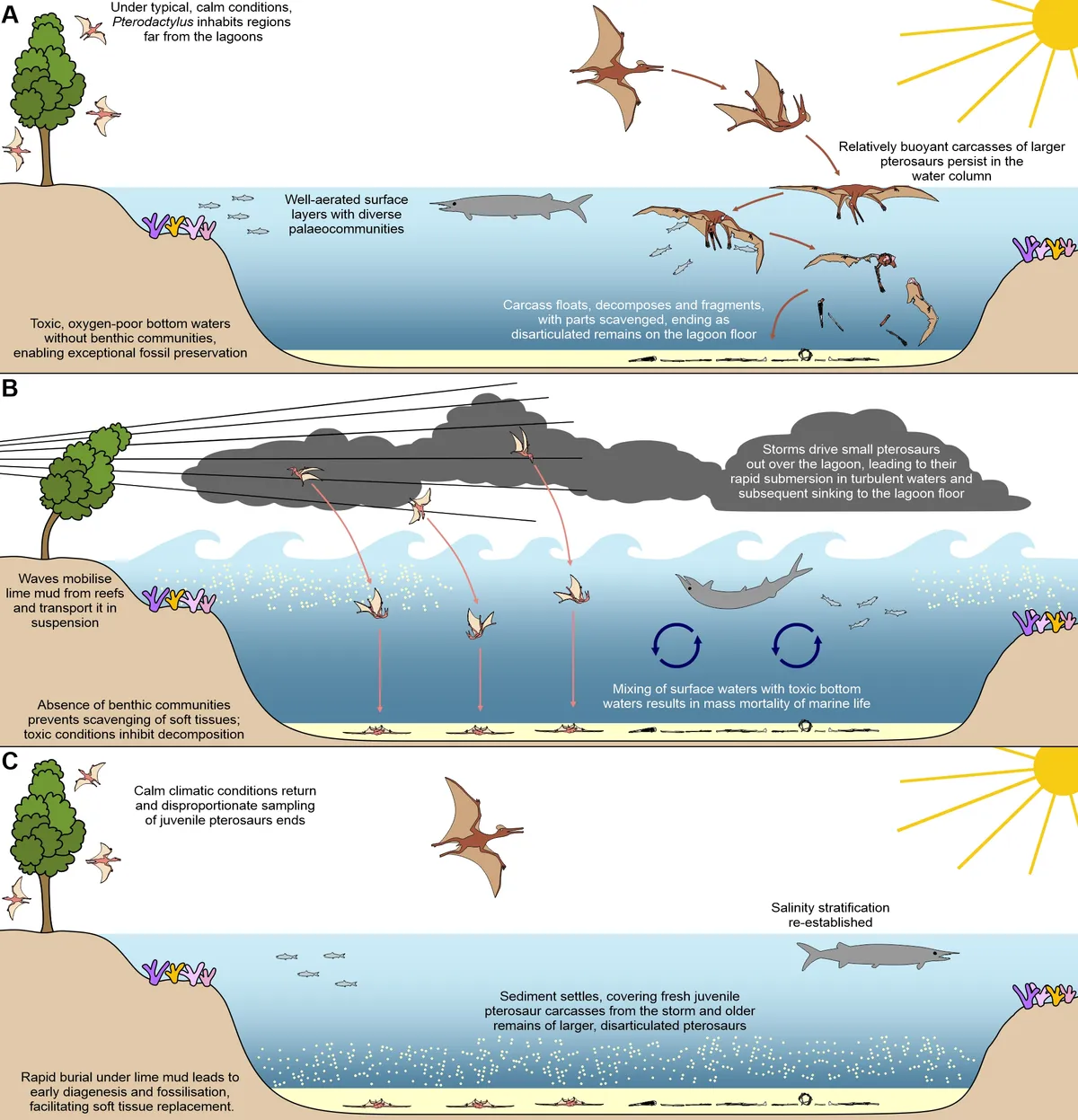
Lucky and Lucky II had humeral fractures compatible with excessive wind force during the flight, similar to those suffered by birds and bats during violent storms today. Researchers think that violent gusts of wind have swept away young pterosaurs far from land safety and forced them in the lagoon. According to the study, the currents fueled by storm quickly forced them into the depths of the water column and buried their bodies in sediments, according to the study.
By studying the two baby pterosaurs, alongside data collected from more than 40 others Pterodactyl Individuals, the team concluded that Solnhofen has so many small pterosaurs because of catastrophic mass mortality events such as these storms that larger individuals could have resisted.
“For centuries, scientists thought that Solnhofen lagoon ecosystems were dominated by small pterosaurs,” said Smyth. “But we now know that this point of view is deeply biased. Many of these pterosaurs were not at all from the lagoon. Most are inexperienced juveniles who probably lived on the neighboring islands which were unfortunately taken in powerful storms.”


