Pakistan-Afghanistan border closures paralyze trade along a key route : NPR

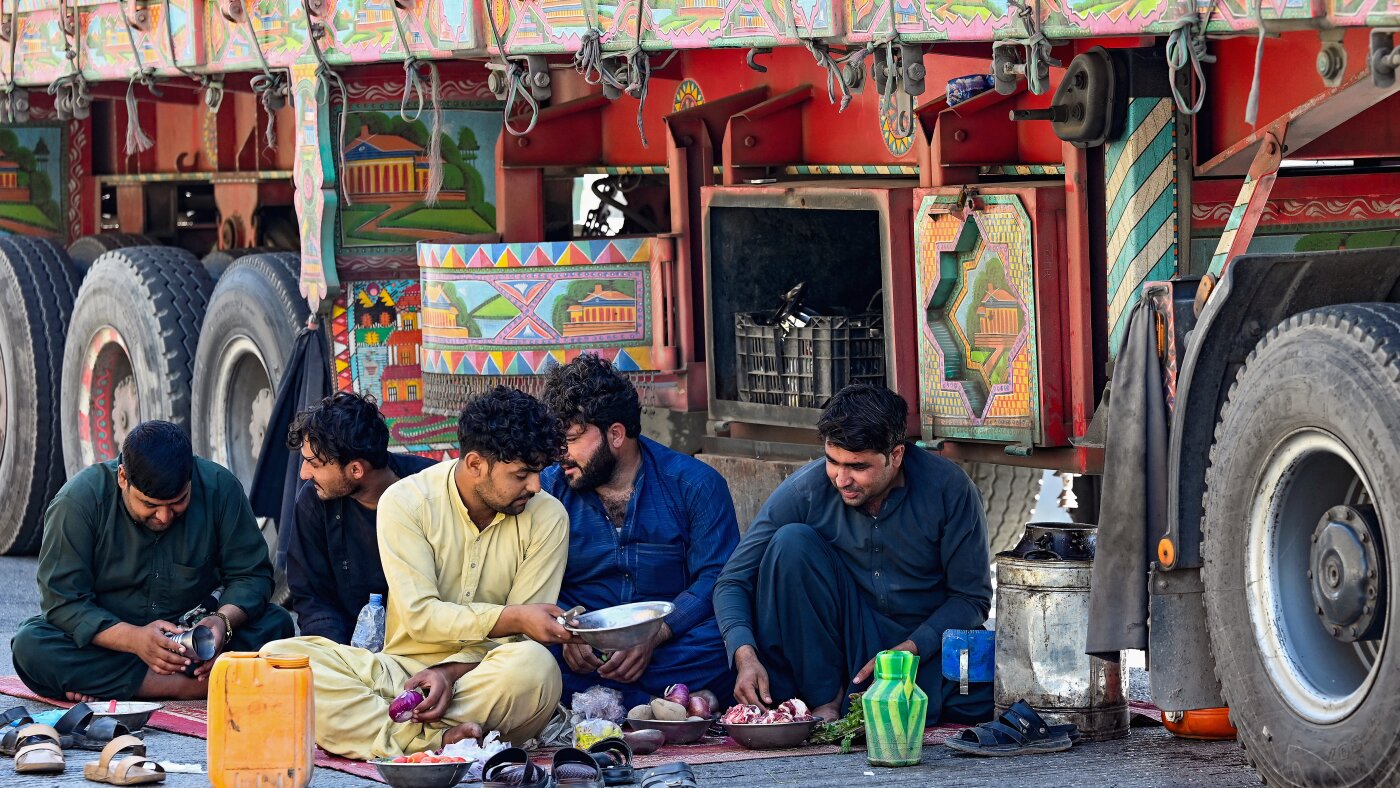

Truck drivers eat on the ground near their broken down vehicles near Torkham, Pakistan, October 13, 2025. More than three months later, the Torkham border remains closed with no end in sight.
ABDUL MAJEED/AFP via Getty Images
hide caption
toggle caption
ABDUL MAJEED/AFP via Getty Images
PESHAWAR, Pakistan — For more than three months, Afghan truck driver Anwar Zadran has been parked in Pakistan with a truck full of cement he was supposed to transport from a factory in Nowshera district to Kabul, the Afghan capital. The task became impossible from mid-October, when Pakistan and Afghanistan closed their borders in response to fighting between the two countries, blocking Zadran halfway, near the Torkham border post.
He now spends his daylight hours huddled in roadside tea stalls with other stranded drivers, waiting for a sign that restrictions in Torkham will ease. Each day, Zadran puts on the same light clothes he arrived in months ago, when it was warm – retreating to his truck to sleep at night when the air turns frigid. “People are destroyed and property is also damaged,” he said. “I wish the border would open soon so we can get some relief.”
Zadran, who is from Afghanistan’s Nangahar province, and his fellow drivers are accustomed to intermittent closures along that border, which winds more than 1,000 miles through the rugged mountains and deserts that separate Pakistan and Afghanistan. Normally, hundreds of trucks pass through daily. In the past, border disruptions were usually resolved within days or weeks, but this extended beyond 100 days – the longest shutdown in decades, with no clear end in sight. It halted trade between Pakistan and Afghanistan and crippled a key transit route stretching across Central Asia.
The closure of five active trade borders is part of a broader dispute between Afghanistan and Pakistan over how to handle a deadly surge in militancy, mainly along the border belt but also including a suicide attack last week claimed by ISIS at an Islamabad mosque that killed dozens of people. Pakistan has repeatedly accused Afghanistan of harboring militant groups that carry out attacks on Pakistani soil, a charge the Afghan Taliban government denies. Among these groups is the Tehreek-e-Taliban Pakistan, known as the Pakistan Taliban or TTP, which aims to overthrow the Pakistani government and has become more active in Pakistan since the Taliban took control of Afghanistan in 2021.
The tipping point came when Afghan and Pakistani forces fired on each other across the border in October. The countries agreed to a ceasefire and participated in several rounds of peace talks in Istanbul, Doha And Riyadh. All failed to reach a resolution. After the ceasefire, the Taliban government accused Islamabad of carrying out airstrikes on Afghan territory that killed civilians, including nine children. Pakistan has denied attacking civilians.
Pakistani Prime Minister Shehbaz Sharif said at the end of last month that Pakistan had no choice but to close its border because the Taliban could not commit to stopping militant groups operating from Afghanistan. “We didn’t want to, but they forced us,” he said. The Taliban government accused Pakistan to close its borders to assert its economic and political power pressure, and hopes that Pakistan provide guarantees that this will not be the case.
Looking for workarounds
In Peshawar, about 65 km from the Torkham border, business leaders were forced to look for possible solutions. On a whiteboard in his office, trader Shahid Hussain has mapped out alternative routes for his exports through China. Its food shipments to Uzbekistan and Kyrgyzstan normally pass through Afghanistan. But not anymore.
The China route is plausible, Hussain says, but the policies for Pakistan to use China for transit trade are unclear. Another option is to go through Iran. The country is, however, subject to international sanctions and banking channels with Pakistan are limited. The political instability that reigns there also makes this path uncertain.
Hussain, who usually also exports cement to Afghanistan, estimates losses at around $400,000 just due to damaged and expired stocks since the border closures began. He stopped paying his employees’ salaries starting this month and compares his more than 20-year-old business to a tree deprived of water. “There is no work,” he said. “And what other activity should we do?”
In January, business leaders from both countries formed a joint committee to assess the situation. The group has so far held two online meetings and hopes to meet in the coming months at the Torkham border if they can get government approval. Both sides agree that the situation is dire and are trying to convince the leaders of their respective countries.
But the business community was left without much leverage, says Jawad Hussain Kazmi, president of the Khyber Chamber of Commerce and Industry, a regional trade body. He heads the joint committee formed last month for the Pakistani side. “Our government has a specific objective,” he says, “which is that security problems must be resolved.”
Naqibullah Safi, secretary general of the Pakistan-Afghanistan Joint Chamber of Commerce and Industry in Kabul, says the border closure has also halted the entry of goods to Afghanistan from other Asian countries, including China, Malaysia and Vietnam. This includes shipping containers filled with food, fabrics and medical supplies, some of which remain stuck in Karachi’s port.
“This is the worst situation for the private sector,” he said.
Safi says there have been minor price increases in Afghanistan for products such as rice, medicine and cooking oil.
Losses in the hundreds of millions
Abdul Salam Jawad, a spokesperson for Afghanistan’s Commerce Ministry, told NPR in a statement sent via WhatsApp that his country’s exports to Pakistan (including fruits, vegetables and coal) were about $300 million lower last year — when the border closures began — than the year before. Pakistan’s commerce ministry did not respond to a request for trade figures. Last month, Pakistan said it allow so that goods blocked in Afghanistan can be re-exported to their country of origin.
As prolonged border closures continue, Afghanistan has sought to diversify your business with other countries in the region, notably India and Iran. As part of this effort, the Taliban government has asked India to help facilitate the movement of Afghan goods through a port in which India participated, in the Iranian city of Chabahar.
The Taliban separately ordered a complete ban on Pakistani pharmaceuticals starting this month, citing quality issues — a blockade that could continue even if the borders reopen.
Due to limited production in Afghanistan, the country depends on Pakistan for more than 60 percent of its medicines, and Pakistan’s annual pharmaceutical exports to Afghanistan are worth around $200 million, according to Tauqeer Ul Haq, former president of the Pakistan Pharmaceutical Manufacturers Association. He says stocks destined for Afghanistan cannot be easily redirected, especially temperature-controlled medicines that got stuck in transit. “We’re worried it’s going to waste,” he says. “It won’t be usable.”
At a Pakistani medicine market in Peshawar, traders are already grappling with the loss of sales to Afghanistan, which accounts for a significant portion of their sales. In addition to bulk buyers from Afghanistan, this market serves Afghan patients who cross the border to purchase medicines in bulk that are difficult to obtain in their country.
Aslam Pervez, a shop owner and general secretary of the Pakistan Chemists and Druggists Association in Peshawar, says he is worried about patients who need life-saving medicines such as insulin.
“On both sides, these are the people who will be the losers,” Pervez says. “We cannot change our neighbor.”
Wasim Sajjad contributed to this report from Peshawar and Torkham border.