
Paleontologists in China have discovered a nearly complete skeleton of a previously unknown species of iguanodontian dinosaur that preserves exceptionally detailed fossilized skin, including structures unlike anything seen in other non-avian dinosaur fossils.
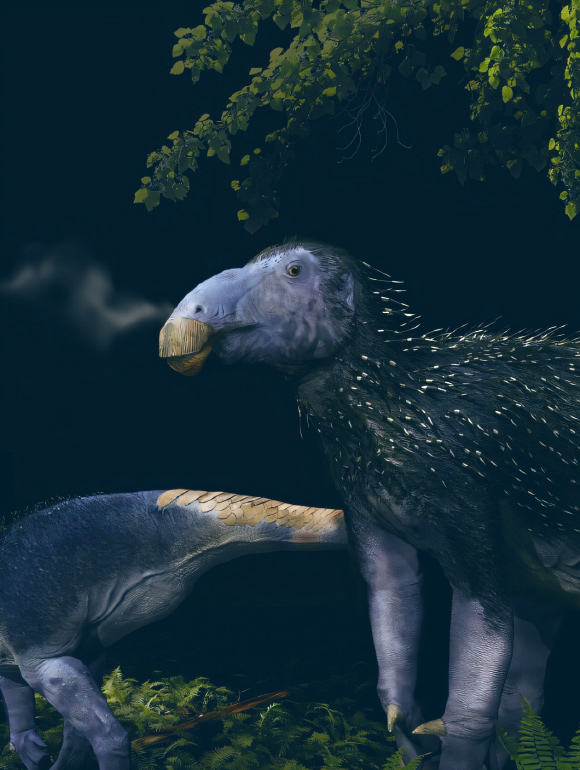
Life reconstruction of a juvenile Haolong dongi. Image credit: Fabio Manucci.
Haolong dongi lived in what is now northeastern China during the Early Cretaceous epoch, around 125 million years ago.
The new species was a type of iguanodontian, a major group of ornithopod dinosaurs.
Evolutionarily, they sit between small, early bipedal ornithopods and the later, highly specialized duck-billed dinosaurs (hadrosaurs).
“Iguanodontia were the dominant herbivorous dinosaurs in most terrestrial ecosystems throughout the Cretaceous,” said Dr. Pascal Godefroit from the Institute of Natural Sciences in Brussels and his colleagues.
“The clade reached its zenith during the closing stage of this period, as hadrosaurids — or duck-billed dinosaurs — spread over most continents.”
“The discovery of remarkable ‘mummies’ from North America and Mongolia revealed precious information about hadrosaurid integument, which consisted of an intricate and often mosaic arrangement of tubercle-like and non-imbricating scales, with enlarged tabular scales along their dorsal midline.”
“By contrast, less information is available about the integument of more basal iguanodontians, with only isolated patches of scaly imprints known in Tenontosaurus, Iguanodon and Mantellisaurus to suggest a scale pattern reminiscent of hadrosaurids.”
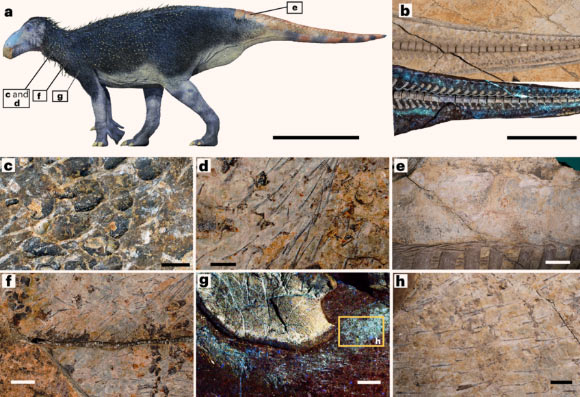
Preserved integumentary structures in the holotype of Haolong dongi. Image credit: Huang et al., doi: 10.1038/s41559-025-02960-9.
The fossilized skeleton of a 2.45-m-long juvenile Haolong dongi was recovered from the Yixian Formation.
The specimen is remarkable not only for the quality of its bones but for the exquisite preservation of its integument, or outer skin.
The fossil includes overlapping scales on the tail and distinct tuberculate scales on the neck and thorax — patterns that differ markedly from previously described iguanodontians.
Most striking, however, are cutaneous spikes scattered among the scales.
Using advanced imaging and microscopic analysis, the paleontologists found that these spikes are hollow and cylindrical, composed of a highly cornified outer layer over a multi-layered epidermis, with keratinocytes preserved down to their nuclei. At the core of each spike lies a porous dermal pulp.
This anatomy sets the spikes apart from both the protofeathers found in some other dinosaurs and the scaly spines seen in modern lizards, suggesting an independent evolutionary origin.
The form and placement of the spikes imply they served primarily as a deterrent against predators, though they might also have played roles in thermoregulation or sensory perception.
“This discovery provides unprecedented insight into the microanatomy of non-avian dinosaur skin and highlights the complexity of skin evolution in ornithischian dinosaurs,” the researchers concluded.
The discovery of the new dinosaur species is reported in a paper in the journal Nature Ecology & Evolution.
_____
J. Huang et al. Cellular-level preservation of cutaneous spikes in an Early Cretaceous iguanodontian dinosaur. Nat Ecol Evol, published online February 6, 2026; doi: 10.1038/s41559-025-02960-9


