Parents are refusing routine preventative care for newborns at rising rates, study finds


One day at an Idaho hospital, half of the newborns seen by Dr. Tom Patterson did not receive the vitamin K injections that have been given to babies for decades to prevent life-threatening hemorrhages. On another recent day, more than a quarter were not vaccinated. Their parents wouldn’t allow it.
“When you look at an innocent, vulnerable child — and a simple procedure that has been performed since 1961 is denied — knowing that the baby is going into the world is very concerning to me,” said Patterson, a pediatrician for nearly three decades.
Doctors across the country are alarmed that skepticism fueled by growing anti-scientific sentiment and medical distrust is increasingly extending beyond vaccines to other proven routine preventive care for babies.
A recent study from the Journal of the American Medical Association, which analyzed more than 5 million births nationwide, found that refusals to receive vitamin K injections nearly doubled between 2017 and 2024, from 2.9% to 5.2%. Other research suggests that parents who refuse vitamin K shots are much more likely to refuse to give their newborn the vaccine. hepatitis B vaccine and eye ointment to prevent potentially blinding infections. Prices for that vaccination at birth has decreased in recent years and doctors confirm that more and more parents are refusing eye medications.
“I think these families care deeply about their infants,” said Dr. Kelly Wade, a Philadelphia neonatologist. “But I hear from families that it’s difficult to make decisions right now because they’re hearing conflicting information.”
Countless social media posts question doctors’ advice on safe and effective measures like vitamin K and eye ointment. And the Trump administration has repeatedly undermined established science. A federal advisory committee whose members were appointed by Health Secretary Robert F. Kennedy Jr. – a leading anti-vaccine activist before joining the administration – voted to end the long-standing recommendation vaccinate all babies against hepatitis B immediately after birth. On Monday, a federal judge temporarily blocked all decisions made by the reconstituted committee.
Jamie Rhodes / Norton Healthcare / AP 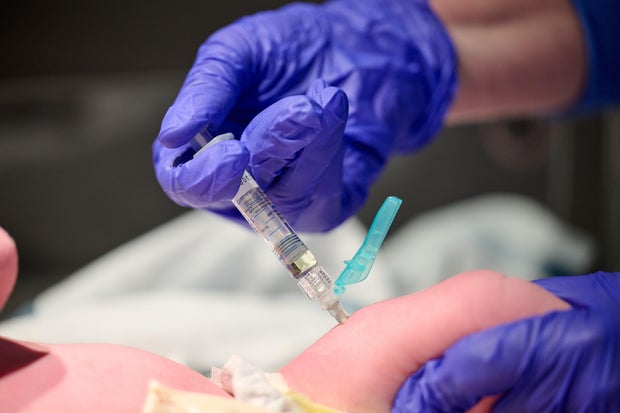
A common thread that connects anti-vaccine views and growing sentiments against other protective measures for newborns is the fallacy that natural is always better than artificial, said Dr. David Hill, a pediatrician and researcher in Seattle.
“Nature will allow one in five human infants to die in their first year of life,” Hill said, “which is why generations of scientists and doctors have worked to reduce that number dramatically.”
Vitamin K and other measures prevent serious problems
Babies are born with low levels of vitamin K, which leaves them vulnerable because their intestines cannot produce enough until they start eating solid foods around 6 months of age.
“Vitamin K is important for helping blood clot and preventing dangerous bleeding in babies, such as bleeding in the brain,” said Dr. Kristan Scott of Children’s Hospital of Philadelphia, lead author of the JAMA study.
Before injections became commonplace, up to about 1 in 60 babies suffered from hemorrhage due to vitamin K deficiency, which can also affect the gastrointestinal tract. Today, the condition is rare, but research shows that newborns who do not receive a vitamin K injection are 81 times more likely to develop serious bleeding than those who do.
Hill has seen what can happen.
“I was caring for a toddler whose parents chose that risk,” the Seattle doctor said. The child essentially had a stroke as a newborn and was left with severe developmental delays and persistent seizures.
At a February meeting of the Idaho chapter of the American Academy of Pediatrics, doctors said they were aware of eight deaths from hemorrhage due to vitamin K deficiency in the state in the previous 13 months, said Patterson, the chapter’s president.
Infections prevented by other neonatal measures can also have serious consequences. Erythromycin eye ointment protects against gonorrhea which can be contracted during childbirth and potentially cause blindness if left untreated. The hepatitis B vaccine prevents disease that can lead to liver failure, liver cancer, or cirrhosis.
Even if a pregnant woman is tested for gonorrhea and hepatitis B, no test is perfect and she may become infected after the test, said Dr. Susan Sirota, a pediatrician in Highland Park, Illinois. In any case, she risks transmitting the infection to her child.
Why do parents refuse routine care?
Parents give many reasons why they refuse preventive measures, such as fear that they might cause problems or because they do not want newborns to feel pain.
“Some will just say they want more of a natural birth philosophy,” said Dr. Steven Abelowitz, founder of Ocean Pediatrics in Orange County, California. “Then there’s a ton of misinformation. … There are outside influences, friends, celebrities, lay people and political agendas.”
Abelowitz practices in a region with roughly an equal mix of Republicans and Democrats.
“There is more distrust on the part of the conservatives, but there is also a lot of it on the liberal side,” he said. “It’s widespread mistrust.”
Social media provides enough fuel, spreading myths and pushing unregulated vitamin K drops that doctors warn babies can’t absorb well.
Doctors in many states say parents refusing vitamin K shots often refuse other measures as well. Sirota, Illinois, encountered a family who refused the use of a heel prick to monitor the blood sugar of a baby at high risk of life-threatening hypoglycemia.
Refusals of care are not a new phenomenon. Wade, in Philadelphia, said she has been seeing them for 20 years. But until recently, they were rare.
Twelve years ago, Dana Morrison, now a doula in Minnesota, refused a vitamin K injection for her newborn son, giving him oral drops instead.
“It came from a real desire to protect bonding time with my baby,” she said. “I was trying to knock out more shots.”
The birth of her daughter, a few years later, went less smoothly, leaving the baby with a bruised leg. Morrison received a vitamin K injection for her.
Knowing what she’s doing now, she said, she would have bought it for her son, too.
Doctors and parents want “the best for their children”
Doctors are hoping to change minds, one parent at a time. And it starts with respect.
“If I walk into the room judgmentally, we’re going to have a really pointless conversation,” Hill said. “Every parent I serve wants the best for their children.”
When parents question the need for a vitamin K injection, Dr. Heather Felton attempts to address their specific concerns. She explains why we give it and the risks of not getting it. Most families decide to get it, said Felton, who has seen no increase in refusals.
“It really helps to be able to take that time and really listen and be able to provide some education,” said Felton, a pediatrician at Norton Children’s in Louisville, Kentucky.
In Idaho, Patterson sometimes finds himself dispelling misconceptions. Some parents will accept a vitamin K shot when they discover it is not a vaccine, for example.
These conversations can take time, especially since the parents doctors see in hospitals are typically not people they know through their practice.
But doctors are happy to invest that time if it will save babies.
“I end every discussion with parents with this: ‘Please understand that ultimately I am passionate about this because I have the best interests of the children in my mind and in my heart,’” Patterson said. “I understand this is a hot topic and I mean no disrespect to anyone. But at the same time, I am desperately saddened that we are losing babies for no reason.”


