Photos Reveal Moths Sipping Tears from a Moose


December 12, 2025
2 min reading
 Add us on GoogleAdd SciAm
In a first, photos show moths sipping on moose’s tears
Butterflies sometimes drink the tears of other animals, but this behavior has mostly been observed in the tropics. New photographs show only the second sighting outside this area
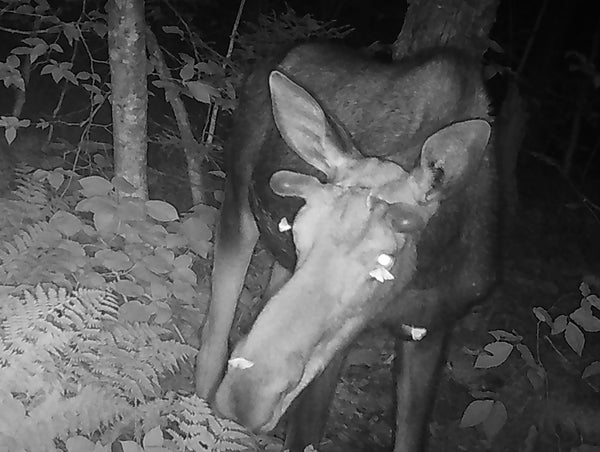
Moths hover around a moose’s face, drinking its tears, trail camera footage from Vermont’s Green Mountain National Forest shows.
Vermont Department of Fish and Wildlife
When animals cry, butterflies start licking their lips.
Butterflies’ less glamorous relatives are known for using their long proboscis to sip tears from everything from birds to reptiles to pets. But this behavior, known as larphagia, has mainly been observed in the tropics.
Now, for the first time, researchers have documented moths drinking the tears of a moose – only the second time this behavior has been documented outside of the tropics. (The other was observed with a horse in Arkansas.)
On supporting science journalism
If you enjoy this article, please consider supporting our award-winning journalism by subscription. By purchasing a subscription, you help ensure the future of impactful stories about the discoveries and ideas shaping our world today.
Laurence Clarfeld, a researcher at the Vermont Cooperative Fish and Wildlife Research Unit at the University of Vermont, discovered the sighting by chance while browsing trail camera footage from Vermont’s Green Mountain National Forest for an unrelated project. “It almost looked like the moose had two [additional] eyes,” he said. “At first I wasn’t sure what it was.”
Only after scrolling through the sequence of images did he realize he was watching moths drinking the tears of a bull moose. “I had looked at a lot of trail camera footage. I had never seen anything like this before,” he says. The results were recently published in Ecosphere. A colleague recently filmed another case of moths drinking the tears of a moose in Vermont.
Moths – and some other insects, like bees – are thought to feed on the tears of other animals to obtain minerals and other nutrients.
The paucity of documentation outside the tropics might simply be because “few scientists are looking in these places,” says entomologist Akito Kawahara, director of the McGuire Center for Lepidoptera and Biodiversity at the Florida Museum of Natural History.
But the reason could be more worrying. “The number of butterfly species and individual species abundance are declining quite significantly in many places,” says Kawahara, who was not involved in the new research. “So it’s also possible that we won’t see many more of them because there aren’t many left.”
It’s time to defend science
If you enjoyed this article, I would like to ask for your support. Scientific American has been defending science and industry for 180 years, and we are currently experiencing perhaps the most critical moment in these two centuries of history.
I was a Scientific American subscriber since the age of 12, and it helped shape the way I see the world. SciAm always educates and delights me, and inspires a sense of respect for our vast and beautiful universe. I hope this is the case for you too.
If you subscribe to Scientific Americanyou help ensure our coverage centers on meaningful research and discoveries; that we have the resources to account for decisions that threaten laboratories across the United States; and that we support budding and working scientists at a time when the value of science itself too often goes unrecognized.
In exchange, you receive essential information, captivating podcasts, brilliant infographics, newsletters not to be missed, unmissable videos, stimulating games and the best writings and reports from the scientific world. You can even offer a subscription to someone.
There has never been a more important time for us to stand up and show why science matters. I hope you will support us in this mission.


