Players Era format determining teams playing for prize money needs to be fixed


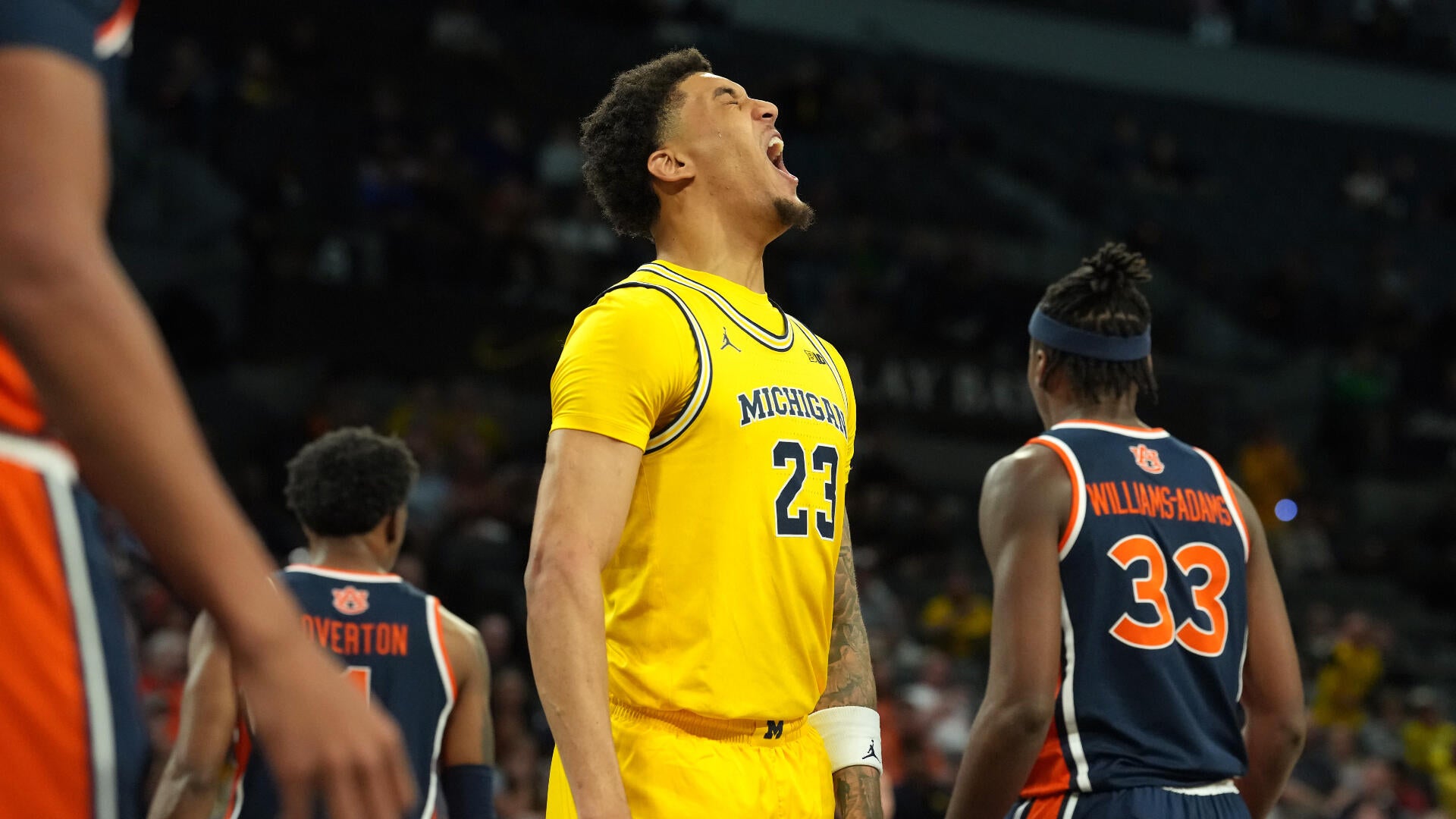
LAS VEGAS — When the format of a sporting event becomes a bigger story than the games themselves, you have a problem.
And right now, the Players Era has a problem. An image problem at least. A problem of understanding.
After two days of very good basketball, here is what awaits you on Wednesday:
- No. 7 Michigan vs. No. 12 Gonzaga (championship game)
- No. 17 Tennessee vs. Kansas (Third Place Game)
It’s obviously a great doubleheader. The championship match will earn an additional $1 million NIL, of which $500,000 will go to the loser. The Tennessee-Kansas winner will receive an additional $300,000, while the loser will receive $200,000.
These four teams have gone 2-0 over the last two days.
But so does No. 15 Iowa State. But due to two games and four points in two games 24 hours apart, Kansas will be playing for more money, while Iowa State will be eliminated. What is the Cyclones’ reward? A match against Syracuse 4-2 at 10 a.m. local time on Wednesday.
Here’s why this happens.
Late buckets counted
On Monday, St. John’s Dillon Mitchell came up short as time expired to give Iowa State an 83-82 win over the Red Storm instead of 83-80. Then, on Tuesday, Kansas’ victory against Syracuse was in hand and surely decisive. With less than 30 seconds left, KU’s Kohl Risario hit a slam to increase the lead from 69-60 to 71-60.
Kansas’ point differential after two games was 21. Iowa State was 19.
That’s why Kansas has an opportunity in a money game, while ISU gets what could well be a Quad 2 result against a Syracuse team that has played well here but still hasn’t managed to win a game.
There are other reasons why teams have gripes. Consider how Tennessee had to fight its way past No. 3 Houston in what was almost certainly the most physically taxing game of the first two days. But the Vols can’t make the championship game for the most money, because they faced the highest-ranked opponent among the 18 Players Era teams.
This all happens because of a statistical tiebreaker that is traditionally reserved for high-level soccer tournaments, where scoring is everything in the sport and the game of pool typically includes round-robin competition.
However, the era of gamers does not apply to any of these scenarios.
“We’re doing something different, so you’re actually not just watching the same thing you watch every November, but just with more teams,” said co-founder Seth Berger. “We’re trying to bring November basketball to more casual fans, so clearly one of the things we need to do is continue to explain why our format is unique and exciting. In this format, every shot counts, every basket counts, every minute counts.”
I admit it: having every game and every basket count is a concept that has some positive points. This is different from traditional bracket play and brings on-field relevance to more games. But casual fans associate college basketball tournaments with brackets. This is what November basketball is all about, not to mention what March Madness is literally built on.
Bracket play works.
And even though this is the second year of Players Era, it’s actually the first year, as last season’s eight-team event didn’t really break through into the public consciousness.
The deployment of public relations was therefore mixed. Most fans can’t easily follow what’s going on, even if the matches have been good. (And many of them did.)
There is nothing to do this year. The matchups were set at 12:30 a.m. ET Wednesday morning/9:30 p.m. PT, and if you’ve made it this far in my column wondering who the hell is fighting, here’s Wednesday’s schedule:
| Syracuse vs. No. 15 Iowa State | 1:00 p.m. (TNT) at Grand Garden Arena |
| Notre Dame vs. Houston No. 3 | 3:30 p.m. (TNT) at Grand Garden Arena |
| Third place: Kansas vs. Tennessee No. 17 | 7 p.m. (TNT) at Grand Garden Arena |
| No. 14 St. John’s vs. No. 21 Auburn | 8 p.m. (truTV) at Grand Garden Arena |
| Championship: No. 13 Gonzaga vs. No. 7 Michigan | 9:30 p.m. (TNT) at Grand Garden Arena |
| Baylor vs. San Diego State | 10:30 p.m. (truTV) at Michelob Ultra Arena |
| Maryland vs. Alabama #8 | 12:00 a.m. (TNT) at Grand Garden Arena |
We will write, talk and react on Wednesday to all of Wednesday’s games.
Evolving format
I want to stay on the broader question of what to do with the format in the years to come. Next year, the event will bring together 32 teams. It will be the biggest regular season event in college basketball history. These 32 teams will be divided into four groups of eight teams. From there, the four teams that win their pool play (against three other teams in predetermined matchups that will take place next offseason) will do so based on best record…and then point differential/margin of victory as the decider.
“These four teams will each play one more match, a first-place match and a third-place match,” Berger said Tuesday at a news conference here. “The system, over time, I think it will become pretty simple and understandable for fans. What we’re trying to do here, and I think it’s an interesting question because for basketball fans or parents or coaches who have played in AAU events, it’s relatively standard, it happens every weekend when you go to an event.”
Berger and his co-founder Ian Orefice faced a lot of skepticism and backlash about their event due to its expensive and unprecedented nature. But they do good things for the players. Over 200 Division I athletes involved in this event will receive a significant amount in NIL opportunities. It’s positive for the sport.
The next step is to make sure the event can attract fans and have a format that is not difficult to follow.
Keep options open
A glimmer of hope for anyone hoping the current format can transition to something more traditional: Orefice told me Tuesday night that he’s not sure whether the future of the event is a pool game that has to include point tiebreakers.
“We are open to all comments,” Orefice said. “Nothing is 100% sure about the future. We’ve committed to having four pools of eight teams next year, that’s almost certain, but we’ll see.”
Orefice said it would take into account the opinions of each team participating in the event as it considered planning in 2026 and beyond. Orefice added that the main goal – what they call a “North Star” – is to make Players Era as good as possible. Orefice made it a point to say that Berger would not act as if he had all the answers and would not resist any type of change. They’ve created something that has shaken up the November sports calendar – and it has the potential to be a monster for years to come, provided they put on an event that’s TV-friendly, fan-friendly and easy to follow.
Asking fans to stay up late to find out each team’s games less than 16 hours before games start is not good for fans – or coaches. A member of this year’s on-field staff messaged me Tuesday after 8 p.m. local to ask if I had the scoop on who they were playing.
You never want that.
We’re only in year two and the event will continue to evolve, but if it’s to reach its maximum potential as a sporting entity, it would probably be best to figure out a way to make the bracket play the Skeleton of Players Era moving forward. Make wins and losses count the most – and don’t let style points be the tiebreakers. If the event can achieve that goal in a year or two, then it will truly be what the founders envisioned: a tournament that embodies the spirit of March Madness and all the good that comes with it.