Powell Declares War on the Trump Administration


The theatrical martyrdom of the Fed chairman
Jerome Powell decided he was under attack by the Trump administration and issued a declaration of war.
The Fed Chairman took an unprecedented step Sunday evening by releasing a video accusing the Trump administration of using the Justice Department to pressure the central bank. He said the Fed received Friday subpoenaed to appear before a grand jury and threatened with criminal prosecution related to renovations to the Fed’s headquarters in Washington, D.C., and his related testimony before a Senate panel last year. But those investigations were just “pretexts,” Powell said. The real goal was to overthrow the independence of the Fed.
President Donald Trump speaks with Federal Reserve Chairman Jerome Powell as they tour the Federal Reserve Renovation Project July 24, 2025 in Washington, DC. (Chip Somodevilla/Getty Images)
It’s an explosive charge. Powell accuses the Trump administration of not only attempt to undermine the independence of the Fed but also to misuse the Ministry of Justice to achieve this objective. And it was delivered in a very provocative way: a two-minute video statement released before Asian markets opened. It would be hard to imagine anything better aimed at disrupting financial markets, although we cannot know whether that was Powell’s goal. At the very least, Powell chose a time and format that ensured the message would immediately reach global markets and left the White House with no discreet way to contain it.
If the intention was to cause a sell-off, it failed. Futures suggest the Dow Jones Industrial Average and S&P 500 could fall by just half a percentage point and the Nasdaq Composite by a bit more. No signs of accident. Monday noon, even these small movements had been erasedand the main indices had turned green. Investors refused to panic over the supposed threat to the independence of the Federal Reserve. The S&P closed at a new all-time high on Monday.
The rush to judgment against Trump
Experts and mainstream media immediately assumed the truth of Powell’s accusationscondemning Trump for trying to take control of monetary policy without the slightest hesitation. Verdict first, evidence second – the typical response to any accusation against President Trump. The market, however, may have realized that Powell’s allegations didn’t make much sense. Even if Trump were tempted to use the law to force Powell out of office, what good would that do? Powell’s presidency will expire in five months. He only has three Federal Open Market Committee (FOMC) meetings left as chairman. Why kick a guy out of an office when he’s already heading for the exit?
It’s true that Powell could remain governor until 2028. But pestering him with a Justice Department investigation seems more likely to encourage Powell to stay rather than leave. Powell now views this as a personal battle for his integrity and an attack on the independence of the Fed. If he hadn’t planned to stay on the Fed board before, he probably does now.
Using the Justice Department to pursue a vendetta against Powell would also amount to risk alienating other FOMC membersmany of whom personally love Powell and served under him for years. Even if the investigation were to force Powell out of the Fed — perhaps because an indictment would give the president reason to remove him — the next president would face a monetary policy committee that would likely feel obligated to demonstrate its independence by refusing to cooperate with the administration’s economic policies.
And then there is the question of the Senate. Trump needs the Senate to confirm his nominee to succeed Powell. There is no provision in the Federal Reserve Act allowing the president to appoint an acting chairman; so if Trump’s nominee is not confirmed, the position will remain vacant. Under the Federal Reserve Act, in the event of the “absence” of a president, leadership of the Fed goes to the vice president. This position is occupied by Phillip Jefferson, appointed by Biden and arrived at the Fed after a long academic career. Staging Powell’s early departure just to put Jefferson in charge seems like a Pyrrhic victory.
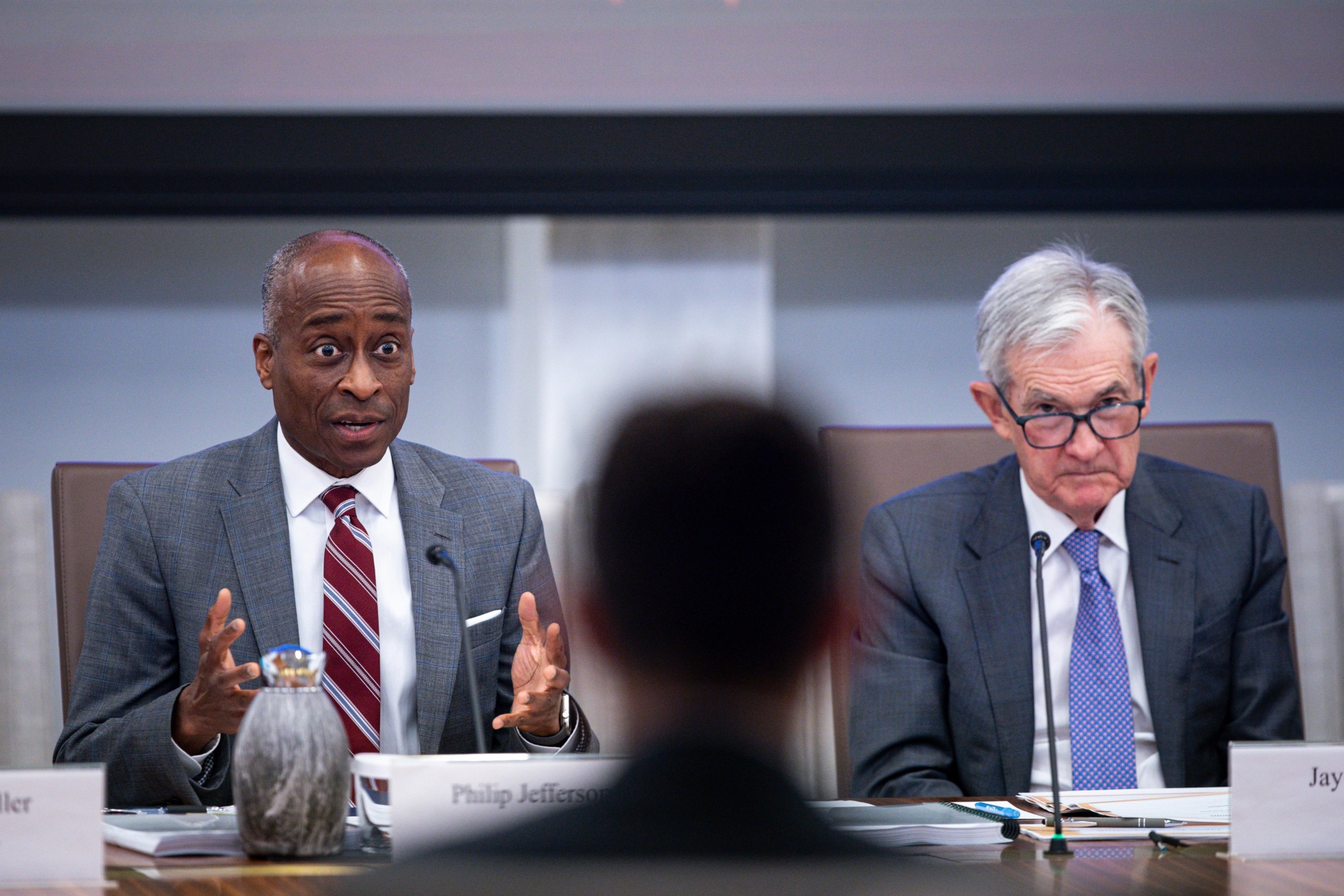
Federal Reserve Vice Chairman Philip Jefferson (left) and Chairman Jerome Powell attend the public meeting of the Federal Reserve Board in Washington, DC, October 24, 2025. (Al Drago/Bloomberg via Getty Images)
Some have suggested that the Fed board could vote to keep Powell as president until a replacement is confirmed. When Powell’s first term as chairman expired in February 2022, under President Biden, he was elected by the Fed Board to act as interim president until it was finally confirmed in May. And this has happened several times in the past, when there has been a delay between the expiration of a president’s term and the confirmation of a new one. So there is precedent for this.
But in 2022, Biden had already announced that he would reappoint Powell, so keeping him in place while his official presidency expired for a few months was not controversial. Attempting to keep Powell in place this time would undoubtedly lead to litigation and further draw the Fed into a political fight with the Trump White House. The Federal Reserve Act only authorizes a interim president when the president and vice-president are absent.
The problem of a prolonged vacancy at the Fed is not a theoretical risk. Sen. Thom Tillis (R-NC) immediately responded to Powell’s video on Sunday, saying he block any candidate until the investigation is resolved. Sen. Lisa Murkowski (R-AK) also said she would block Trump’s nominations until the Powell investigation is resolved, going so far as to say it is “clear that the administration’s investigation is nothing more than an attempt at coercion.”
At least on a formal level, this is the constitutional and statutory role of the Senate. Unlike other laws, the Federal Reserve Act does not specifically define what constitutes grounds for removing a Fed governor, and it offers no protection to the president against removal. The constraint on recall is actually the need to convince the Senate that a recall was appropriate in order for the new nominees to be confirmed.
It should be noted, however, that the Senate’s ability to keep the Fed chair vacant may be limited in practice. A 1978 memo from the Office of Legal Counsel (OLC) asserted that the statutory provision requiring the vice president to preside during the temporary “absence” of the president did not clearly cover a permanent vacancy resulting from the expiration of a president’s term—and that relying on an implied vice presidential succession would be of questionable legality. The OLC instead concluded that because there is no explicit succession mechanism for a vacant presidency, the president can designate a sitting governor as acting president until the Senate confirms a nominee. If it’s true, a blockade imposed by Tillis and Murkowski could increase Trump’s room for maneuveralthough the practical power of any acting president will always depend on the cooperation of the rest of the Board and the FOMC.
Trump himself denies having anything to do with the investigation. In an interview with NBC News on Sunday evening, Trump said he was not even aware of the subpoenas and that there were no criminal investigations related to his disagreements with Powell over interest rates. And Powell’s Fed finally began cutting rates in September, moving in the direction Trump had been advocating all year. Opposing him now – after he has complied with Trump’s demands for budget cuts and with only a few meetings left to chair – would have been a strategic mistake.
Is Powell a “turbulent priest?” »
So what’s going on? There are two possibilities. Firstly, it could be a case of overenthusiastic Trump supporters– perhaps including members of his administration – pushing the Justice Department to prosecute Powell. A Bloomberg report citing anonymous sources claimed that Federal Housing Finance Agency head Bill Pulte was the “driving force” behind the decision to subpoena Powell. Pulte has acted as something of a watchdog to the Fed in the past, highlighting allegations of mortgage fraud against Fed Governor Lisa Cook and even referring the matter to the Justice Department.
This inevitably reminds me the infamous assassination of Thomas BecketArchbishop of Canterbury, after falling out with King Henry II over the respective powers of the Church and the crown. A frustrated Henry asked: “Will no one rid me of this turbulent priest? Four knights are said to have taken this as an implicit order and murdered Becket in his cathedral. The murder caused a huge scandal throughout Christian Europe. Becket was quickly canonized as a martyr and Henry had to do public penance. The king claimed that he never intended to kill Becket and was simply expressing his frustration.
that of Shakespeare Richard II tells a similar story. The play opens with the consequences of the mysterious death of Thomas of Woodstockthe Duke of Gloucester. King Richard II resented Gloucester, a powerful nobleman who opposed Richard’s policies. But Richard never explicitly ordered the murder. Instead, he appears to have expressed his wishes in a way that could have led his supporters to kill the Duke. For Richard, this sets off a chain of events that ends with the loss of the crown and his life.
Maybe what we have here is a repetition of these edifying stories about subordinates who mistake their boss’s expressed frustrations for an order to act.
The other possibility has been almost completely ignored: the Department of Justice may have serious reasons to believe that Powell committed a crimepossibly perjuring himself during his Senate testimony. What is being treated as a political vendetta may actually be the functioning of the judiciary. To declare Powell a modern martyr, a Becket or a Gloucester of our times, seems premature in the absence of evidence.
Powell’s statement amounts to a sort of self-canonization and condemnation of the Trump administration for the heresy of violating central bank independence. However, the rest of us need not take Powell’s statements as gospel. Certainly, on Monday, financial markets did not seem to believe that Trump was threatening the independence of the Fed.

:max_bytes(150000):strip_icc()/Health-GettyImages-ConditionsTurmericCanHelpWith-73e93e547c534162b3a55d2dc5b121d6.jpg?w=390&resize=390,220&ssl=1 "10 Conditions Turmeric Can Help Manage Naturally")


