Prehistoric Underwater Wall Hints at Sophisticated Human Engineering 7,000 Years Ago


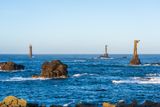
After mapping the coast of Brittany using remote laser technology, a French geologist discovered an unexpected anomaly 30 feet below the churning waves of the Atlantic.
A subsequent dive confirmed the presence of a 400-foot-long man-made granite wall, built about 7,000 years ago. As detailed in a study published in the International Journal of Nautical Archeologythe structure is composed of carefully positioned monoliths and slabs. Based on the layout and location of the wall, researchers believe it could have functioned either as an early fish trap or as a protective barrier protecting coastal settlements from the sea.
Either interpretation indicates a surprisingly high level of technical skill at a pivotal moment in human history: the transition from the Mesolithic to the Neolithic, when mobile hunter-gatherers began to settle down and adopt agriculture.
Learn more: Analysis of Neolithic DNA from Northwest Africa reveals that some hunter-gatherers were retained in agriculture
Man-made wall beneath the waves
The first clue came in 2017 when retired geologist Yves Fouquet examined LiDAR maps of the ocean floor off the island of Sein in western France. The analysis revealed 11 submerged structures located at significant depths, far beyond what archaeologists expected to find in such turbulent waters.
Between 2022 and 2024, divers investigating the site discovered several granite structures, including a wall measuring nearly 400 feet long. The structures lie about 30 feet underwater and date from between 5,800 and 5,300 BCE, with sea levels considerably lower than today. At the time, the coastline was a few kilometers further offshore, meaning that what is now the seabed was once dry land.
Archaeological work in this region has long been limited by strong tidal currents, high-energy waves, and dense algae cover. This makes the preservation of these structures particularly striking. The researchers were surprised to find such well-defined, vertical monoliths and slabs surviving in what is today a harsh marine environment, according to CBS.
Because organic matter was not preserved on the surfaces of the structures, radiocarbon dating cannot be used directly. Instead, the age of the walls was determined by reconstructing past sea levels and comparing them to known periods of human occupation along the ancient coastline.
An ancient wall could be fish traps or sea defenses
On the Breton and Normandy coasts, archaeologists have already identified numerous prehistoric fish weirs using aerial photography and satellite imagery. Some of the newly discovered structures fit this model, while others are notable for their unusual size.
Fish weirs are usually built on the foreshore to channel fish during tidal changes, but many of the submerged walls are much larger than would normally be necessary for this purpose. Their scale suggests that they may also have played a protective role, shielding communities from storm surges or encroaching seas during times of environmental change.
Regardless of their exact use, the constructions reflect a level of social organization and engineering skill sufficient to collect, transport, and position heavy materials. Importantly, this knowledge appears to predate the region’s first ceremonial megaliths by around 500 years.
A window into a critical transition
These submerged remains offer a rare insight into maritime societies from the Mesolithic to the dawn of the Neolithic. As described in their study, fish dams were a major food source for coastal hunter-gatherers, and their construction required collective labor and regular maintenance, strong signs of a more sedentary lifestyle already taking shape.
The Mesolithic-Neolithic transition in Brittany, dated to around 5,500 to 5,000 BCE, coincided with a slowdown in sea level rise after the last ice age. The newly discovered walls suggest that coastal communities were actively reshaping their environments long before agriculture fully took hold.
Learn more: Stop looking for Atlantis and find these 4 ancient underwater cities instead
Article sources
Our Discovermagazine.com editors use peer-reviewed research and high-quality sources for our articles, and our editors review the articles for scientific accuracy and editorial standards. See the sources used below for this article:


