President Dina Boluarte slams court’s call to suspend Peru’s amnesty law

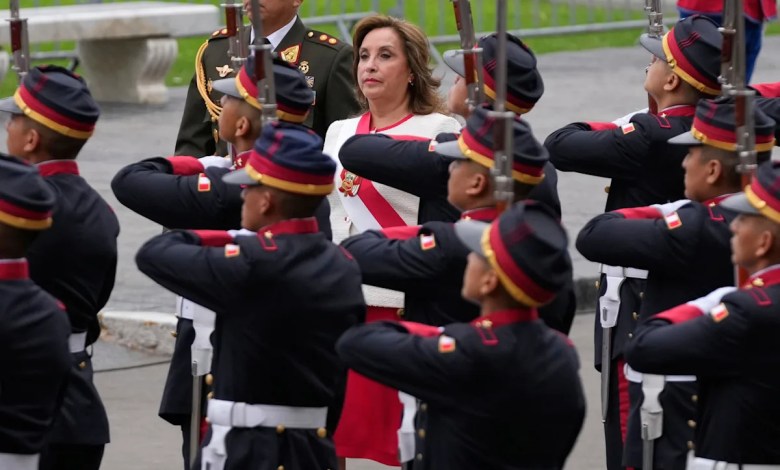
President Dina Boluarte has castigated the Inter -American Court of Human Rights for her opposition to a recently adopted bill which would grant the amnesty to soldiers, police and other security staff involved in the internal conflict of Peru from 1985 to 2000.
Bololuarte said on Thursday that the International Court had exceeded its authority by requesting the suspension of the law.
“We are not anyone’s colony,” she said, displaying an extract from her speech on social networks.
“And we will not authorize the intervention of the Inter -American Court which intends to suspend a bill that seeks justice to members of our armed forces, our national police and the self -defense committees who fought, risking their lives, against the madness of terrorism.”
Since he adopted the Peru Congress in July, the amnesty law awaited Boluarte’s approval. It can either sign it, allow it to automatically take effect or return it to the congress for revisions.
But the bill caused an international outcry, in particular because it is considered to be practicing the security forces of the responsibility of the atrocities which took place during the War of Peru.
The legislation would also offer “humanitarian” amnesty to authors over 70 years old who have been found guilty of war crimes.

People carry false coffins representing their relatives who died in the midst of political violence, July 28, 2025 [Martin Mejia/AP Photo]
Some 70,000 people were killed in the internal conflict, the majority of them rural and indigenous communities.
The soldiers and the police were ostensibly responsible for fighting against the uprisings armed with rebel groups such as the brilliant path and the revolutionary movement of Tupac Amaru. But the conflict has become sadly famous for its human rights violations and its massacres of civilians without links with any rebellious group.
Francisco Ochoa was 14 years old when residents of his Andean village, accompanied, were killed by soldiers. He told Al Jazeera earlier this week that he and other survivors felt “indignant and betrayed” by the new amnesty law.
International organizations also denounced the law as a step back for Peruvian society.
Nine human rights experts at the United Nations signed a declaration on July 17 expressing “the alarm” when the bill by the Congress. They called on the Government of Peru to veto the bill.
“The proposed legislation would prevent criminal proceedings and the conviction of people who have committed raw violations of human rights during the internal armed conflict of Peru,” they said.
“This would place the state in clear violation of its obligations under international law.”
A week later, on July 24, the president of the Inter -American Court of Human Rights, Nancy Hernandez Lopez, ordered Peru to “immediately suspend the treatment” of the bill. She judged that the legislation had violated previous decisions against such laws on amnesty in the country.
“If it is not suspended, the competent authorities refrain from applying this law,” she said.
She noted that a session would be summoned with survivors, Peruvian officials and members of the Inter -American Commission on Human Rights (IACHR).
In previous decisions, the Inter -American Court concluded that the laws and statutes of prescription of amnesty are illegal in the case of serious violations of human rights as forced disappearances and extrajudicial executions.
He also said that age is not a disqualifying factor for suspects accused of serious human rights violations. These exemptions, according to the court, are acceptable only by virtue of international law for lower or non -violent offenses.
The National Human Rights Coordinator, a coalition of humanitarian groups in Peru, believes that the country’s last amnesty law could cancel 156 convictions and disrupt more than 600 current surveys.
A previous amnesty law implemented in 1995, under the president of the time, Alberto Fujimori, was then repealed.
However, President Boluarte tried on Thursday to supervise his government’s actions according to international human rights standards.
“We are defenders of human rights, citizens,” she wrote on social networks, while stressing that her government was “free”, “sovereign” and “autonomous”, exposed to the decision of the Inter-American Court.


:max_bytes(150000):strip_icc()/Health-GettyImages-2158564696-3cc21715a98e4bf19953cd0ecaba6c0b.jpg?w=390&resize=390,220&ssl=1 "How Many Calories Do You Need to Eat Per Day to Gain Muscle?")
