Prop 50 passes to give Democrats advantage


Christine HayesLos Angeles

 Getty Images
California voters approved a measure to redraw political lines in favor of Democrats, launching a counterattack against similar efforts by conservative-led states in a national battle for control of the U.S. House of Representatives.
CBS predicts that the redistricting measure, called Prop 50, has passed.
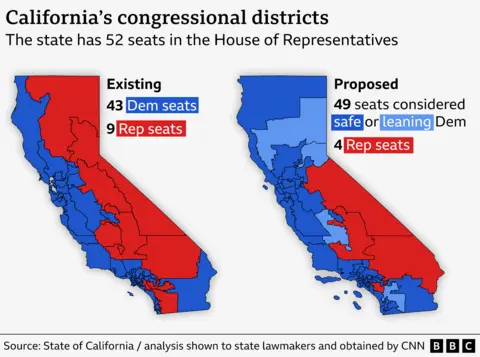
It aims to reconfigure the state’s voting districts to give Democrats a better chance of winning five seats from Republicans in next year’s midterm elections.
It remains to be seen whether the move will tip the balance of power in Washington, as more Republican-led states are also redrawing their voting lines under pressure from President Donald Trump.
Currently, Republicans hold a slim majority of five seats in the 435-member House of Representatives, the lower house of Congress.
If Democrats gain a majority in the House in the 2026 elections, they will be able to delay Trump’s legislative agenda for at least the next two years and also direct congressional oversight of his administration — action that could range from investigations, accompanied by subpoenas, to impeachment.
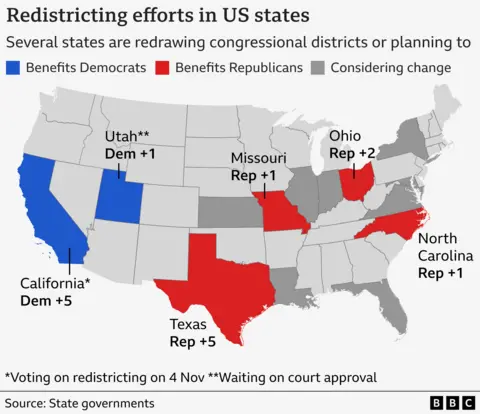
A national look shows that efforts in Democratic-heavy California alone will not be enough to reverse the gains of Republicans who have also redrawn the electoral maps. Four Republican-led states have already redrawn their lines this year, giving the party a likely advantage in nine new congressional districts.
Still, experts told the BBC that these district changes may not be enough for Republicans to keep control of the House next November.
They are called midterm elections, where voters vote for congressional as well as state candidates, because they take place in the middle of a president’s four-year term. Historically, a president often loses power in at least one house of Congress midterm.
The Brookings Institution found that the president’s party has lost seats in the House of Representatives in 20 of the last 22 midterm elections, dating back to 1938.
“There are still a lot of unknowns and a lot that can happen before the midterm elections politically, but if you look at history, it’s an uphill battle for Republicans,” said Galen Sheely, research director for the State Voting Laws Roundup project, a collaboration between the Brennan Center for Justice and the Goldman School of Public Policy at the University of California, Berkeley.
Redistricting is typically done every 10 years, to reflect population changes recorded by the U.S. Census.
Redrawing voting lines in the middle of the decade to try to make electoral gains is “a new strategy that pushes boundaries that have never been pushed before,” Dr. Sheely added.
The redistricting battle began when Trump pressured conservative-led states to redraw their congressional districts to help Republicans maintain control of the House. Today, more than a dozen U.S. states are openly considering redrawing voting lines – so-called political gerrymandering.
“Whether it’s Democrats or Republicans, it’s just not good for our republic in the long run,” said Erik Nisbet, a professor at Northwestern University. “The question now is where does this stop? This is political sabotage of our democracy.”
In his view, the battle risks both eroding trust in government, with people seeing their votes and representation in Washington dwindle, and erasing battleground districts where members of both parties have an equal chance of winning the seat.
Representatives from these districts often play a crucial role in brokering deals and finding common ground — things that have become more difficult in Congress because of deep political division, he said.
“It is difficult not to mention the current government paralysis,” he added. “It will worsen the polarization and gridlock in Congress. And it will have the effect of emboldening this president and future presidents to act unilaterally without Congress.”
Trump, who began his redistricting campaign with Texas, argued that he and Republicans were entitled to more congressional seats because he won those states in the 2024 presidential race.
Texas responded to Trump’s call by redrawing its maps to give Republicans an advantage in five new seats. And in turn, California Democrats introduced Prop, short for “Proposition,” 50.
California Gov. Democrat Gavin Newsom, a Trump foe with reportedly presidential ambitions, has championed Proposition 50. He is now pushing Democrats to follow his lead and fight fire with fire — something he says the party has been unwilling to do in the past.
“These people don’t play by the rules,” he said of Republicans. “If they can’t win the game with the existing rules, they will change them. That’s what Donald Trump did.”
Prominent Democrats, including former President Barack Obama, Rep. Alexandria Ocasio Cortez and Kamala Harris, helped raise money and generate support for the measure across the country.
The campaigns for and against the measure received a total of $200 million, but Democrats far outperformed Republicans, with Newsom telling donors last week they could stop sending money.
However, if other states do not join, the proposal and its momentum may not lead to meaningful change in the House.
While this could help secure five seats for Democrats, more and more Republican-led states are also changing their maps.
North Carolina, Missouri and Ohio all adopted new maps that give Republicans a new advantage. Utah also adopted a new map, which would give Democrats an advantage in one district, but it is undergoing legal review.
Each state decides its voting districts differently, and many Republican-led states have had an easier time changing their maps, due to their state laws, election deadlines, current districts, or political leadership.
Texas, for example, created its new districts through the state legislature.
California, however, needed voter support to change its political map.
Under a state law intended to end political gerrymandering, an independent commission typically draws California’s voting districts once a decade. To deviate from this, the state had to call a special election, where Proposition 50 was the only thing on the ballot, costing taxpayers more than $200 million. The new Prop 50 maps will only be used until 2030, when the commission will redraw the districts again.
As leaders in liberal and conservative-leaning states consider redistricting, another factor looms on the horizon, threatening to impact the 2026 midterm elections: The Supreme Court is currently considering a case that — depending on the decision — could radically reshape the distribution of districts.


