Protect Arctic from ‘dangerous’ climate engineering, scientists warn


Mark PoyntingReport on climate and science, BBC News

 Getty images
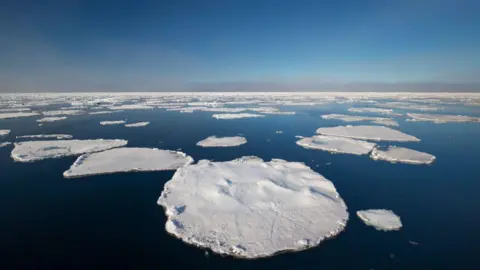
Plans to combat climate change by manipulating the Arctic and Antarctic Environment are dangerous, unlikely to function and could distract from the need to abandon fossil fuels, have warned dozens of polar scientists.
These polar techniques of “geo-engineering” aim to cool the planet in an unconventional manner, as artificially thickening sea ice or free from tiny reflective particles in the atmosphere.
They drew attention as potential future tools to combat global warming, in parallel with the carbon emission cutting.
But more than 40 researchers say that they could bring “serious environmental damage” and urged countries to simply focus on the damage of Net Zero, the only way established to limit global warming.
Geo -engineering – intervening deliberately in the climate system of the earth to counter the impacts of global warming – is one of the most controversial areas of climate research.
Certain types are widely accepted – eliminate carbon dioxide warming the planet from the atmosphere via trees or the use of machines, for example, are recognized parts of zero net efforts.
Net Zero means balanced the quantity of “greenhouse” gas warming the planet produced by human activities with the actively withdrawn quantity from the atmosphere.
But certain more radical geo-engineering ideas, as reflected in sunlight “treat the symptoms of climate change rather than causes,” said the main author Martin Siegert, professor of geoscience at the University of Exeter.
For supporters, it is worth exploring techniques that could help brake growing temperatures, which already bring serious impacts for people and ecosystems around the world.
But for opponents, the risks are simply too large – especially for fragile polar regions, many of which remains unknown.
The scientists of the new evaluation, published in the journal Frontiers in Science, examined the proofs of five of the most discussed polar geoengineering ideas.
Not everyone meets basic criteria for their feasibility and their potential environmental risks, they say.
Such a suggestion is to release tiny reflective particles called aerosol high in the atmosphere to cool the planet.
This often attracts attention among theorists of the online conspiracy, who wrongly affirm that the condensation trails in the sky – water vapor created from plane reaction motors – are proofs of a large -scale sinister geoengineering today.
But many scientists have more legitimate concerns, including disturbances in weather conditions around the world.
With these potential training effects, this also raises the question of which decides to use it – especially in the Arctic and Antarctica, where governance is not simple.
If a country was to deploy geo-engineering against the wishes of others, it could “increase geopolitical tensions in the polar regions”, according to Dr. Valerie Masson-Delmotte, principal scientist at Paris Saclay University in France.
Another fear is that, although certain ideas can be theoretically possible, costs and time to scale mean that they are extremely unlikely to make a difference, according to the review.
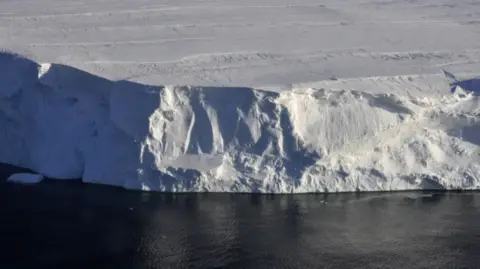
An idea of BBC News recently examined was a plan to pump seawater on the surface of the Arctic Sea ice in winter to thicken it, giving the ice a better chance to survive in the summer.
But to cover 10% of the Arctic may require around 10 million seawater pumps, an estimate suggests.
A more fundamental concern is that these types of projects could create the illusion of an alternative to the reduction of emissions from humanity of warming gases.
“If they are promoted … then they are a distraction because for some people, they will be a solution to the climate crisis which does not require decarbonization,” said Professor Siegert.
“Of course, it would not be true and that is why we think they can be potentially damaging.”
 BBC / Jemma Cox
Even supporters of geo-engineering research agree that it is, at best, a net zero supplement, not a substitution.
“The need for programs discounts comes first … Almost everything we do is futile without it,” according to Dr. Shaun Fitzgerald, director of the Center for Climate Repair of the University of Cambridge, who was involved in some of the projects highlighted.
The evaluation raises “very valid concerns” concerning some of the ideas, but they must be balanced against the risks of “the perilous state of the climate”, he argued.
Like many other supporters of research on geo-engineering, Dr. Fitzgerald does not yet support it on a large scale, and has recognized that a more in-depth investigation could indeed note that ideas are “males”.
But he argued that more research would allow society to make “more informed decisions” on their way of helping or hindering in the fight against climate change.
An agency supported by the British government has recently announced nearly 60 million pounds of funding for such research, although the government says that it did not intend to deploy them.
But the authors of the new evaluation consider these unrealistic projects that the efforts would be better directed towards decarbonization and polar research.
“There are basic truths that do not need many research to conclude that they are not really viable,” said Professor Siegert.


:max_bytes(150000):strip_icc()/Health-ApplesVsOranges-c5e23fc00ce24a6fb07194243b517bc8.png?w=390&resize=390,220&ssl=1 "Which Is Higher in Vitamin C and Fiber?")


