Punch the monkey and his plushie re-create a famous psychological experiment


March 3, 2026
4 min reading
 Add us on GoogleAdd SciAm
Punch the monkey and his stuffed animal recreate a famous psychological experiment
Punch, a monkey who went viral after being abandoned by his mother in a Japanese zoo, recalls a fundamental experiment in attachment theory.
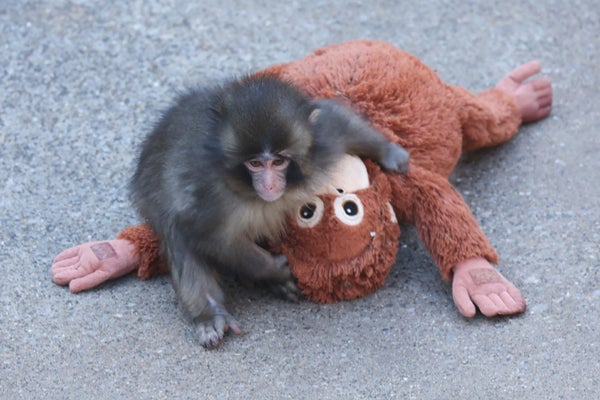
A 7-month-old male macaque monkey named Punch, abandoned by his mother shortly after birth, spends time with a stuffed orangutan at the zoo and botanical gardens in Ichikawa City, Chiba Prefecture.
Photo by JIJI PRESS / AFP via Getty Images
The following essay is reproduced with permission from  The Conversation, an online publication covering the latest research.
A baby macaque monkey named Punch has gone viral for his heartbreaking quest for companionship.
After being abandoned by his mother and rejected by the rest of his troop, his keepers at the Ichikawa City Zoo in Japan provided Punch with a stuffed orangutan as a substitute mother. Videos of the monkey clinging to the toy went viral around the world.
On supporting science journalism
If you enjoy this article, please consider supporting our award-winning journalism by subscription. By purchasing a subscription, you are helping to ensure the future of impactful stories about the discoveries and ideas shaping our world today.
But Punch’s attachment to his inanimate companion isn’t just the subject of a heartbreaking video. It also recalls the story of a famous series of psychology experiments carried out in the 1950s by American researcher Harry Harlow.
The results of his experiments underlie many of the central tenets of attachment theory, which positions the bond between parent and child as crucial in child development.
What were Harlow’s experiences?
Harlow took rhesus monkeys as soon as they were born and removed them from their mothers. These monkeys were raised in an enclosure in which they had access to two “surrogate mothers”. One of them was a metal cage shaped like a “mother” monkey, which could provide food and drink via a small feeder. The other was a monkey doll wrapped in a terry towel. This doll was soft and comfortable, but it provided no food or drink; it was little more than a furry figure for the baby monkey to cling to.
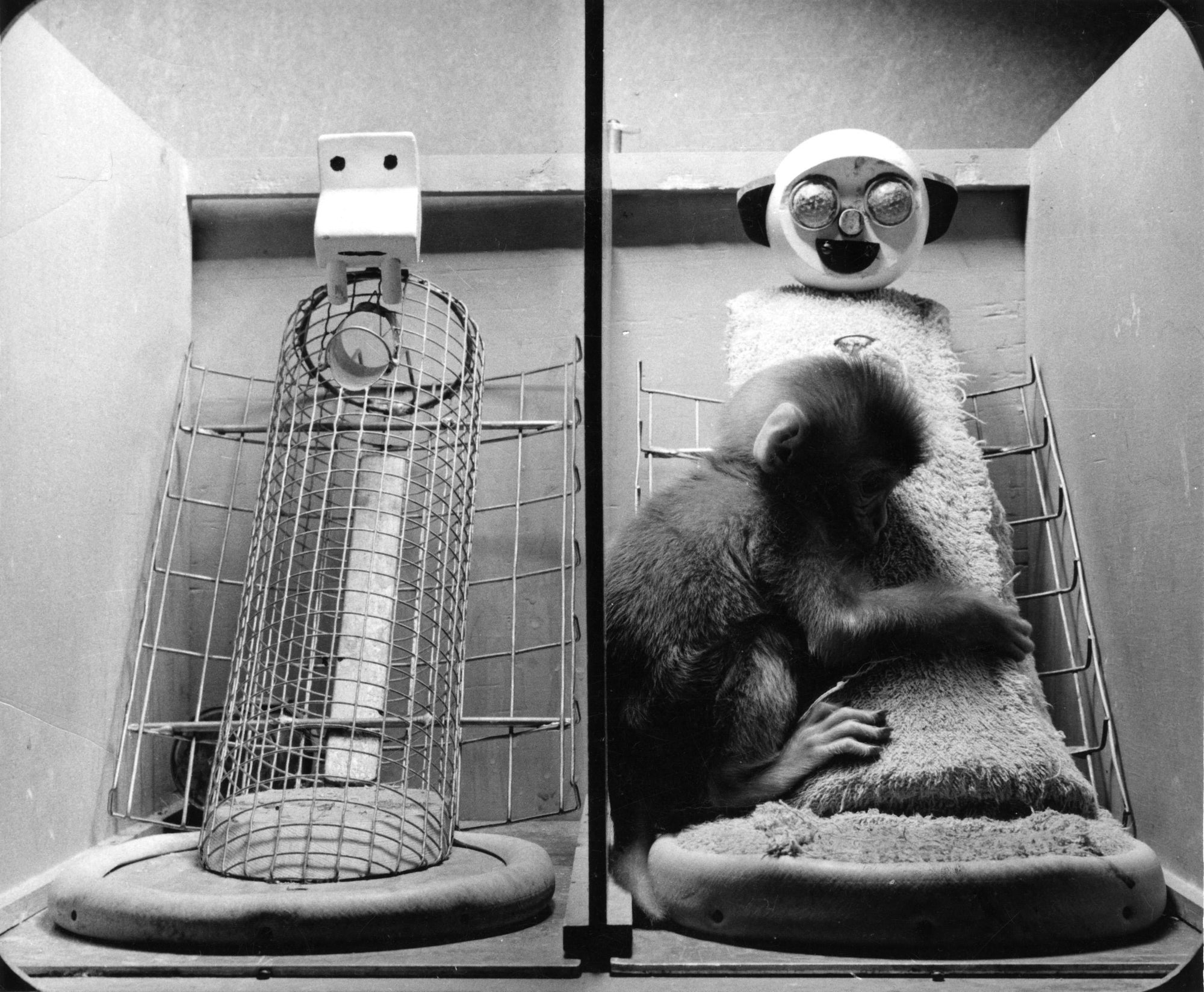
The wired “mother” and the soft “mother” in Harlow’s experience.
History of Science Images/Alamy
So we have one option that provides comfort, but without food or drink, and another that is cold, hard and nervous but provides dietary sustenance. These experiments were a response to behaviorism, which was the dominant theoretical view at the time. Behaviorists suggest that babies form bonds with those who provide them with their biological needs, such as food and shelter.
Harlow challenged this theory by suggesting that babies need care, love, and kindness to form attachments, rather than just physical nourishment. A behaviorist would have expected baby monkeys to spend all their time with the wire “mother” who fed them. Actually, that’s not what happened. The monkeys spent significantly more time each day clinging to their terry cloth “mother.”
Harlow’s experiments in the 1950s established the importance of gentleness, nurturing, and kindness as the basis of attachment. Harlow showed that given the opportunity, babies prefer emotional food over physical food.
How has this influenced modern attachment theory?
Harlow’s discovery was important because it completely reoriented the dominant behaviorist view of the time. This dominant view suggested that primates, including humans, operate in cycles of reward and punishment and form attachments with anyone who satisfies physical needs such as hunger and thirst. Emotional eating was not part of the behaviorist paradigm. So when Harlow did his experiments, he overturned the prevailing theory.
The monkeys’ preference for emotional feeding, in the form of cuddling the surrogate “mother” covered with a fur terry towel, formed the basis for the development of attachment theory. Attachment theory posits that healthy child development occurs when a child is “securely attached” to their caregiver. This is achieved by the parent or caregiver providing emotional nourishment, care, kindness and attention to the child. Insecure attachment occurs when the parent or caregiver is cold, distant, abusive or neglectful.
Just like rhesus monkeys, you can feed a human baby everything it needs, give it all the food it needs, but if you don’t provide it with warmth and love, it won’t attach to you.
What can we learn from Punch?
The zoo was not conducting an experiment, but Punch’s situation inadvertently mirrors the controlled experiment conducted by Harlow. Thus, the experimental setup was mimicked in a more natural setting, but the results appear very similar. Just as Harlow’s monkeys preferred their terry cloth mother, Punch grew attached to his IKEA stuffed companion.
Now, what we don’t have with the zoo situation is the comparison to a harsh, physically nourishing option on offer. But clearly, that’s not what the monkey was looking for. He wanted a safe, comforting, soft place, and that’s what the doll gave him.
Were Harlow’s experiments ethical?
Most of the world now recognizes primate rights that are, in some cases, equivalent to human rights. Today we would view Harlow’s experiments as a cruel and wicked thing. You wouldn’t take a human baby from its mother to do this experiment, so we shouldn’t do this to primates.
It’s interesting to see people so fascinated by this parallel with an experiment carried out more than 70 years ago. Punch the Monkey isn’t just the Internet’s latest animal celebrity: he’s a reminder of the importance of emotional nourishment.
We all need soft spaces. We all need safe spaces. Love and warmth are far more important to our well-being and functioning than physical nourishment alone.
This article was originally published on The conversation. Read the original article.
It’s time to defend science
If you enjoyed this article, I would like to ask for your support. Scientific American has been defending science and industry for 180 years, and we are currently experiencing perhaps the most critical moment in these two centuries of history.
I was a Scientific American subscriber since the age of 12, and it helped shape the way I see the world. SciAm always educates and delights me, and inspires a sense of respect for our vast and beautiful universe. I hope this is the case for you too.
If you subscribe to Scientific Americanyou help ensure our coverage centers on meaningful research and discoveries; that we have the resources to account for decisions that threaten laboratories across the United States; and that we support budding and working scientists at a time when the value of science itself too often goes unrecognized.
In exchange, you receive essential information, captivating podcasts, brilliant infographics, newsletters not to be missed, unmissable videos, stimulating games and the best writings and reports from the scientific world. You can even offer a subscription to someone.
There has never been a more important time for us to stand up and show why science matters. I hope you will support us in this mission.


