Firms ordered to reduce forever chemicals in drinking water for 6m people


Esmée Stallard,Climate and science journalist, BBC News And
Becky Dale and Wesley Stephenson,Senior Data Journalists, BBC Verify

 Getty Images
Water companies have been ordered to tackle potentially harmful levels of so-called permanent chemicals in the drinking water sources of more than six million people, the BBC can reveal.
Forever chemicals, or PFAS, are a group of thousands of substances used in everyday products. These are persistent pollutants that accumulate in the environment, and a small number of them have been linked to an increased risk of certain serious illnesses.
The BBC looked at 23 enforcement notices issued by the Drinking Water Inspectorate regarding high levels of PFAS which could “pose a potential danger to human health” to see how many people were affected.
Industry body Water UK said it was confident the drinking water was safe.
But Water UK has called for a ban on these chemicals to prevent their build-up.
Amid growing concerns about these chemicals, water companies have been required since 2021 to test 47 of the products of greatest concern in water supplied to customers’ homes and in drinking water sources such as aquifers and reservoirs.
Over the past four years, 1.7 million permanent individual chemical tests have been performed across the network. At least 9,432 of them recorded PFAS levels above the level that the DWI said could pose a potential danger to human health.
When a test result is above or likely to exceed this level – set at 0.01ug/L – (micrograms per litre), the Drinking Water Inspectorate issues enforcement notices to the water company requiring measures to be taken to ensure the safety of the water.
The BBC analyzed enforcement documents, highlighted by Watershed Investigations – a group of activist journalists – to identify all water supply areas subject to sanctions.
Using publicly available information, we compared each supply system to the number of customers it serves, identifying a minimum of six million people.
Forever chemicals have been used prolifically since the 1940s in thousands of products, from frying pans to medical equipment to school uniforms.
Over time, they found their way into the environment – and into water treated for drinking – through washing of PFAS products, runoff and discharges from industrial sites, according to Dr. William Hartz, an environmental chemist specializing in PFAS at the NILU research institute in Norway.
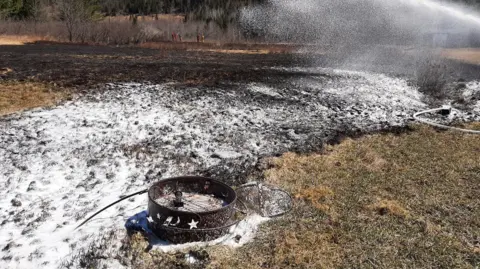
He said that could include the leaching of PFAS when rainwater filters through landfills or firefighting training sites, where the use of a certain firefighting foam releases permanent chemicals directly into the environment.
The study of PFAS is an emerging field, but a small number of these chemicals have been identified as posing significant risks to human health.
Earlier this year, the World Health Organization expressed serious concerns about two specific compounds. It classified PFOA as a carcinogen and PFOS as a potential carcinogen, increasing the risk of thyroid, testicular and kidney cancer. Both substances are now banned.
But Megan Kirton, senior projects manager at environmental charity Fidra, said the chemistry of PFAS means they do not break down easily, so even if they are banned they remain in the environment unless treated by water companies.
“We’re in a very difficult situation because PFAS is very difficult to remove from water. It’s like trying to get the milk out of your coffee after you’ve already poured it in,” she said.
The BBC evaluated more than 2,000 individual test results dating back to 2024, obtained through Freedom of Information Act requests, to identify which specific PFAS compounds were found when levels exceeded limits. This showed that PFOS and PFOA were found in more than 350 drinking water tests.
 Kristen Colwell/Getty Images
The Drinking Water Inspectorate said water quality remains safe because, once a penalty is issued, water companies are required to increase testing, change or strengthen PFAS treatment, or remove a drinking water source altogether.
This process can take several years and requires months of monitoring before a sanction is lifted.
The inspectorate told the BBC it “runs one of the most comprehensive PFAS monitoring programs in the world”, ensuring the public can have “complete confidence in the safety of their drinking water”.
However, environmental charities and the Royal Society of Chemistry have raised concerns that the UK guidelines are not legally binding and that the limits, which are 2.5 times higher than those in the US, should be reduced.
“I think we have a pretty good idea of what PFAS is in waters in the UK and knowing that these health effects are occurring at very low levels, so we think it’s time they put this guidance into law, to ensure that water companies are held fully accountable,” said Stephanie Metzger, policy adviser at the Royal Society of Chemistry.
In July, an independent review into England and Wales’ water supply system, commissioned by the government, found that “it is necessary to impose stricter treatment requirements to protect public health and the environment”.
The BBC understands that the government is currently preparing a white paper in response to the review, which will include changes to the Drinking Water Inspectorate.
But removing PFAS is very difficult for water companies with conventional water treatment infrastructure, the Environment Agency said.
Professor Peter Jarvis, professor of water science and technology at Cranfield University, said there were technologies such as nanofiltration, sometimes deployed by the water industry, which could be used more widely, but they came with high costs and huge energy requirements.
“We need to have a little more mature conversation about how we go about implementing these types of technologies and how we pay for them,” he said.
Water UK told the BBC that: “No matter where you are in the country, when you turn on your tap you’re enjoying the best drinking water in the world.”
But speaking to the Today show, CEO David Henderson said that in light of rising processing costs, the chemicals should be banned.
“This £70 million we spend every year should be paid for by the chemical companies. It’s really unfair for people to see this added to their water bills,” he said.