Israel expands operations in Gaza City; tells famine-stricken residents to move to safe zone


The Israeli army called on the Palestinians of Gaza City on Saturday to move to a humanitarian area which she designated in the South as she widens her operations In preparation for the entry The city struck by famine.
Certain parts of the city, which house nearly a million people, are already considered “red areas”, where evacuation orders have been issued before intense fights.
Help groups have repeatedly warned that a large -scale evacuation of the city of Gaza would exacerbate the Unpleasant humanitarian crisis. The Palestinians were uprooted and moved several times during the war of almost two years, many being too weak to move and having nowhere to go.
Israeli military spokesperson Avichay Adraee wrote in X that the army said Muwasi – a makeshift tents camp in the south of Gaza – a humanitarian area and urged everyone in the city, which he called a bastion of Hamas and specified as a combat zone, from. The army said that it could travel to cars on a designated road without being excavated.
Youf al Zanoun / AP 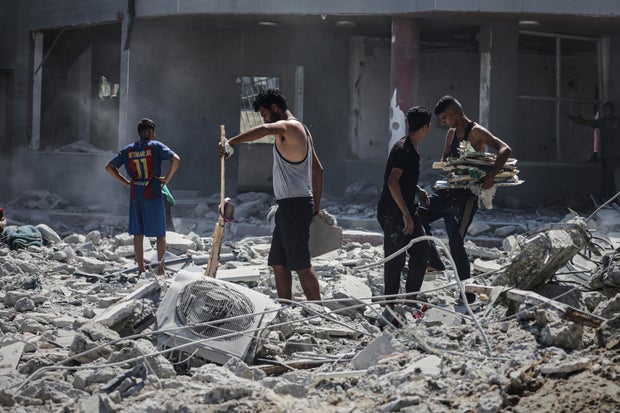
The army, in a press release, provided a card showing the Khan Younis area that the humanitarian area includes, which includes the block where the Nasser hospital is located. The area around the hospital was considered a red zone, but not the medical establishment itself. Last week, Israel hit the hospitalkilling 22 people, including Mariam Daggawho worked for the Associated Press and other media. The hospital was not being evacuated.
The designated security zone would include field hospitals, water batteries, food and tents and help efforts “will continue in progress in cooperation with the UN and international organizations,” the statement said. The United Nations could not be immediately joined to comment.
According to the Ministry of Health, Israeli forces have struck humanitarian areas throughout the war, notably Muwasi, which they previously declared a safe area.
The evacuation order one day came after Israel struck a high -rise building in Gaza City, saying that Hamas had used it for surveillance, without providing evidence.
Youf al Zanoun / AP 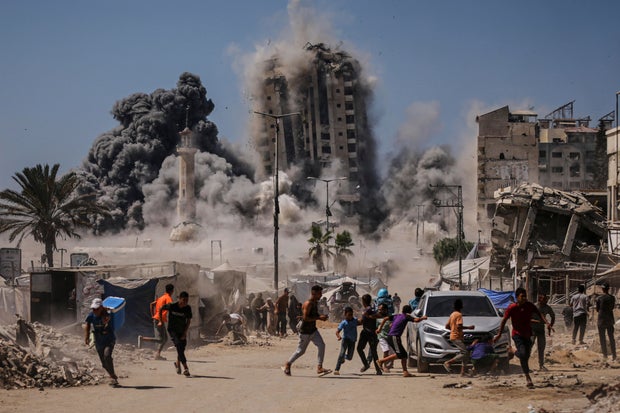
The war began after Hamas terrorists killed around 1,200 people, mainly civilians, and removed 251 people in their attack on southern Israel on October 7, 2023. Forty-eight hostages remain in Gaza, with many people released by ceases or other agreements. Israel believes that around 20 are still alive, although the Bodies of two hostages have been recovered during a joint operation at the end of August.
The Israel’s reprisal offensive killed more than 64,000 Palestinians, according to the Gaza Ministry of Health, which does not say how much civilians or combatants were, but says that women and children represent about half of the dead. The UN and independent experts consider it the most reliable source on the victims of the war. Israel disputes its figures but has not provided its own.
Israel says that the war will continue until all the hostages have returned and that Hamas is disarmed, and that it will keep Open safety check of the territory of some 2 million Palestinians. Hamas said that it would only release the remaining hostages in exchange for Palestinian prisoners, a sustainable ceasefire and a complete Israeli withdrawal from Gaza.
“Lack of food, treatment and possibilities”
Shamm Qudeih, a toddler who was photographed by Dagga and evacuated to Italy for treatment for severe malnutrition and genetic metabolic disease, celebrated his second birthday in an Italian hospital this week. She was evacuated with her mother and 10 -year -old sister. The Italian Ministry of Foreign Affairs claims that 181 Palestinian children are treated in Italy.
A photo of Shamm in her mother’s arms in Gaza has become viral for the fine members of the child, the visible ribs and the face in distress. Shamm weighed about nine pounds when she arrived at the children’s hospital in Santobono Pausilipon in Naples.
Mariam Dagga / AP 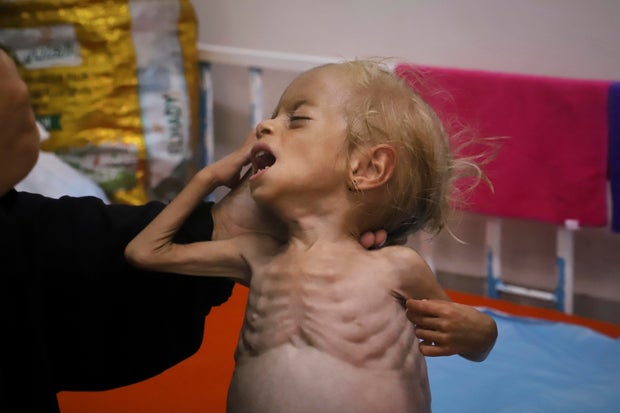
Toddler was “in a serious and difficult clinical condition,” said Dr. Daniele de Brasi, specialist in pediatric genetic diseases that treats Shamm. De Brasi said that “a large part” of its undernourishment was due to a genetic metabolic disease called glycogen storage disease, which interferes with the absorption of nutrients, in particular carbohydrates, and can cause muscle weakness and hinder growth. The condition is mainly managed by a regime rich in carbohydrates.
Shamm’s mother, Islam Cedeih, said the family had moved more than a dozen times since the war in Gaza. It was a struggle to obtain appropriate medical care, she said. Doctors suspected that Shamm had the rare situation, but could not test it or treat it correctly. Qudeih said that the condition of her daughter “worsened due to the lack of food, treatment and possibilities”.
Shamm now weighs a little more than 12 pounds, which does not yet exceed half of the median weight for a child of his age, said Brasi. Its current calorie intake is around 500 calories per day, which doctors are gradually increasing. A cornerstone of his diet is a porridge rich in carbohydrates. At night, a food tube guarantees that it gets the right mixture of nutrients while it sleeps. Doctors hope to remove the tube in about a month.
Andrew Medichini / AP 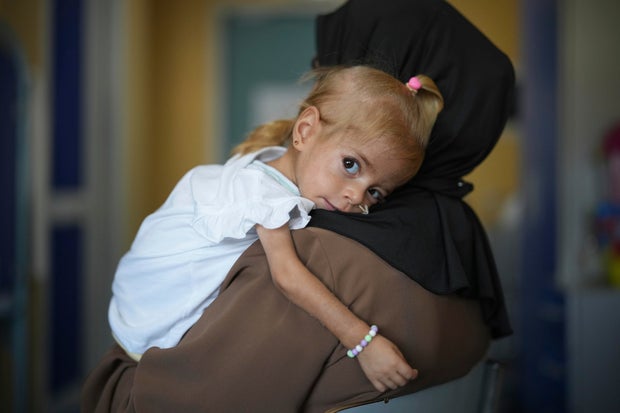
Shamm’s sister Judi was also treated by doctors after noticing that she had weight insufficiency, Brasi said. Judi has won about five pounds and is in condition. Qudeih said she allowed herself to worry about improving her daughters, but she cannot imagine returning to Gaza, where Shamm’s father remains.
“Now there is no way to go back, as long as the war continues. There is no possibility for my daughters,” said Oudeih.

:max_bytes(150000):strip_icc():format(jpeg)/Health-GettyImages-1412795780-0704a34e61484d0ca9c518efabe29512.jpg?w=390&resize=390,220&ssl=1 "5 Worst Foods for Your Gut—and What To Eat Instead")


