A $1.3-billion river dredging in North Carolina by the U.S. Army Corps of Engineers could unleash ‘forever chemicals’


Taking a blood sample from a wild American alligator is not a clinical procedure. North Carolina native Kemp Burdette describes the process as an “all-hands-on-deck” situation. After rolling up on the gator in a boat and tossing a hook and a lead weight tied to a heavy-gauge fishing line across the beast’s backside, you reel until the hook catches and flips the creature. Then comes the all-hands part. Ideally a small group of people tag-team to hold the animal down—it will chill out, but just watch for the tail—drape a towel over its eyes, duct tape its mouth, and prick between the thick armor with a needle.
“Alligator jaws have an incredible amount of crushing force but not very many pounds of opening force,” Burdette says. “You can actually hold an alligator’s mouth shut, even a big one.”
Burdette knows this because the Cape Fear River is his jurisdiction. A former Navy search and rescue swimmer who grew up sloshing around swamps and backwaters, he’s a Riverkeeper, the local leader of the national Waterkeeper environmental organization dedicated to saving the region’s 200-mile riverine ecosystem.
On supporting science journalism
If you’re enjoying this article, consider supporting our award-winning journalism by subscribing. By purchasing a subscription you are helping to ensure the future of impactful stories about the discoveries and ideas shaping our world today.
He wrestles these apex predators not for sport but to hunt for a microscopic threat: PFAS, or per- and polyfluoroalkyl substances. Burdette worked with a team of North Carolina State University scientists who measured PFAS concentration in the blood of alligators and found that it was correlated with immune issues in the animals—another worrying sign in a decades-long history of PFAS poisoning in Cape Fear.
First brought to the public eye by investigative stories in Wilmington, N.C.’s local paper StarNews in 2017, GenX—a PFAS substance used to produce Teflon coating, also known as hexafluoropropylene oxide dimer acid—has saturated the region’s watershed and drinking water for years. It has made the region a hotbed of investigation, research and regulatory efforts around the dangerous “forever” chemicals.
But a federal megaproject may stir up even more trouble. The U.S. Army Corps of Engineers has proposed a $1.3-billion plan to enlarge the Cape Fear River—using a fleet of boats, barges and construction equipment to unearth 35 million cubic yards of soil and sand. Roughly half of that material would be placed on nearby beaches and habitat-restoration sites; the rest would be transported offshore for disposal. The dig would deepen the harbor from 42 to 47 feet and, in some places, stretch the width of the river by the length of two football fields.
It’s a massive logistical bet designed to fit ever larger post-Panamax ships—whose size corresponds to the dimensions of the recently extended Panama Canal, which expanded in 2016—and to keep the local maritime industry competitive in a global supply chain obsessed with efficiency. In estuaries like the one at Cape Fear, deepening a channel can allow tides and storm surges to push farther upriver, bringing salt water with them. That’s one reason opponents argue the project could unsettle contaminated sediment and amplify flooding as sea levels rise—changes that, in their view, could worsen the region’s substantial PFAS problem.
After months of escalating community concern, the plan was temporarily paused in January. And on February 24 the standoff escalated: the North Carolina Department of Environmental Quality formally objected to the draft Environmental Impact Statement (EIS) from the Corps, stating in a press release that the proposal failed to supply “sufficient information about PFAS, flooding, and placement of dredged material.” Both the Corps and the North Carolina State Ports Authority said in written statements that they are deciding the next steps to take. The Corps could still reach an agreement through a mediation process with state environmental officials, according to Jedidiah Cayton, a Corps public affairs specialist.
“If the Army Corps of Engineers can make changes to its proposal to protect people’s health and the environment, we are at the table to continue this conversation,” DEQ Secretary Reid Wilson said in a statement.
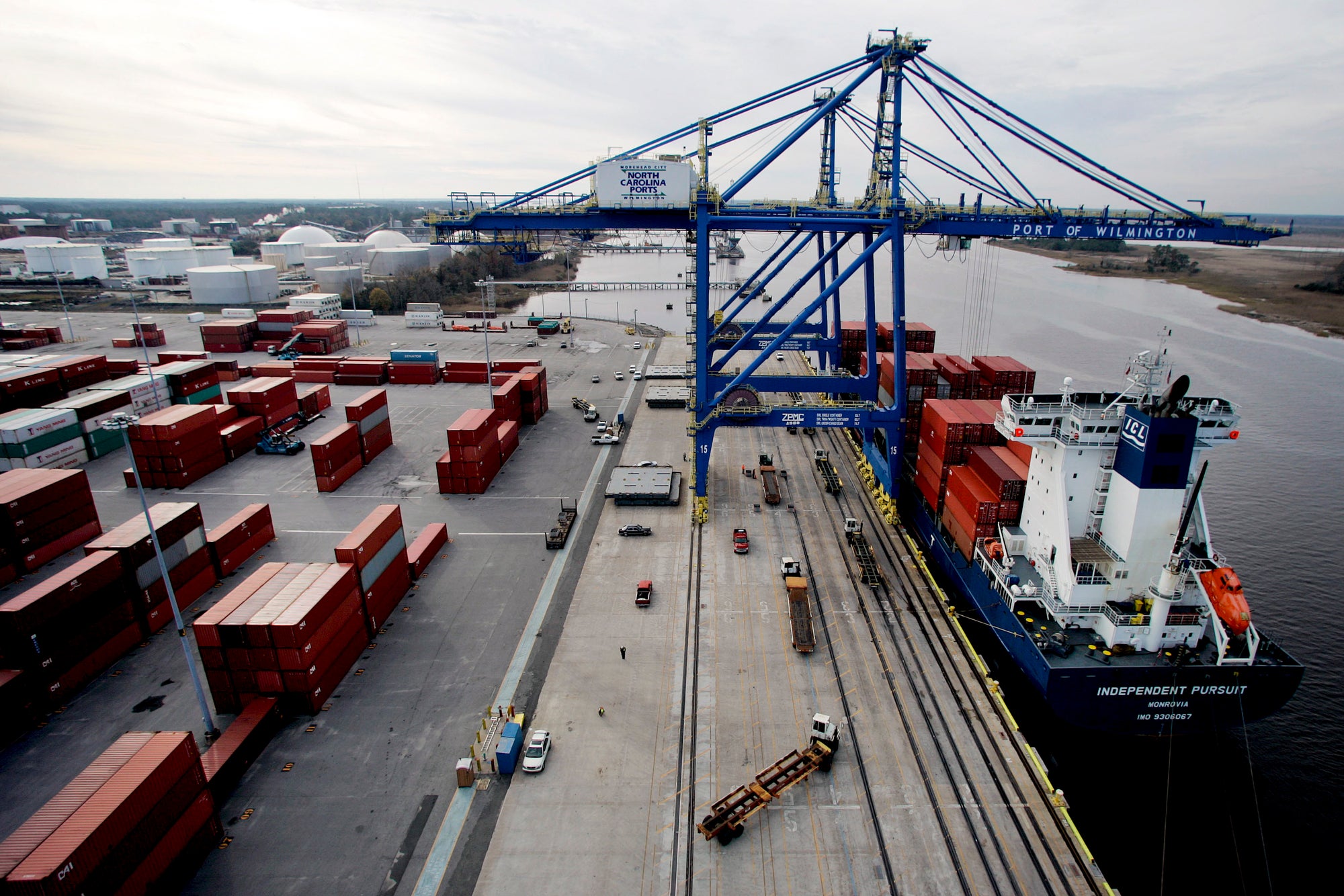
Cranes unload a cargo ship at the Port of Wilmington. Proponents of the $1.3-billion dredging project argue that deepening the harbor is essential to accommodate massive modern ships and keep the port competitive.
Jim R. Bounds/Bloomberg via Getty Images
The state port authority has argued the project is existentially necessary to keep the Wilmington port competitive in an era of larger ships, heavier loads and deeper harbors. Nearby harbors in Charleston, S.C., and Savannah, Ga., have already been dredged to depths of 52 and 47 feet, respectively. Without a deeper channel, shippers using modern post-Panamax ships must pack lighter loads or reroute goods by roadway to reach Wilmington—expensive propositions that threaten a port that contributes $14.8 billion annually to North Carolina’s economy.
But local communities are pushing back. Some municipalities in the state, including Wilmington, Bald Head Island, Southport and Leland, have passed resolutions demanding stronger mitigation measures. The Cape Fear River supplies drinking water to more than 500,000 residents, but contamination from the expansion project would disproportionately harm people in low-income and minority populations. People in these groups are more likely to rely on subsistence fishing from the river for protein—and less likely to be able to afford the expensive reverse-osmosis filtration systems that screen out PFAS.
An Army Corps of Engineers spokesperson told Scientific American that because the review is ongoing, the agency wouldn’t comment any further on the current plan. The Corps’ own calculus in the draft report found that the dredge operation would allow bigger ships to enter the expanded channel fully loaded, delivering an overall annual economic benefit to the region’s economy of nearly $16 million. The benefit-to-cost ratio is relatively small, however, at 1.3 to 1.
The Corps has adamantly refused to conduct sediment testing for PFAS, which alarms local scientists and environmentalists like Burdette. Unearthing the sides of the Cape Fear will not only disturb ecosystems but will likely also drive salt water intrusion further upriver. Burdette fears the phenomenon of “ghost forests”—clusters of native bald cypress trees weakened, warped and ruined by salinity—could creep up to his childhood island.
And this is where the PFAS danger may become more pronounced. When a PFAS gets trapped in sediment, it bonds with the organic material sequestered in the murky depths. But as salinity increases, there is increased potential for the PFAS to return to the dissolved phase. It becomes an “agent for exposure,” says Ralph Mead, an Earth and ocean sciences professor at the University of North Carolina Wilmington and leader of the North Carolina PFAS Research Network.
Mead cautions that while this shift caused by salinity has been proved in some of the thousands of PFAS chemicals, it remains a hypothesis for some of the forever chemicals found in Cape Fear, such as GenX. To his knowledge, there has never been a comprehensive, systematic study looking at the before-and-after impact of dredging on PFAS exposure.
That risk keeps Kerri Allen, coastal management program director at the North Carolina Coastal Federation, up at night. Her organization has pushed back against multiple aspects of the dredging plan: its impacts on water quality, local animals and shoreline erosion. But the PFAS concerns raised here have been “a uniting factor” in advocacy and pushback.
The science supports significant concern over the combination of salt water intrusion, sediment and seeping PFAS chemicals. A study of historical tidal records from the 19th century to today found that the tidal range around Wilmington, or the height difference between high and low tide, has already doubled in the past 130 years. “We’re just in the purgatory of knowing the risk but not being able to do anything about it,” Allen told Scientific American before the DCM nixed the initial proposal. Now she’s encouraged to see that the state is taking the PFAS concerns seriously.
“The science is clear that PFAS are present in Cape Fear River sediments, and dredging has the potential to mobilize that contamination,” Allen says. “Even when the Corps suggests there’s little that can be done, it matters that DCM is pressing for a more thorough evaluation of those risks.”
What’s unfolding on the Cape Fear is a preview of a much larger regulatory blind spot in the Corps’s national mission and the broader maritime economy. The Corps dredges approximately 240 million cubic yards of material every year, according to agency public affairs officer Doug Garman, with a yearly dredging budget of $1.8 billion. As scientists race to better understand the interplay of PFAS, salinity and sediment, there’s no effort by the Corps to factor the risk of these chemicals into its key mission of maintaining about 12,000 miles of inland and intracoastal waterways, 13,000 miles of coastal waterways, and 400 ports, harbors and turning basins.
“There are compounds that never break down,” Burdette says. “PFAS is a pretty big deal, and this area has been contaminated for over 50 years. You should really do a lot of modeling and sampling.”
The Corps first proposed the Cape Fear expansion in 2020, after a feasibility study by the state port authority and a few years after the PFAS risks in the region first made headlines. The expansion is part of a nationwide effort to expand ports to receive the latest generation of supersized, post-Panamax container ships.
As such, it’s one of many massive dredging projects underway by the Corps. According to William Doyle, CEO of the industry group Dredging Contractors of America, the U.S. spent $2.4 billion on dredging in 2024, with billions of dollars’ worth of future projects commencing in Alabama, Texas, New York State, Georgia and Maryland. Between the need to widen and maintain harbors for trade and the imperative to replenish beaches that drive local tourism economies, moving dirt and sand has become a big, climate-driven industry.
“God’s not building land anymore,” Doyle says. “There’s only two ways you get land: one’s volcanic eruption, and the other is excavating dredge material from the ocean floor.”
Doyle argues the reconditioning of riverbeds isn’t as chaotic as opponents suggest. Teams of ships—cutter dredges that steer underwater drill bits, clamshell dredges that swing a bivalve bucket over the shore and pump dredges that suck sediment from the riverbed—work in relatively quick succession. For the Cape Fear project, much of the sediment will be repositioned on estuaries, islands and beaches; if it does in fact contain a PFAS risk, it’s one that will be spread across human and animal habitats.
Doyle says the industry has been constrained by increased environmental regulations that require mitigation, testing, and restrictions that limit work to certain times and areas. But those regulations, by and large, don’t include testing for or even considering PFAS.
Beginning in 2020, Michigan’s Department of Environment, Great Lakes, and Energy (EGLE) became one of the first regulatory bodies in the country to ask dredging operations to test for PFAS. After the state passed its PFAS Drinking Water Rules in August 2020, EGLE decided to mandate PFAS sediment tests for dredging projects to make sure the spoils of such work didn’t contaminate the drinking supply. An EGLE representative says that of the 69 harbors in the state maintained by the Corps, 14 have been impacted by known sources of PFAS.
The Michigan testing mandate became contentious earlier this year when it was cited as a holdup to plans to dredge the harbor in the city of Grand Haven; the industry members balked and the state’s congressional delegation even lobbied EGLE to defer the “harbor-killing” rules. In the end, the dredging continued, but it was based on a compromise; the project would be split into sections, with two areas of highest priority that happened to have already valid sediment testing green-lit to move ahead.
The lack of testing in North Carolina is a direct reflection of the limited state of the nation’s regulations. Federal PFAS rules cover only a handful of the estimated 15,000 known PFAS chemicals, and the Trump administration has sought to roll back the regulations the federal government has on them—totally dropping regulations on four and pushing the implementation of the two remaining regulations back from 2029 to 2031. Trump’s EPA has also proposed rescinding a Biden-era expansion of the Toxic Substances Control Act that would have greatly improved awareness of PFAS risk. There is a way to hold polluters accountable for PFAS damage and potentially damage caused by dredging: EPA’s rule designating PFOA and PFOS as hazardous substances under CERCLA, the Superfund site law. But by that time, the damage will have been done.
Environmental advocates in North Carolina argue that testing should be a basic precursor to any work on the Cape Fear river system because of the region’s history with PFAS. For decades the Fayetteville production site of Chemours, a DuPont spinoff, has been dumping GenX into the river. During a speaking event last year, Emily Donovan, an activist with community action group Clean Cape Fear, proclaimed that downstream, “Churches in Brunswick County baptize their babies in PFAS-contaminated tap water.” Although Burdette and others have worked to expose the extent of PFAS pollution and a consent agreement was put in place in 2019 to reduce Chemours’s dumping, the company was cited for violating the consent order in 2021, and is actively seeking to expand production at its facility.
“The Cape Fear River has a long and storied history of just being horribly abused and mistreated,” Allen says. “In pretty much every situation where we’ve sampled, there’s been high concentrations of PFAS.”
Proponents of dredging argue that there hasn’t been testing of the sediment, so there’s no proof it contains high concentrations of PFAS. Allen believes that point has been “weaponized” to some extent. Maybe the levels aren’t that bad. But that’s a fair question that deserves to be explored. There’s a pervasive sense in the area that the risks are real; the local water utility recently installed a $46-million carbon-filtration system to clear the region’s drinking water. Meanwhile the Corps didn’t even mention PFAS in its entire initial draft EIS.
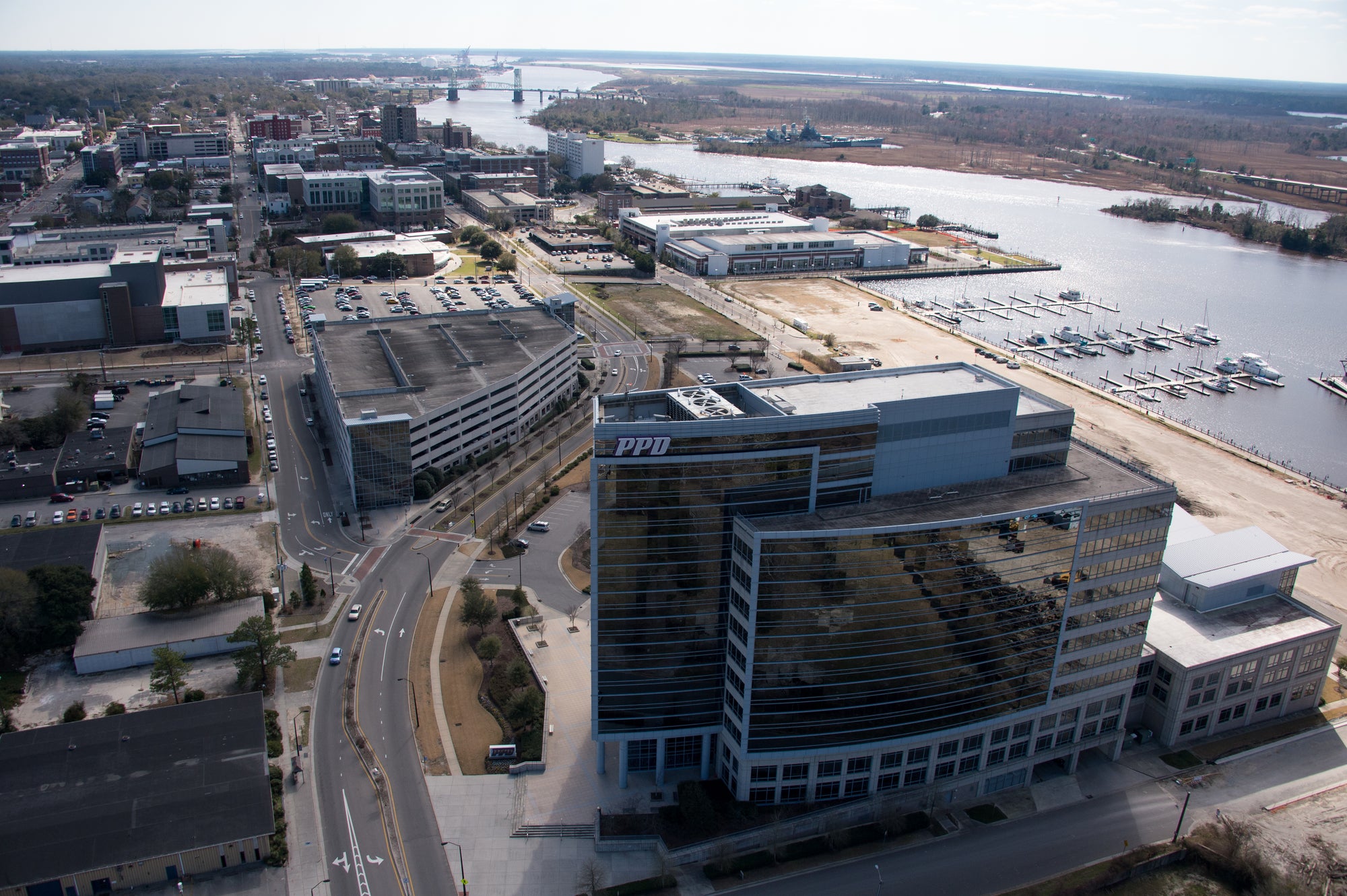
Downtown Wilmington lies directly alongside the Cape Fear River. Proposed federal dredging downriver—hints of the port visible past the distant bridge—designed to bring economic promise for larger ships, has alarmed residents reliant on this water for their primary drinking source.
The complex interplay of tides, sediment, shorelines and salinity is, by its nature, an extremely fluid situation. Currently, a team of local researchers in North Carolina is collaborating to better understand how dredging may lead to the formation of more ghost forests and salinity, in an effort to gauge just how salt water intrudes the river system and how much salt water is needed to impact local ecosystems. A variety of approaches are being integrated to obtain a more detailed understanding—measuring the history of foraminifera, a single-celled marine organism, in sediment to gauge tidal movements; coring bald cypress trees and measuring ring widths to see when saltwater caused slow growth; and installing a series of sensors to obtain hour-by-hour measurements of tidal activity to better predict how storms and extreme weather can alter tree health. The researchers recently published a study that found that dredging may be speeding up ghost forest formation.
“It’s really amazing to see what these salinity signatures actually look like on a daily, monthly, annual timescale because it’s not like salinity just slowly creeps up uniformly,” says Phil Bresnahan, a UNC Wilmington oceanographer and one of the co-authors of the study. “There are these big questions about what frequency, duration, intensity, severity—like, what’s the combination of these factors in salinity that’s then impacting the ecology?”
Studies like this one, along with sediment testing, may create a better understanding of what setting massive dredging machines loose on the river system may do. Mead estimates that a comprehensive before-and-after study of dredging and PFAS would take a year, though mimicking the actual dredging might be challenging. Scientists at Michigan’s EGLE found that testing sediment for PFAS—taking a core sample, drying it and running it through a mass spectrometer—cost about $335 per sample. At a standard rate of one test for every 10,000 cubic yards of material, testing would cost roughly $1.2 million for the Cape Fear project—less than 0.1 percent of its total budget.
Because there’s no viable way to clean PFAS-laced sediment—it can only be contained—opponents face a strategic problem: they are fighting an irreversible infrastructure project without the definitive data needed to prove its toll. Bresnahan calls this the ecosystem ratchet effect; once something gets set in motion, it’s very, very hard to turn back.
But there is still pushback. If the Corps and the state port authority are able to get the project approved, it still needs to be funded; North Carolina’s government can perhaps be convinced by voters not to provide the state’s required 25 percent share of the budget, roughly $339 million.
Large government infrastructure projects carry immense momentum, and they are famously hard to stop. But the state’s recent rejection of the initial plan has shifted the momentum, and Burdette is continuing to push for the data.
Burdette, who grew up swimming in and drinking the water from Cape Fear, has significant exposure himself; his blood has tested positive for significant PFAS concentration levels. His father died of kidney cancer a few years ago, a type of cancer closely linked to PFAS exposure. Despite his vegan diet, Burdette has sky-high cholesterol, another known side effect of exposure to these forever chemicals; he does blood tests and kidney scans on a regular basis. Like the shores of the river he protects, Burdette is carrying the chemicals with him, waiting for more data and more answers.
“I’m trying to get ready for whatever the doctor finds,” he says.


