‘Arsenic Life’ Microbe Study Retracted after 15 Years of Controversy


Microbe study ‘arsenic life’ ‘retraction after 15 years of controversy
A controversial arsenic microbe study unveiled 15 years ago was retracted. The authors of the study cry
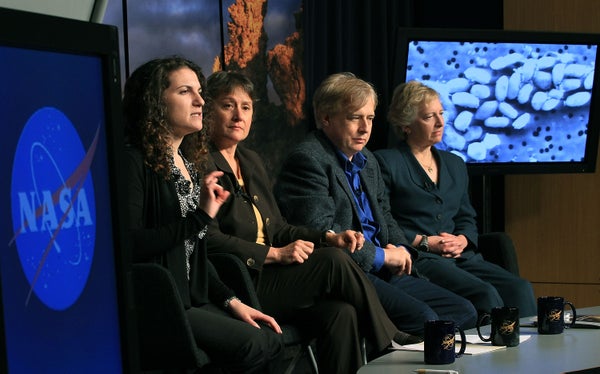
Felisa Wolfe-Simon speaks during a press conference at the NASA headquarters on December 2, 2010 in Washington, DC.
“Can you imagine eating toxic waste for breakfast?” Science The magazine asked in a 2010 press release praising a newly discovered microbe pretended controversial “living and developing entirely on arsenic”.
The complaint was controversial because it stole from a well -established biochemistry. Among the many elements deemed crucial for life, one of the most important is phosphorus, which serves as a construction block for DNA and other biomolecules. But in samples from Lake Mono in California, a research team had found evidence of a bacteria exchanging phosphorus for arsenic. If this is true, the result would have rewritten the textbooks and leads to radical revisions in our understanding of the place where and how life could occur elsewhere in the cosmos. The problem was: many experts were not convinced.
Now, about 15 years later, the venerable scientific review withdrew this “Arsenic Life” study, formerly the star of a NASA press conference because of her epoch astrobiological implications. First of all an American geological survey researcher at the start of his career, Felisa Wolfe-Simon, to acclaim, then to the controversy, the study convulted the scientific community for two years, raising questions about how science is both conducted and published.
On the support of scientific journalism
If you appreciate this article, plan to support our award -winning journalism by subscription. By buying a subscription, you help to ensure the future of striking stories about discoveries and ideas that shape our world today.
“”Science decided that this research article meets the withdrawal criteria according to today’s standards, “said the editor -in -chief of the journal Holden Thorp in the July 24 withdrawal notice. SciencePrevious standards have only enabled the retraction of a study due to fraud or fault, he explained that the newspaper now allows withdrawal if the experiences of an article do not support its key conclusions. He underlined two 2012 studies, also published by Science, This suggested that the microbe of Lake Mono, called GFAJ-1, simply kidnapped with an extraordinarily well internal arsenic and did not count on its metabolism or its reproduction. “Given the evidence that the results were based on contamination, Science believes that the key conclusion of the document is based on defective data, ”says a co-author monitoring blog article by Thorp and Valda Vinson, editor of the Science Newspapers. Ten Science Studies have been retracted for an involuntary error since 2019, according to a journal spokesperson.
The authors of the study, including Wolfe-Simon, protested the retraction in a letter to Science. “Complaints must be made, tested, disputed and ultimately judged on the scientific merits of the scientific community itself,” they wrote.
One of the authors of the study, the geochemist Ariel Anbar of the Arizona State University, calls for the explanation of “incredibly misleading” retraction, saying that proofs of contamination in the original study were weak and had to be judged by scientists, not in the newspaper. “You might think that if Science I wanted to withdraw this document after almost 15 years, they could offer a clear and convincing argument for the published file – developed in a transparent manner and presented in a coherent manner. You would be wrong.
A NASA official also asked for Science To reconsider the retraction, claiming that the newspaper “distinguished” the study and that the decision upsets scientific standards.
In some respects, the saga of the life of the arsenic concerns less the result disputed itself and more on the zeitgeist in which he emerged. The study made its debut at a fundamental moment when the majestic and slow tradition of the scientific examination of peers accelerated and moved online, opening up to the wider scientific community and coupling closely with the 24/7 trigger of social media and digital news. With the advantage of the hindsight, the fury that followed was if nothing else a warning on the results of the “big and real” research quickly took place with a fanfare out of breath – in this case the now notorious press conference of NASA. Wolfe -Simon, then NASA 33 -year -old scholarship holder, became a scientific celebrity almost overnight – and also a lightning rod for controversy.
The decision of the research team to engage at least with online criticism while managing disagreements in the more formal and slow world of scientific journals has badly played in the era booming of the blogosphere, with effects that are clear today. “Over the years, Science continued to receive requests on the media on the Wolfe-Simon research article, stressing to what extent the article is still part of the scientific discussions, “said ThorP in the retraction statement.
In February, the study’s retraction issues were apparently relaunched by a New York Times Profile of Wolfe-Simon who depicts it and the search for the life of the arsenic in sympathetic terms. In the midst of the publication of the profile, said Anbar, he and other study authors received questions on a retraction from the journal, followed by a notification of his decision to carry out a withdrawal plan (against the declared disagreement of the authors). The authors finally granted a withdrawal project which clearly indicated that there was no misconduct, but the base indicated for the retraction was still vague, says Anbar.
“My conclusion is that, yes, the document must be retracted so that a declaration of prudence appears whenever it is accessible,” explains Patricia Foster, professor emeritus of biology and research ethics at the University of Indiana, noting that it still generates new quotes in scientific documents with a reading committee. But, she adds, it is important that the notice of retraction clearly indicates that no lack of research is suspected about the work.
Leonid Kruglyak of the David Geffen School of Medicine of the University of California in Los Angeles, co-author of one of the articles of 2012 which found that the GFAJ-1 is simply kidnapped in arsenic, also agrees with Scienceretraction. It is now appropriate on the basis of the new standards of withdrawal of articles with seriously defective conclusions such as the GFAJ-1 study, he says. “I don’t think it’s really a dispute, except from the authors themselves.”
A critic of the retraction, however, is the chemist Steven Benner of the Foundation for Applied Molecular Evolution, who was seated during the NASA press conference in 2010 as a skeptical voice. Sciencehe said, should not act as a “guardian” by retracting a study which could be wrong but which was not fraudulent; This carries his own threat to open scientific research, in his opinion. “The newspaper should stay, and he simply met the fate of many articles that were false,” he said. “It is an object lesson on how the bancal results are corrected.”


