Researchers try bold new approach in a race to better treat autoimmune diseases

Scientists are trying a revolutionary new approach to treating rheumatoid arthritis, multiple sclerosis, lupus and other devastating autoimmune diseases – by reprogramming patients’ haywire immune systems.
When your body’s immune cells attack you instead of protecting you, current treatments mitigate friendly fire, but they don’t correct the cause. Patients face a lifetime of expensive pills, injections or infusions with serious side effects – and too often, the medications are not enough to control their disease.
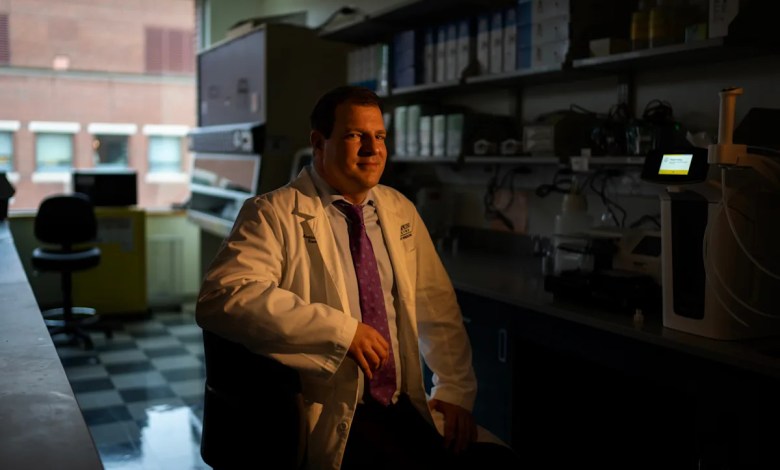
“We are entering a new era,” said Dr. Maximilian Konig, a rheumatologist at Johns Hopkins University who is studying some of the possible new treatments. They offer “the opportunity to control disease in a way we’ve never seen before.”
How? Researchers are modifying dysfunctional immune systems, not just suppressing them, in a variety of ways that aim to be more powerful and precise than current therapies.
They are highly experimental and, due to potential side effects, so far largely reserved for patients who have exhausted current treatments. But people who undertake early studies seek hope.
“What’s wrong with my body?” » Mileydy Gonzalez, 35, of New York, remembers crying, frustrated that nothing was helping her daily lupus pain.
Diagnosed at age 24, his illness worsened, attacking his lungs and kidneys. Gonzalez was having trouble breathing, needed help getting up and walking and couldn’t pick up her 3-year-old son when last July, her doctor at NYU Langone Health suggested the hospital’s study using tailored cancer treatment.
Gonzalez had never heard of this CAR-T therapy, but decided, “I’m going to trust you.” » Over several months, she slowly regained energy and strength.
“I can actually run, I can chase my child,” said Gonzalez, who is now pain-free and pill-free. “I had forgotten what it was like to be me.”
“Living drugs” reset the immune system
CAR-T was developed to eliminate hard-to-treat blood cancers. But the cells that deteriorate in leukemias and lymphomas – immune cells called B cells – deteriorate differently in many autoimmune diseases.
Some US studies in mice suggest that CAR-T therapy could help these diseases. Then, in Germany, Dr. Georg Schett of the University of Erlangen-Nuremberg tried it with a seriously ill young woman who had failed other treatments for lupus. After an infusion, she has been in remission – without further medication – since March 2021.
Last month, Schett explained at a meeting of the American College of Rheumatology how his team has gradually treated a few dozen more patients, with additional diseases such as myositis and scleroderma — and few relapses so far.
Those early results were “shocking,” Konig recalls of Hopkins.
They have led to an explosion of clinical trials testing CAR-T therapy in the United States and abroad for a growing list of autoimmune diseases.
How it works: Immune soldiers called T cells are filtered from a patient’s blood and sent to a lab, where they are programmed to destroy their related B cells. After chemotherapy to eliminate other immune cells, millions of copies of these “living drugs” are reinfused into the patient.
Although autoimmune drugs can target certain B cells, experts say they can’t get rid of those hidden deep within the body. CAR-T therapy targets both problematic B cells and healthy cells that could eventually go crazy. Schett theorizes that profound exhaustion reboots the immune system, so that when new B cells form, they are healthy.
Other ways to reprogram unwanted cells
CAR-T is exhausting, time-consuming and expensive, in part because it is personalized. CAR-T cancer treatment can cost $500,000. Some companies are now testing commercially available versions made in advance using cells from healthy donors.
Another approach uses “peacekeeping” cells at the center of this year’s Nobel Prize. Regulatory T cells are a rare subset of T cells that dampen inflammation and help hold back other cells that mistakenly attack healthy tissue. Some biotech companies are engineering cells from patients with rheumatoid arthritis and other diseases not to attack, as CAR-T does, but to calm autoimmune reactions.
Scientists are also repurposing another cancer treatment, drugs called T-cell activators, which do not require custom engineering. These laboratory-made antibodies act as a matchmaker. They redirect the body’s existing T cells to target antibody-producing B cells, said Dr. Ricardo Grieshaber-Bouyer of Erlangen, who works with Schett and is also studying possible alternatives to CAR-T.
Last month, Grieshaber-Bouyer reported giving treatment with one of these drugs, teclistamab, to 10 patients with various diseases, including Sjögren’s disease, myositis and systemic sclerosis. All but one improved significantly and six went into drug-free remission.
Next-generation precision options
Rather than wiping out entire sections of the immune system, Hopkins’ Konig aims to be more precise, targeting “just that very small population of unwanted cells that are actually doing the damage.”
B cells have identifiers, like biological barcodes, showing that they can produce faulty antibodies, Konig said. Researchers in his lab are trying to design T-cell activators that would mark only “bad” B cells for destruction, leaving healthy cells in place to fight infection.
Nearby, in another Hopkins lab, biomedical engineer Jordan Green is working to find a way for the immune system to reprogram itself using instructions delivered by messenger RNA, or mRNA, the genetic code used in COVID-19 vaccines.
In Green’s lab, a computer screen glows with brightly colored dots that resemble a galaxy. This is a biological map that shows the insulin-producing cells in a mouse’s pancreas. Red marks unwanted T cells that destroy insulin production. Yellow indicates these peace-making regulatory T cells – and they are outnumbered.
Green’s team aims to use this mRNA to direct certain immune “generals” to fight bad T cells and send out more peacemakers. They package mRNA into biodegradable nanoparticles that can be injected like a drug. When the right immune cells receive the messages, the hope is that they will “divide, divide, divide and form a whole army of healthy cells that will then help treat the disease,” Green said.
Researchers will know it’s working if this galaxy-like map shows less red and more yellow. Human studies are still a few years away.
Could you predict autoimmune diseases – and delay or prevent them?
A drug for Type 1 diabetes is “leading the way,” said Dr. Kevin Deane of the University of Colorado Anshutz.
Type 1 diabetes develops gradually, and blood tests can detect those developing it. Treatment with teplizumab is approved to delay early symptoms, modulate unwanted T cells, and prolong insulin production.
Deane is studying rheumatoid arthritis and hopes to find a similar way to block this joint-destroying disease.
About 30% of people with a certain autoreactive antibody in their blood will eventually develop RA. A new study followed some of these people for seven years, mapping immune changes leading to disease long before joints became swollen or painful.
These changes are potential targets for drugs, Deane said. While researchers look for possible compounds to test, he is leading another study called StopRA: National to find and learn more about people at risk.
On all these fronts, there is still a lot of research to be done – and no guarantees. There are questions about CAR-T’s safety and how long its effects last, but it is furthest along in testing.
Allie Rubin, 60, of Boca Raton, Fla., spent three decades battling lupus, including frightening hospitalizations when it attacked her spinal cord. But she qualified for CAR-T when she also developed lymphoma — and although a serious side effect delayed her recovery, next month will mark two years without signs of cancer or lupus.
“I just remember waking up one day and thinking, ‘Oh my God, I don’t feel sick anymore,'” she said.
This kind of result makes researchers optimistic.
“We have never been closer – and we hate to say it – to a potential cure,” Hopkins’ Konig said. “I think the next 10 years will radically change our field forever.”
—-
The Associated Press Health and Science Department receives support from the Howard Hughes Medical Institute’s Department of Science Education and the Robert Wood Johnson Foundation. The AP is solely responsible for all content.


