
With their bubble-net feeding strategies, humpback whales (Megaptera novaeangliae) are a new level of ”smart” animal. Their method of making “nets” out of air bubbles is even more special than once thought. It is considered tool use, which is one way to assess an animal’s level of intelligence. Out of seven species of baleen whales, humpbacks are likely the only whales that can pull off the high-performance turns required for bubble-net feeding.
How bubble-net feeding works
Bubble-net feeding is a hunting strategy that individual whales and whales eating in groups both utilize. When a group feeds this way, it is a very synchronized set of behaviors that requires communication and cooperation, which is even more evidence of their high social intelligence.
In bubble-net feeding, the group of whales or a single whale dives down below a school of fish or a small crustaceans called krill. Then, they blow bubble rings from their blowholes to stun their prey and trap them closer to the surface. Once near the surface, the whales open up their giant mouths and swallow everything in the bubble net before shutting their mouths. The baleen plates push out the water, while the whales swallow the animals whole.
It’s all in the pectoral flippers
Now it appears that humpbacks are the only baleen whales that can feed this way, thanks to their unique pectoral (or side) flippers. The biomechanics and more are detailed in a study recently published in the Journal of Experimental Biology.
A team at the University of Hawai’i at Mānoa’s Institute of Marine Biology Marine Mammal Research Program used data from drones and noninvasive suction cups to get a closer look at how the whales feed. With this data, they could accurately quantify the immense turning performance required for the maneuver.
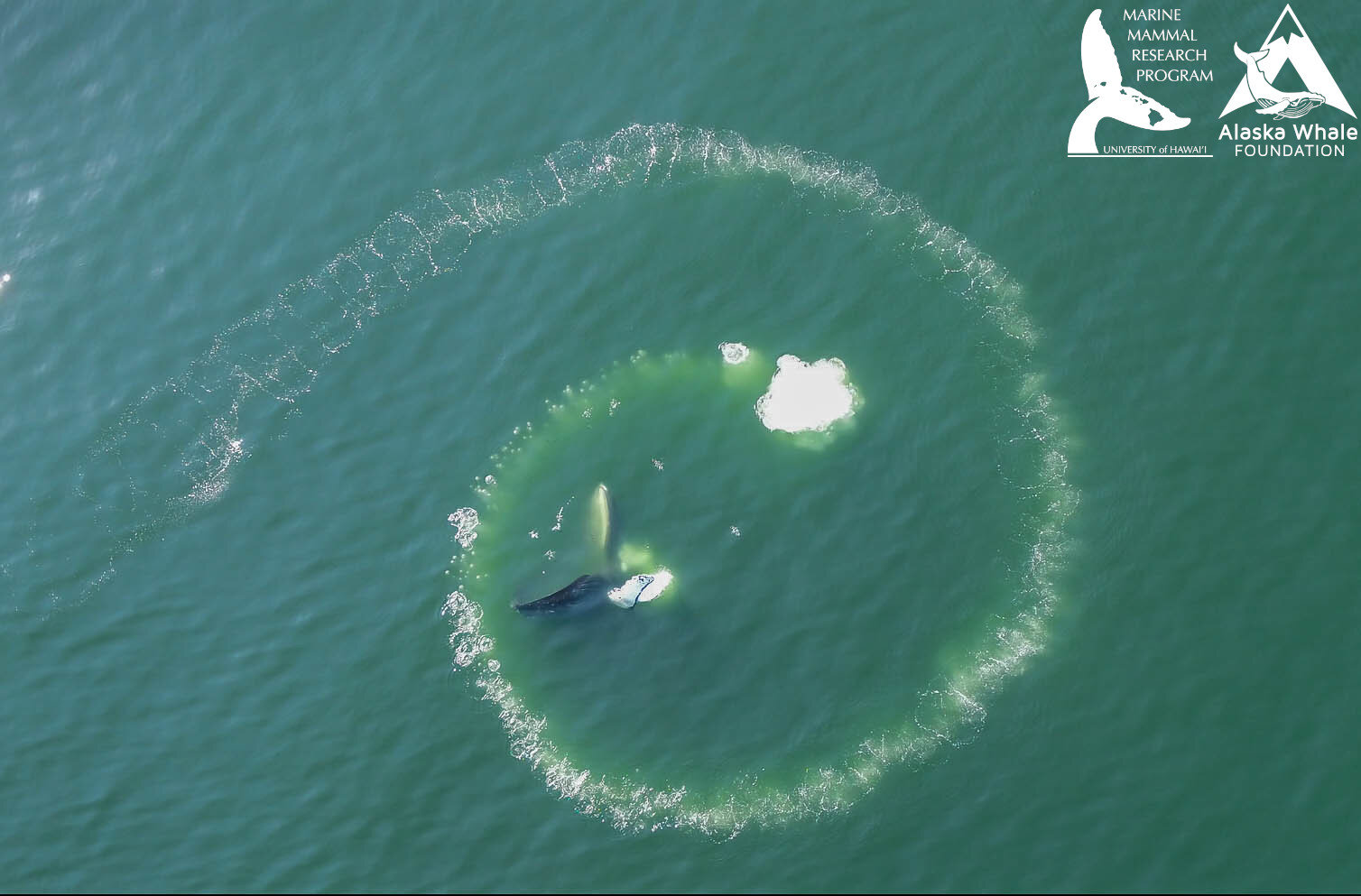
“The fact that humpback whales’ pectoral flippers enhance their maneuverability wasn’t the most surprising part of our study, as there have been previous studies on the morphology of these flippers,” Cameron Nemeth, a study co-author and recent UH graduate, said in a statement. “However, it was shocking to discover that amongst thousands of turns from a variety of behavioral states, no other species of whale examined were achieving the turning performance required to create a bubble-net.”
In order to make the turn needed to form the bubble net, the humpback whale’s large pectoral flippers can generate nearly half of the necessary force. Even if other whale species are physically capable of making similar turns, they would need to spend significantly more energy to do so. Having to burn so much energy would make it an impractical feeding strategy.
Humpbacks’ special body shape also allows them to successfully hunt for smaller or scattered groups of prey, without using bubble-net feeding. They can also lunge feed, where the whales swim through schools of fish with their mouths open to swallow huge schools of krill and plankton.
The Hawai’i connection
Humpback whales in Hawaiʻi fast while they’re visiting the islands during the winter months. Instead, they focus on mating and calving in the warm tropical waters. To get by, they rely on the energy reserves they build up when feeding in Alaska over the summer. Understanding the efficiency of their foraging techniques can help marine biologists assess their health and energetic needs while in Hawaiʻian waters.
Nemeth also worked with the journal to include an abstract of the paper in the Hawaiian-language. He translated the text and worked with a Hawaiian language professor to edit the text. The team hopes that this will set a precedent for future publications.

More deals, reviews, and buying guides


