Revolutionary eye injection saved my sight, says first-ever patient


Michelle Roberts and Sophie HutchinsonBBC News

 BBC News
Doctors say they have achieved the previously impossible: restoring sight and preventing blindness in people with a rare but dangerous eye condition called hypotonia.
Moorfields Hospital in London is the world’s first clinic dedicated to the disease and seven out of eight patients who received the innovative treatment responded to the therapy, according to a pilot study.
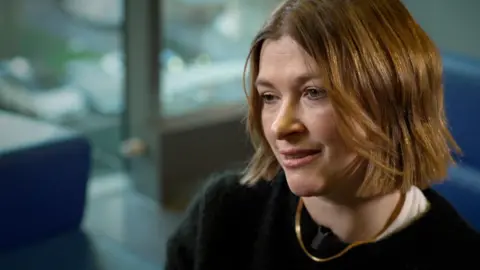
One of them – the very first – is Nicki Guy, 47, who shares her story exclusively with the BBC.
She says the results are incredible: “It changed my life. It gave me everything back. I can see my child growing up.
“I went from counting fingers and everything was really blurry to being able to see.”
Currently, she can see and read most lines of letters on an eye test chart.
She’s one line away from what’s legally required to drive – a huge change from being visually impaired, using a magnifying glass for anything close, to having to navigate around the house and outside using largely memory.
“If my vision stays like this for the rest of my life, that would be absolutely awesome.
“I may never be able to drive again, but I’ll take this!” she said.
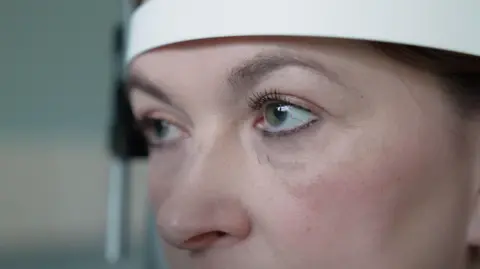
With hypotony, the pressure inside the eyeball becomes dangerously low, causing it to collapse in on itself.
This can occur if there is poor production of natural gelatinous fluid inside the eye, such as following trauma or inflammation.
Sometimes it is a side effect of eye surgery or certain medications. Without treatment, people can go blind.
Previously, doctors had tried using steroids and silicone oil to plump up the eyes. But it can be toxic in the long term and doesn’t restore much vision.
Even when the cells in the back of the eye used for vision are working, the silicone oil is difficult to see, causing blurred vision.
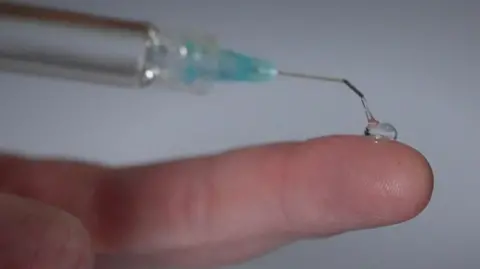
The experts at Moorfields decided to try a different approach with something they already had in their cupboard: an inexpensive, water-based, clear gel called hydroxypropyl methylcellulose, or HPCM.
It is already used in certain types of eye surgery.
But rather than using it ad hoc, Moorfield’s team decided to inject it into the main part of the eye as a new type of therapy.
 BBC News
When Nicki first had vision problems in 2017, right after the birth of her son, she was initially given a lot of silicone oil in her right eye, which didn’t work.
She said he had lost his normal shape and “kind of collapsed” or “crumpled like a paper bag” because of hypotonia. The treatment did little to help.
And a few years later, his left eye began to suffer in the same way.
“After I lost the vision in my left eye, I thought, ‘There must be something else we can try,’” she explains.
“Sheer determination. I said to myself ‘I’m not going to give up’.”
 BBC News
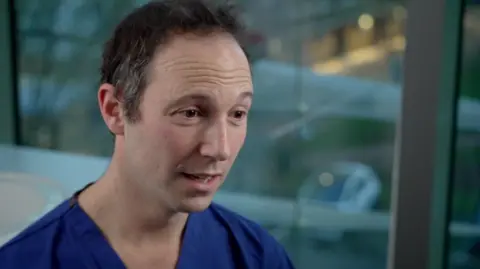
His ophthalmologist, Mr. Harry Petrouchkin, said that together they decided to do something entirely new: fill the eye with something you can see through.
“The idea that we could harm someone who only has one eye with a treatment that may or may not work was distressing,” he recalls.
“We found this solution and, surprisingly, it worked.
“Really, we couldn’t have dreamed she would get the result she did.
“Someone who obviously should have lost sight in both eyes…is now living normally. It’s quite remarkable. We couldn’t have asked for more.”
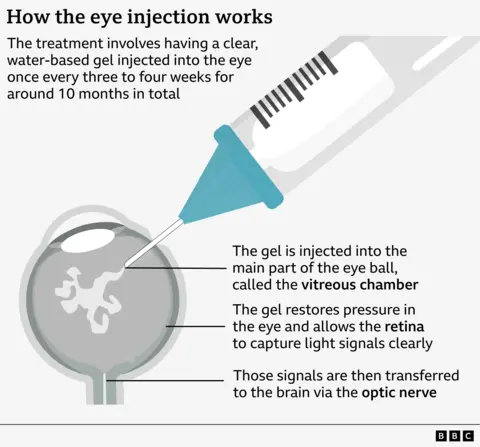
He claims the same treatment could potentially help hundreds, if not thousands, of people each year in the UK. This is about whether they still have viable cells in the back of the eye that allow vision.
“We knew that with Nicki there was vision to be gained and that she would get better if we could make her eyes round and hard.”
They have treated 35 patients so far, thanks to funding from Moorfields Eye Charity, and have now published the results of the first eight in the British Journal of Ophthalmology.
The treatment is given once every three to four weeks for approximately 10 months in total.
Researchers hope that over time they will be even better able to determine who might benefit.
“It’s a fantastic story. The results are really promising, but we’re still at the beginning,” says Petrouchkin.

Sign up here to receive our weekly newsletter highlighting uplifting stories and remarkable people from around the world.


