RIP Ed Feulner, the Intellectual Godfather of Conservatism


Since the Reagan administration in the 1980s, the Heritage Foundation has regularly ranked as the most influential conservative reflection group. Now, seven presidents later, in the 1920s, heritage still shapes conservative thinking, as well as national results. And although credit for this achievement returns to many, a particular figure deserves the most credit: Ed Feulner, who died on July 18 at 83.
Feulner helped found heritage in 1973, and from 1977, he was president for almost four decades. Meanwhile, the heritage crossed a single town house on Capitol Hill to an imposing complex overlooking Massachusetts avenue, only two houses in the American Senate and the rest of Capitol Hill. The proximity – the proximity of conservative ideas in real political power – which made the heritage so effective. It could really translate words into acts.
But it was not like that.
In the mid -1960s, when Feulner, from Chicago, came for the first time to DC, the Republicans were in a deep minority. It was Democratic President Lyndon B. Johnson at the White House, and his liberalism of the great society was the predominant vision in the congress.
This liberal vision fell on the rocks of Vietnam, riots of the campus and urban crime; And so, the Republicans began to win Gros. Winning big, electoral, that is to say, but not in a tangible way, in terms of real results. At that time, the forces of liberalism – in the media, in the deep state and in the republicans “Rino” – were such that the right was thwarted, even congested.
This was the fate of Richard Nixon, the Republican who won the presidency in 1968. It had been a narrow election, but only because a right -wing populist, the Democratic Governor Renégat de l’Alabama, George Wallace, presented a third -party candidate. If Wallace had not run, its 13.5% of the votes would have mainly gone to Nixon, not the liberal candidate, the democrat Hubert Humphrey. Thus, the Nixon voting-toter, a reaction against LBJ proto-so-so-so, would have been around 57%-a landslide. And in fact, the 1972 presidential election, with Wallace not in the arena, was a Nixon landslide. The outgoing Republican President earned almost 61% of the vote and brought 49 states.
However, even after such victories of monsters, Nixon quickly dropped deep trouble. Even when the re-elected president was at high tide, in 1973, the Democrats and their many allies blocked his plan to abolish the worst of awakening at the time, the office of economic opportunities, a radical unit within the former Ministry of Health, Education and Well-Being (Hew, which is now the Ministry of Health and Social Services).
Even more striking, in 1974, the same anti-nixon forces used Watergate to force the resignation of the 37th president. From massive national defeat to a coup at the media -based palace in less than two years – now that It was a huge return and triumph for the left.
This desolate situation led Pat Buchanan to the Nixon help that has become the force that has become the fact of publishing his 1975 book, Conservative votes, liberal victories: why the right failed. Buchanan wrote that despite all the conservative electoral victories of the previous decade, “the conservative influence on public policy in America was pitifully small”. He continued: “The conservatives have completely failed to translate political support and victories by election in national politics.”
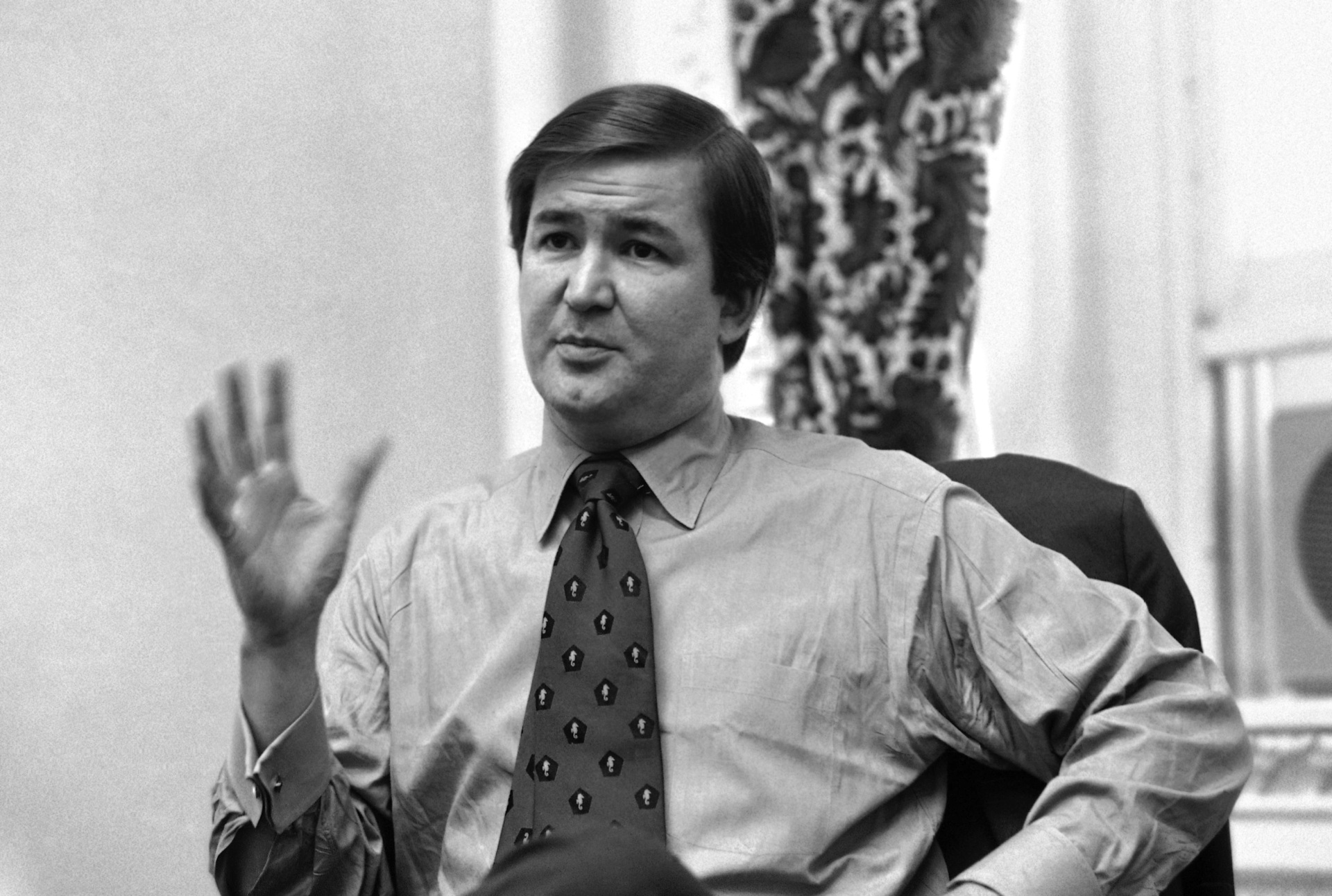
Nixon’s presidential discourse writer Patrick Buchanan speaks during a press briefing in Washington, DC, May 14, 1974. (Photo AP)
More specifically, Buchanan recalled the presidential campaign of 1972: “Three of the questions on which the White House joined the new majority where racial quotas, amnesty and new taxes.”
And yet, Buchanan continued:
During the following two years, the department of Hew of the same administration which had sworn eternal hostility towards quotas imposed on dozens of university faculties, under euphemism, “digital objectives and schedules”. And the furniture of President Nixon were not outside the oval office sixty days before President Ford declares a limited amnesty [for Vietnam draft dodgers]And begged his former colleagues from the Congress to impose a 5% from Businessmen and Voters in the middle class who had returned the Republicans to power on a commitment of “no new taxes”.
It was in this drearly backdrop, in 1973, that Feulner, joined by his relatives allies, Joe Coors and Paul Weyrich, founded Heritage. Yes, it was a discouraging period for the conservatives, and yet these three amigos were full of mind – the spirit of spit in the face of adversity and to advance things.
One of their key ideas was that The staff are political. They realized that a key problem with the victories of Nixon was that there was no conservative bench. In the absence of a talent basin on the right, the people who filled the Nixon administration – the inhabitants of the White House and through the departments and agencies of the Cabinet – were simply not conservatives. Thus, these non-conservatives were happy to team up with the liberal establishment in Washington, DC, to continue with liberalism.
Feulner’s idea was to start launching effective preservatives who had diplomas to serve the government. Feulner and his team in Heritage realized that many weight and worthy books had been written on conservative ideas – Fulner had read most of them and wrote some of them – and yet the political world moved too quickly for a volume. People on the political shooting line needed catchy sorrows, no sound soliloquies.
Thus, Feulner built his favorite tool: The two pages. After all, a good idea, so heavy, can be summed up shortly. The heritage has launched summaries of two pages of problems, written from a right -wing perspective, calling for a right solution. These memoirs were placed before the members of the staff of the Congress – Fulner himself had worked on Capitol Hill as a high -level help of two republican members of the Congress – who then served them for their bosses, the legislators. The points condemned, in turn, have become sound points on television and grains of legislation.
The two pagers were supported by scholarships; And the scholars, who tended to be young themselves, were available to discuss and consult, although the accent put on brevity and the point. In addition, heritage heritage seminars and lunches of brown bag – everything that could make his ideas friendly. It was not lobbying, it was denial. And everything worked, because Feulner and his team in Heritage have always known that good ideas could overcome bad ideas. A clear presentation has never been more important than the basic substance.
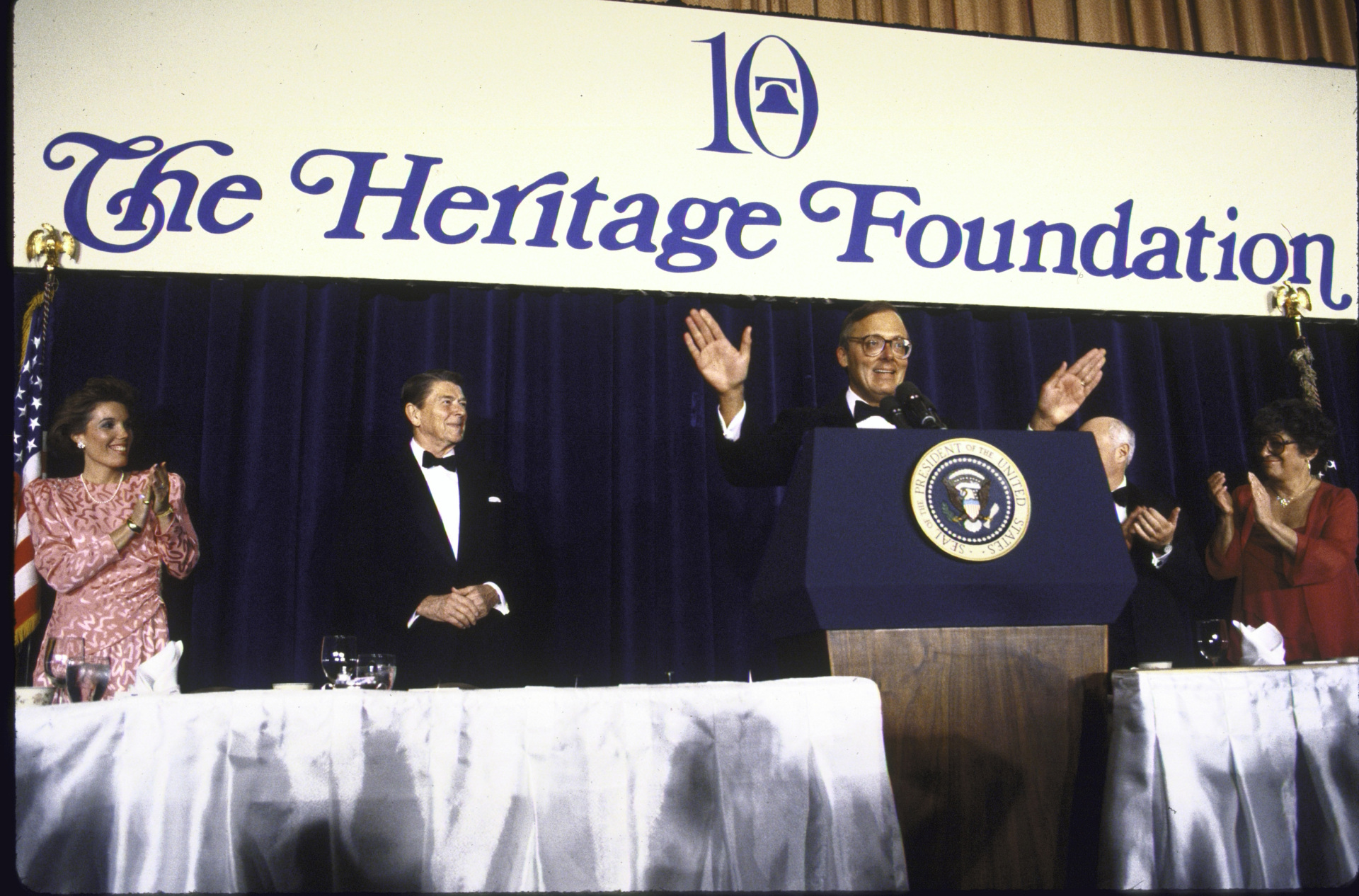
The president of the Heritage Foundation Edwin J. Feulner, Jr. speaks to the podium with President Ronald W. Reagan and others are looking in a Heritage foundation function in 1986. (Diana Walker / Getty Images)
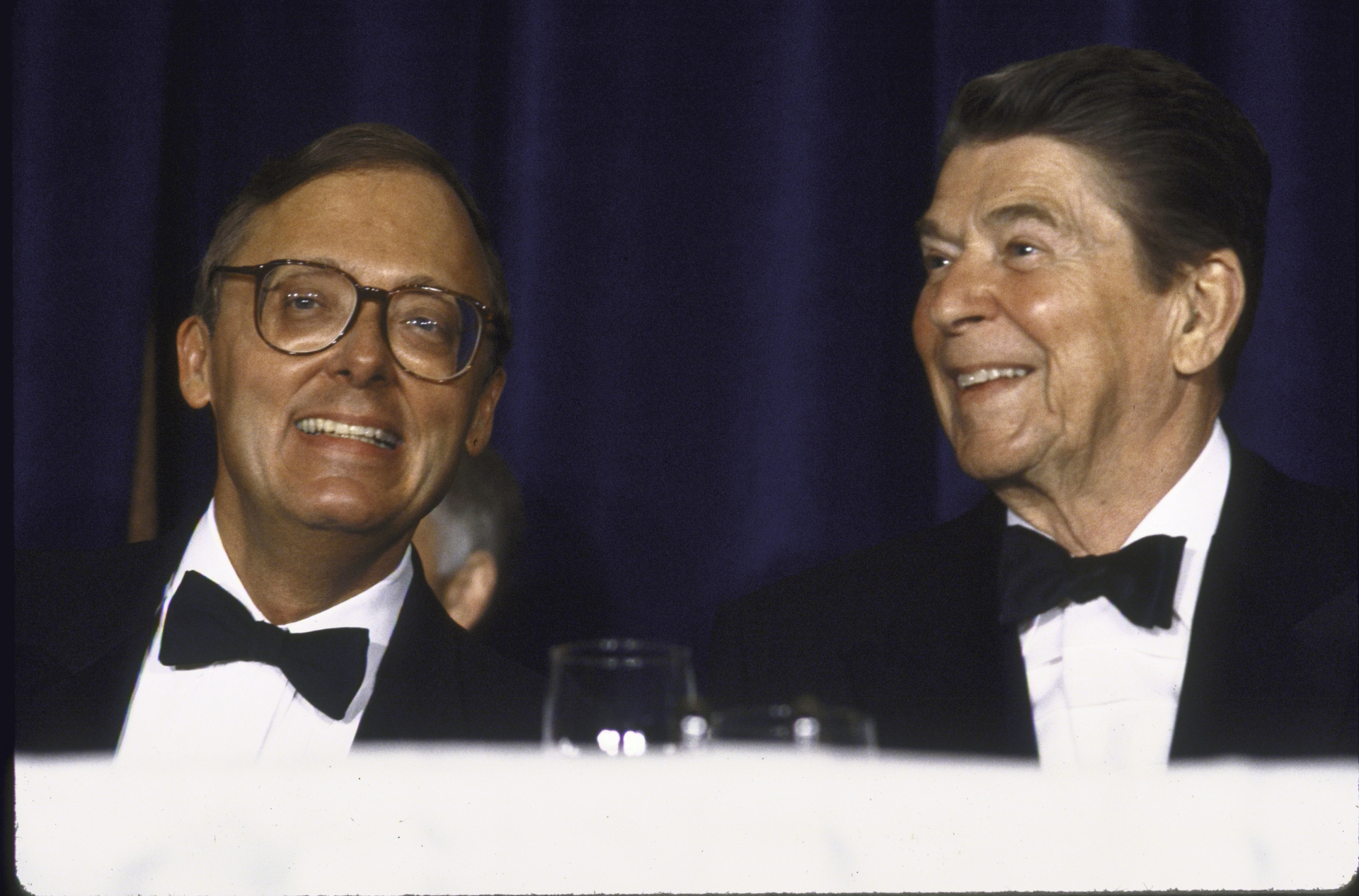
President Ronald W. Reagan (right) with the president of the Heritage Foundation, Edwin J. Feulner, Jr. during a Heritage Foundation function in 1986. (Diana Walker / Getty Images)
Admittedly, the other reflection groups and the brokers of ideas had their own approaches to influence politics, and some of them also worked. Again The heritage was the show. He created a machine in the 1970s: a carpet treading ideas with a legislative branch. And that the conveyor transported people in and out of jobs: time on Capitol Hill, the time of heritage nearby, repeat, repeat. And because they had been tested and verified when they crossed the Heritage Factory, they had to trust them once they participated in their posts of government – no more conservative votes and liberal victories.
Then, after Feulner’s good friend, Ronald Reagan, was sworn in as 40th president in 1981, the treadmill also spread to the executive branch.
The rest is history, because heritage has become a robust presence on the right and a constant influencer of national events. Not everyone likes heritage and some hate. However, everyone agrees that heritage has an impact, including their many former dispersed through the Trump administration.
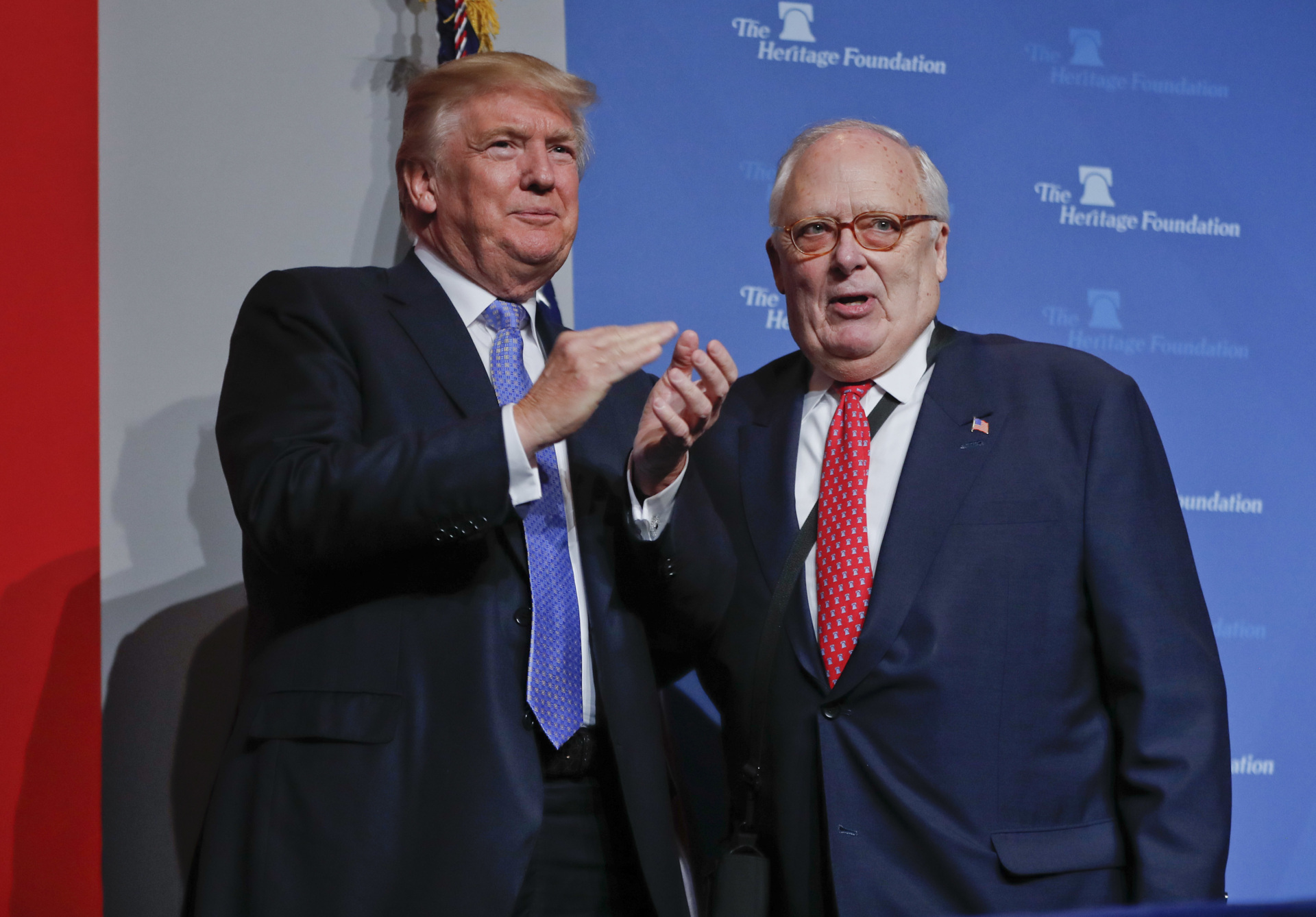
President Donald Trump is presented by the founder and president of the Heritage Ed Feulner Foundation, on the right, before speaking at the annual meeting of the club of the president of the Heritage Foundation on October 17, 2017 in Washington. (AP photo / Pablo Martinez Monsivais)
Feulner had a good idea half a century ago, and it was even better when he put his plan in action, year after year, decade after decade. Never looking for the spotlight, he was a silent godfather to the right-oriented right.
It is his inheritance and his calm as it may seem, behind the scenes, it is actually epic.


