RIP ‘other ATLAS’: Watch doomed comet C/2025 K1 explode into pieces in incredible new images


In space, death can be a beautiful thing. That’s certainly the case for the recently deceased “other” comet ATLAS, which is slowly falling apart after meeting its explosive end earlier this month, stunning new images reveal.
C/2025 K1 (ATLAS) is a comet from the Oort Cloud beyond Neptune that was discovered in May by astronomers with the Asteroid Impact Warning System (ATLAS). It reached its closest point to the sun, or perihelion, on October 8, less than 50 million miles from our home star. But the comet went largely unnoticed until earlier this month, when it developed a rare golden glow in his coma and his tail.
On November 13, astronomers noticed that C/2025 K1 had broken into several pieces. Austrian astrophotographer Michael Jäger has been closely monitoring C/2025 K1 since it began to collapse, and has now shared a stunning timelapse animation that shows the fragments of the comet slowly separating from each other.
“After the brightness peaks in early November, we were able to observe this comet split into three brighter fragments over the last two weeks,” Jäger explained. Spaceweather.com. “The animation shows it on November 12, 14, 18, 19 and 20.”

The comet was not expected to survive its perihelion – astronomers predicted that the proximity of its trip around the sun would put enormous gravitational pressure on the object. After its solar flyby, initial observations suggest that it emerged unscathed. However, following a sudden brightening, the comet then broke into three separate pieces.
More recent photos showed that a fourth, smaller fragment also separated from the comet, according to Spaceweather.com. However, this part of the comet is not visible in the new animation.
C/2025 K1 was one of the few comets ever observed with a golden hue (see below), which is likely the result of a surprising lack of carbon molecules, such as dicarbon, carbon monoxide, and cyanide, in its core. In fact, only two other known comets have ever had fewer of these molecules, according to astronomer David Schleicher of the Lowell Observatory in Arizona. recently reported.
Researchers hoped to learn more about the comet and its surprising composition during its closest approach to Earth on Tuesday, November 25. However, this now seems unlikely.
But fragments of the comet will still be visible in the constellation Leo to anyone with a decent telescope or a pair of binoculars for stargazing.
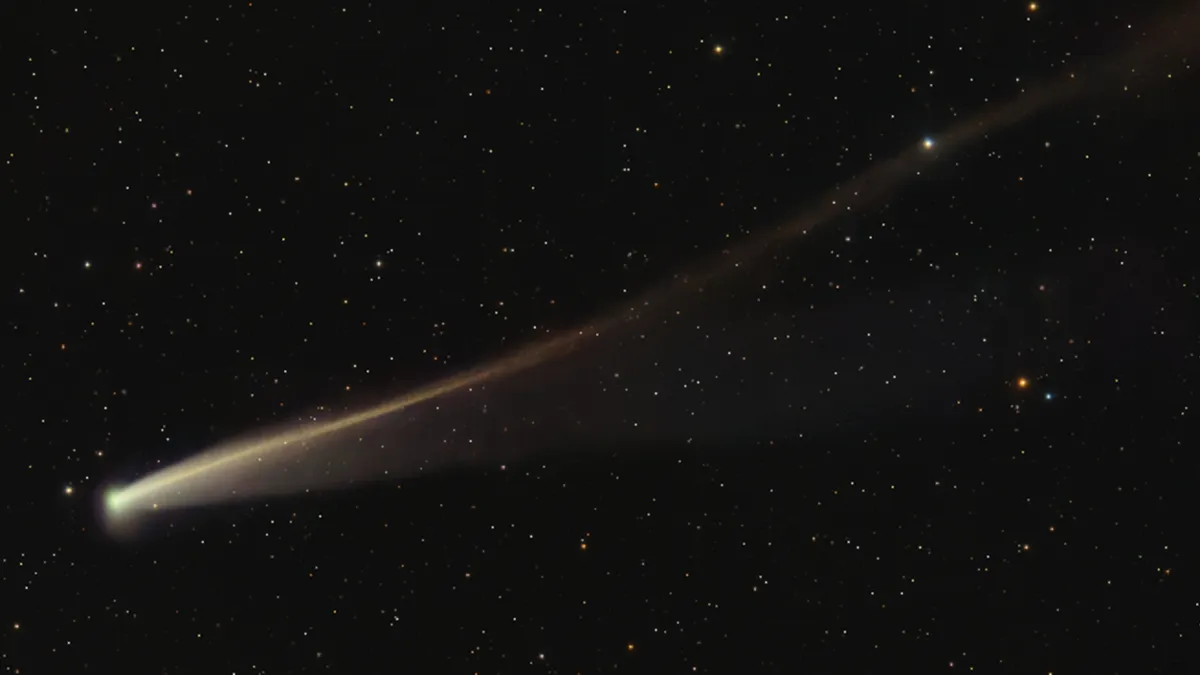
Other ATLAS
C/2025 K1 is not the first comet to bear the name ATLAS. In fact, dozens of other comets have been discovered by the Asteroid Earth Impact Warning System – a NASA-funded robotic survey that has been scanning the night sky using telescopes in Hawaii, South Africa and Chile since 2015.
In recent years, several ATLAS comets have made the news, including C/2024 G3appeared in spectacular shots of the astronauts aboard the International Space Station (ISS) earlier this year, as well as a Sungrazer comet doomedTHE Comet ATLAS for Halloween And Comet Tsuchinshan-ATLASall of which shone in 2024.
But the most famous ATLAS is 3I/ATLAS, an extraterrestrial comet which passes in front of us after having been ejected from its own star systempotentially long before the birth of the solar system.
3I/ATLAS is currently on the verge of leaving the solar system, after having reached its own perihelion on October 29and will reach its closest point to Earth on December 19, when it will reach a minimum distance of 168 million miles (270 million km) from our planet. And despite what some claim, the astronomical community is in complete agreement that it’s not an alien spaceship.
Only time will tell what wonders future ATLAS comets will have in store for us.


