I watched scientists view the interstellar comet 3I/ATLAS in real time. Here’s what they saw.


Few cosmic visitors have captured the fascination of astronomers like the interstellar comet 3i / Atlas. Faillant through our solar system from the depths of interstellar space, this icy vagabondie is only the third known object of the genre, and from which it came remains a mystery.
Since its discovery on July 1, 2025, by the telescope far from the in-depth random investigation in Chile, part of the Atlas project (Asteroid-Impact Last System), scientists have run to point telescopes to the visitor as experts and that the public is impatient to look more closely. Even the NASA Hubble Hubble Space Telescope and the James Webb space telescope recently saw this ice comet as it continues to move to our sun.
So, when I heard that the Gemini South observatory in Chile organized a live event – as part of the Shadow the Scientists (STS) initiative, which works to bring the public to the real -time research fold – I knew that I had to join. From the moment the live session started, me and other participants were thrown into the Gemini South control room while astronomers began to calibrate the telescope. The team planned to use GMOs (Gemini Multi-Object Specrographs) as well as the new high-resolution optical spectrograph instrument (ghost) to measure the chemical composition of 3i / atlas.
The astronomer Karen Meech of the Institute for the Astronomy of the University of Hawaii reminded the public to what extent of opportunities like this are rare: “Interstellar objects are elements of construction of other solar systems which have been completely expelled from their star at home via ours.
In relation: New photos of the interstellar comet 3i / Atlas reveal its tail that grows before our eyes
Other experts added to the Meech point, saying that they should ask the director of the Gemini South observatory if they could take this precise time to other observers in order to host the event. You can watch a record of the event on the link below.
While Meech prepared the land, the Telescope team in Chile prepared the 26 -foot giant mirror (8 meters) for its delicate work. Inside the control room, scientific operations specialists gave us a window on the process: “We take stallions, adjusting the telescope and checking the conditions of the sky … Tonight, it’s very dry, with regular winds, perfect for good vision.”
The comet remained with me because it was only recently that the area had been sprinkled with snow. Although the Southern Gemini Observatory has not been so seriously struck by precipitation, lower, its neighbor, the large millimeter / submilmetric (Alma) of large installation of Atacama on the Chajnantor plateau, had enough snow to have temporarily suspended all scientific operations. Fortunately, the snow had melted at the time of the live event, allowing everything to continue as well as possible.
While the calibrations continued for an hour, Meech answered the questions and made its appearance for the moment when the comet could be spotted: “We simply do not know what we are going to see this evening, and it’s exciting.”
Before Gemini South started looking for, Hubble and JWST had already taken a look early. Hubble estimated that the core of the comet, or nucleus, at less than 1.86 miles (3 kilometers) in diameter, buried under a halo of dust and gas. JWST, meanwhile, had trouble seeing the nucleus because of this halo, revealing that 3i / Atlas seems to be unusually rich in carbon dioxide. This makes him different from his 2i / Borisov predecessor, the second interstellar comet never detected, which had much more carbon monoxide.
Meech and the others to Gemini South hoped to see if they could confirm that 3i / Atlas actually has a lot of carbon dioxide, or dry ice, which would burn as the comet was getting closer to the sun. Meech explained that the approach closest to the comet of the sun will be in October, but it will be impossible to spot while the comet moves behind the sun at the time. She mentioned that NASA scientists are currently discussing the temporary reduction of existing spacecraft to observe 3i / Atlas on the other side of the sun, removing this dead angle.
Even if this is not the case, observations can resume in November when 3i / Atlas re -emerges behind the sun and, according to its activity and chemical composition, the comet might seem even more brilliant because it burns more gas and dust. But even if 3i / Atlas effectively clears up, the window so that scientists studied it will always be limited.
“Once these objects become too weak to see, they will never be seen again,” said Meech. “They only go through our solar system. Even 1i / ‘Oumuamua is still in our solar system. It is now near the Kuiper belt.”
“Oumaumua is the first interstellar object ever spotted in our solar system. Astronomers detected it in 2017.
While the telescope began to turn to 3i / Atlas, a silence fell on the experts while everyone looked at the shared screen of scientists from the Gemini South control room. Meech had explained earlier than the first chemical that they hoped to see using the GMOS was cyanide because it interacts with sunlight.
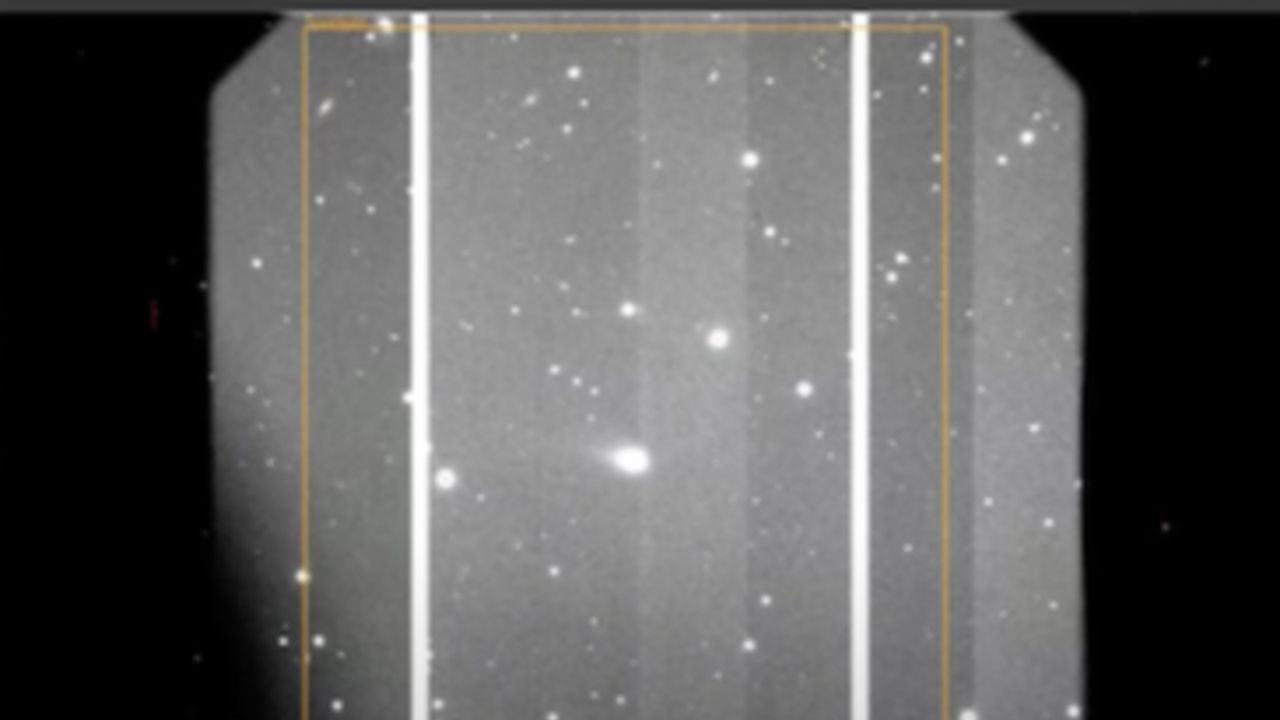
Then came the first image, a shiny and blurred stain. There was a collective dress as we all saw, and the cat’s cat was full of surprise and excitement.
“You look at a construction element of someone else’s house,” said Meech. However, she added: “It is impossible to go back the comet according to her trajectory, because everything else moves too.”
The first images showed a slight but distant Glow of a development tailConfirmation that this visitor behaved more as a “classic” comet than the strange “elongated Oumaumua, that Meech had also studied.
“It’s the raw image,” she said. “I bet you once this image is more calibrated, it will have a longer tail.”
In addition to taking the spectra, scientists have measured the brightness of the comet, comparing the reflected sunlight of 3i / Atlas to their reference points. This has led to an estimated color and brightness, which suggests that the 3i / atlas is low but regularly active, releasing gas and dust even at its current considerable distance from the sun.
Before the experts could dive more, the events of the event decided that two hours were sufficient for one night. With the captured spectra and the brightness measured and many unanswered questions, the session wrapped in a note of anticipation, many of which wishing to be able to return to the control room of the Gemini South observatory.
Fortunately, the Shadow the Scientists initiative provides for another public viewing event after 3i / Atlas reappeared from the sun, this time using the Gemini North observatory, which I am excited to join.


