Larry McMurtry’s Tall Tales | The Nation


At most McMurtry family reunions at the Clarendon Country Club, the days were split between mealtime and storytelling. After lunch, the aging uncles—all of them cowboys—would gather round and tell stories of their gallant youthful suffering on the Texas frontier, aggrieved that the days of their heroism lay behind them, that their bodies were now failing them. But the story that stayed with a young Larry McMurtry, more than any of the cowboy exploits, was the one about a molasses barrel. It was fall, at the turn of the 20th century. McMurtry’s grandfather, William Jefferson, had traveled by wagon 18 miles to the small town of Archer City in search of winter provisions. He returned to the family ranch with the wagon loaded, and sitting among the supplies was an 80-pound barrel of sorghum molasses, “in those days the nearest thing to sugar that could be procured,” McMurtry wrote.
Yet at the end of this retelling—in his 1968 book of essays on Texas, In a Narrow Grave—McMurtry included a sardonic footnote of correction. What “really happened,” he wrote, was that a sow had come along and pulled the spigot out of the barrel, causing it to run dry. The emptied barrel was discovered, and the children lined up at the scene of the catastrophe to cry. The fault was no human folly but an animal’s. Nevertheless, “as with many family stories,” McMurtry concludes, “I think I prefer the fiction to the truth.”
Truth and fiction have been two threads in the grand yarn of the American West since before the West was even settled; they are wound so tightly together that it becomes moot to distinguish one from the other. In fact, as McMurtry knew intimately, “the selling of the West preceded the settling of it, sometimes narrowly but other times by decades.” It was an “inescapable fact” that the American West’s so-called traditions were actually “invented by pulp writers, poster artists, impresarios, and advertising men.” To tell the story of the West, then, the teller needs to voice the truth about its fictions, even if that means telling fictions about its truths. McMurtry devoted his whole career to doing just that, across dozens of novels, essay collections, memoirs, a biography, and over 30 screenplays.
In his fiction, McMurtry chronicled the lives of Texas Rangers and Comanche warriors, the lives of cowboys turned suburbanites, of Houston city slickers studying for their PhDs. And in his essays and histories, he took aim at the many figures who had a hand in inventing the formidable myth of the West: Buffalo Bill Cody, Annie Oakley, Kit Karson, and P.T. Barnum. In each of these settings, McMurtry refused the seductive invitation to write in a register of high romance. His subjects might have been tragic, dark, or absurd—but they were never treated with nostalgia.
McMurtry was not interested in clawing back the “reality” of the West from its complicated illusions, either. He wrote with the knowledge that the myths were inextricable from the history of the place itself, at once bloody and banal. McMurtry saw that any idea of the “real” West was as fabulated as the illusions were, and that the pursuit of it was equally harebrained. “To do the cowboy realistically would have amounted to a sort of alchemical reverse English: it would have meant turning gold into lead,” he wrote. In other words, it would have meant turning the cowboy into something he was not and never was and losing hold of him entirely. Instead, McMurtry approached his subjects by exchanging one kind of fable—the high romance of myth—for another: the picaresque. Through his rogue’s gallery of hucksters, deadeye bandits, and hardheaded Rangers, he unveiled the West as a place of absurd, mythical invention. His great and lasting contribution was to teach Americans how to see their country and to read its history—as legend, reality, and advertising.
Unsurprisingly, then, McMurtry’s inventions went beyond the page. “I have this compulsion to fictionalize,” he once confessed. “And I don’t make a good journalist, either. I just can’t stick to the facts. By necessity, I invent.” It turns out that the writer who devoted his career to reweaving Texas’s yarns could not help but tell yarns about himself. This is the motivation for a new biography, Western Star: The Life and Legends of Larry McMurtry, written by McMurtry’s longtime friend the journalist David Streitfeld. “I wanted to rescue things [in McMurtry’s life] that were hidden or even scorned,” Streitfeld writes early on, “and to see beyond his self-inventions.” By treating McMurtry like one of his rogues, one finds that he—like all Americans, yarn-tellers every one—occupies an ambiguous relationship to his country’s history. Which is to say that we, Americans, all indulge in some kind of mythmaking, and it was McMurtry who understood how integral that was to the place we call “the West.”
When McMurtry was born in 1936 in Archer City, he, his parents, and his paternal grandparents lived under one roof—a simple shotgun house that his father and grandfather had built with their bare hands. At that time, “the Depression sat heavily on all but the most fortunate, a group that didn’t include us,” McMurtry later wrote. The family had a cook and the occasional resident cowboy, but no indoor plumbing, no electricity, no telephone.
There was also a conspicuous absence of the thing that would go on to define McMurtry’s entire life: “Of books there were none,” he recalled. Perhaps there was a magazine or two, and surely there was a Bible (whereabouts unknown). But mostly, McMurtry described growing up in an aural culture: “My mother, father, grandfather, grandmother, and whatever uncles or cowboys happened by, sat on the front porch every night in good weather and told stories.” That changed one day in 1942, when McMurtry’s cousin stopped by on his way to enlist in the Marines and dropped off “the gift that changed my life”—a box of 19 books.
Those books were a godsend for a bronchial kid who considered the many animals on the family ranch his first “enemies,” and remembered with measured disdain the time he tumbled off the front porch into a pile of cow manure. Or the time his cousins threw him into a pig pen. Or how he suffered the torments of his schoolmates on the 80-mile bus ride to school: “They did make fun. It did not scar me for life. I overcompensated,” McMurtry later told Streitfeld. He read the 19 books to tatters, often sick in bed, staying home from school, “closeted like a tiny Proust.” (The stack included Sergeant Silk: The Prairie Scout, Poppy Ott and the Stuttering Parrot, and Jerry Todd in the Whispering Cave, all of them boys’ adventure books that would have been McMurtry’s first introduction to the western as a genre.) He didn’t remember learning to read at all or who, if anyone, taught him. But he quickly decided that reading was the thing he was meant to do, even if he had no idea what kind of vocation he could make of it.
McMurtry grasped that vocation by 1960, when he was accepted into Stanford University’s Stegner Fellowship for Fiction. After having lived his first 24 years in Texas—first in Archer City, then in Denton and Houston—McMurtry moved to California. He would always take great pride in having had a “prolonged and intimate contact with first-generation American pioneers”—his grandparents—“who came to a nearly absolute emptiness and began the filling of it themselves.” And he was struck by a similar enthusiasm when he arrived in Palo Alto, where he was taught by two literary giants: Malcolm Cowley and Frank O’Connor. “There is, for young writers, a motivating excitement in knowing men who had once seen Shelley plain—or in Cowley’s case, Hemingway and Faulkner,” he wrote.
The initial mythic awe that McMurtry felt soon gave way to the reality that Cowley was “deaf as a post.” Cowley sat with the fellows for most of the semester with his hearing aid turned off, completely silent, his critiques or praise amounting only to a “glint in his eye.” O’Connor was more passionate and yet more particular: He couldn’t forgive McMurtry’s fondness for the Scottish surgeon and picaresque novelist Tobias Smollett, and he refused to read aloud any profanity-laced story in his workshops. (In O’Connor’s mind, even the most innocuous swear word had no place in fiction.) After an entire semester of trying, McMurtry recalls, not a single member of his Stegner class had “produced anything that Mr. O’Connor considered a story.”
Outside of class, drugs were a mainstay for many of the Stegner fellows, but McMurtry’s interests lay elsewhere. He spent his mornings dashing off five or so pages of prose and made extra money scouting used books—finding rare and valuable items for a cheap price and then selling them at a profit. He tried peyote a few times, ate a mushroom shortcake and a few marijuana-laced cookies once. None of it was appealing enough to pull him away—as it did with his classmate, Ken Kesey—from the work of those daily pages, or from Texas, where McMurtry soon returned. “I will give a wave of the hand to college life and concentrate on being a hardy son of the soil,” he wrote to his agent in 1961. That was certainly tongue in cheek, but it did reveal an essential feature of McMurtry’s life as an artist: that he was a Texas writer, who would write about Texas, from Texas. In this way, he wanted to be seen as a regional writer (many articles about him refer to a well-known photograph of the young McMurtry wearing a sweatshirt emblazoned with the words “minor regional novelist”). But by burrowing into the specificities of place, McMurtry would also give himself access to a broader, national consciousness: one that was inebriated with self-obsession, salesmanship, and the perennially false readings of its violent history.
It was a feat that not one writer preceding him had come close to. Texas writers before McMurtry had been too steeped in—even disoriented by— romanticized visions of the state’s past. It was a struggle, the critic Benjamin Moser has written, “between a core of real experience and an asphyxiating cushion of fraud,” and it was a struggle most of the writers had lost. They produced books that were love letters to a genocidal past, that made a fetish of nature, and that were generally uninterested in modern Texas, which was just then struggling to come into being.
When McMurtry came of age as a writer in the early 1960s, the myth that most captured the state’s imagination was the myth of the cowboy—precisely because, as he observed, the cowboy’s way of life was a dying one. Ranching had been the central means of sustenance and support for two generations of McMurtrys, but it would support them no longer: “The cattle range had become the oil patch; the dozer cap replaced the Stetson almost overnight. The myth of the cowboy grew purer every year because there were so few actual cowboys left to contradict it.” In dime-store novels and Hollywood movies, the archetypal cowboy was a man more at home in nature than he was in the company of humans, especially women. He was loath to get off his horse—ever—and felt himself superior because he had gone a-horseback. He was wild, often drunk, rebellious, and rash, “distinguished for his daring and his cheerful indifference to middle-class values.”
McMurtry was the first to acknowledge that “the tradition [of the cowboy] is not bogus,” even if most of the skills associated with him were a Mexican import. The cowboys were often wild and reckless, spurning the niceties of modern life. What McMurtry did, brilliantly, in his first three novels was to ask: What happened to the cowboys with no range and no gun? Who were these people, young and old, trapped in a world and a way of life that no longer existed? McMurtry’s contemporary, Cormac McCarthy, would soon be another to dismantle the myth of the cowboy. But while the Providence, Rhode Island–born master of gothic envisioned the West as a savage fount of nihilism, McMurtry saw it as something more ordinary: an invented place that was nevertheless filled with real, ordinary people who were struggling with the burden of their tall-tale-laced inheritance.
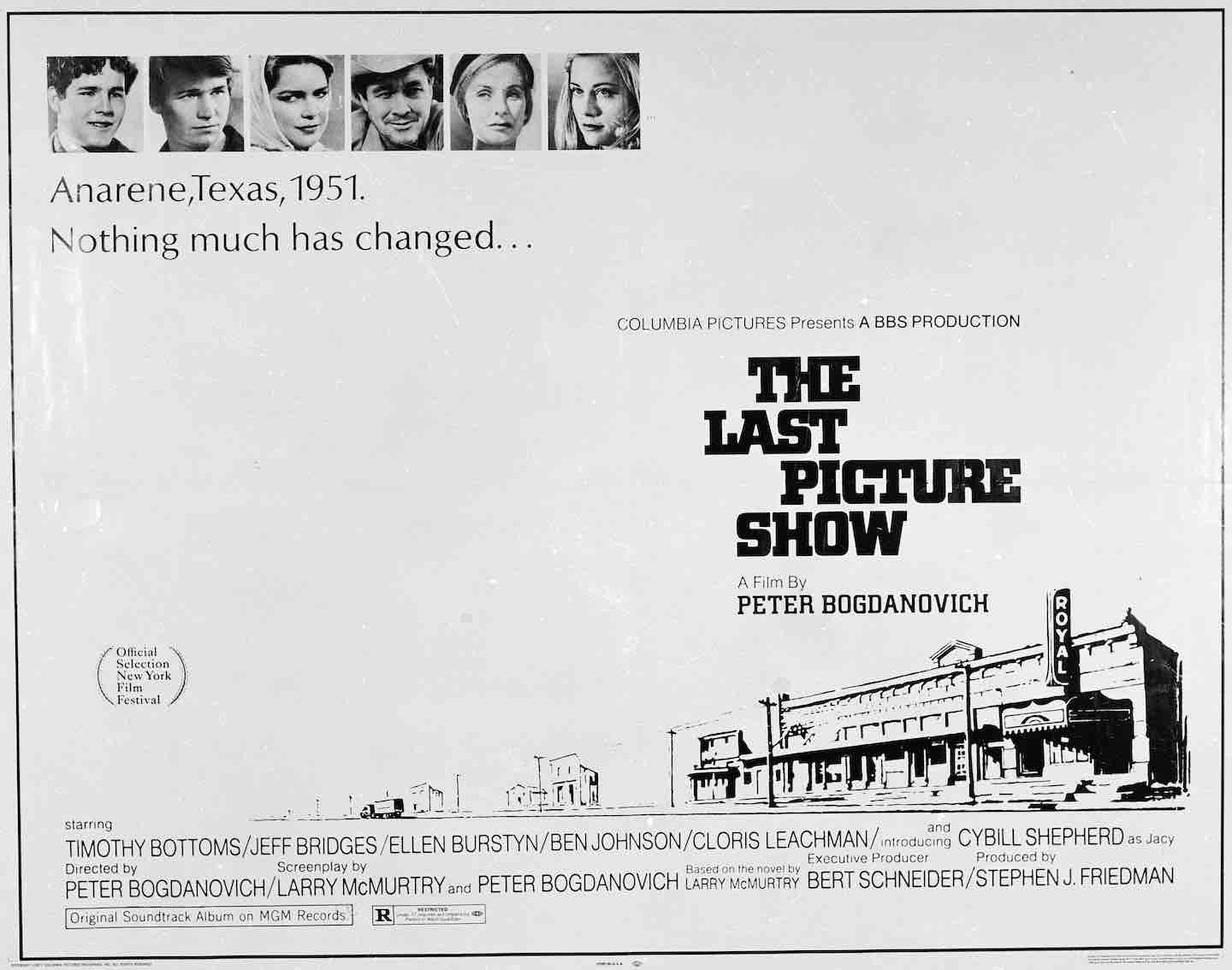
In his first novel, Horseman, Pass By (1961), McMurtry’s too-late and aimless cowboy was Hud, a borderline sociopath, rapist, and gunfighter with no true enemy who resorts in the end to killing his family and exchanging his horse for a shiny Cadillac. In Leaving Cheyenne (1963), his answer was Adam Fry, a rancher so hardworking and devoted to the land that once his body begins to fail him, he shoots himself in the head because he cannot imagine a life not on a horse or mending fences. McMurtry’s third answer to his question was The Last Picture Show (1966), a novel that scandalized its readers when it was first published. Here, an entire town compensates for its empty, dead-end life—left behind by urban modernity and unable to return to its storied past—by having (mostly) meaningless sex. A group of young boys spends eight pages copulating with a blind heifer, while the lonely wife of a satanic gym teacher finds doomed comfort in a high-school boy’s naked embrace. There are no cowboys remaining in the town of Thalia, a place now drained of dreams and talent and purpose since that era ended, and as enterprising young people began pursuing their ambitions in cities. So when the titular picture show finally shuts down, no one save the protagonist, Sonny, cares. Life, and society, have passed all of Thalia’s people by. Unlike the myths of the West, and of the cowboy, McMurtry’s stories were not something to take comfort in.
Hollywood saw something different. For producers and directors, McMurtry’s novels were promising source material for movies that would reinscribe the very myths that he had sought to undo.
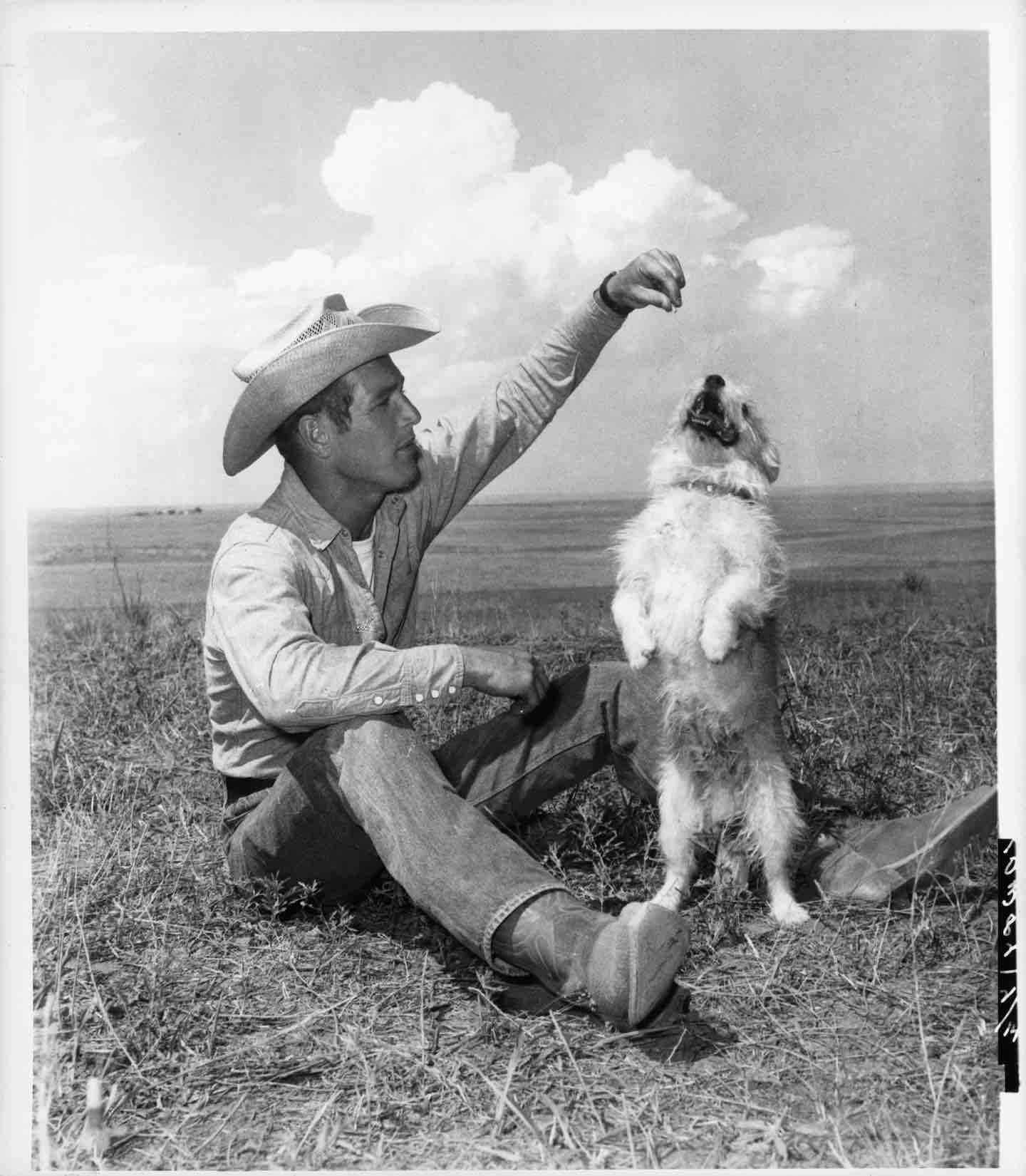
In the long history of inventing and selling the illusion of the West, the Hollywood western was the 20th-century boon that grew out of pulp fiction and the live showmanship of “Buffalo Bill’s Wild West.” It was not a genre responsible to history—to the messy, violent facts of the West’s settling—but a genre responsible to invented or borrowed traditions. So as Horseman, Pass By made its way from hardcover to the silver screen, the 1963 film adaptation starring Paul Newman turned into a much friendlier, even feel-good version of the book. The film’s producers replaced the novel’s original title, a reference to Yeats, with Hud (the producers didn’t bite at McMurtry’s inspired suggestion: Coitus on Horseback). They whitewashed the complex racial and gendered dynamics of McMurtry’s novel by turning an important Black character, a family housekeeper named Halmea, into the white Alma. And they morphed the Hud of Horseman into a brooding, redeemable hero, his violence tempered and given an acceptable, romantic orientation. It was a sign that, as much as a bold and original writer might try to disentangle its myths, the West’s great advertisers were not so willing to let their versions go.
The film crew on the set of Hud continually showed its ignorance of matters Texan, Western, and farm-related. In one scene, what was supposed to be a dead heifer was clearly a steer, as McMurtry pointed out to a crewmember on a visit to the set. “In essence, it’s a cow,” the man responded, shrugging. Later, when Newman was about to operate a heavy cow chute—difficult even for expert hands—and would have likely broken his jaw, McMurtry intervened. Yet the actual cowboys on the set—local boys hired to be extras and stand-ins for dangerous stunts—were having a great deal of fun. As McMurtry wrote: “It is not every day that cowboys get the chance to assist in creating an illusion about themselves.”
McMurtry knew well the commercial limitations of the Hollywood western. In his letters to Ken Kesey, he insulted Hud’s scriptwriters and director and lamented where they were taking his novel. For McMurtry, westerns were at best used to “disengag[e] myself from life.” He often expressed a dislike for moviemaking and claimed once in a 1983 article that he hadn’t watched a film over the past decade unless he’d been forced to. McMurtry didn’t enjoy the art form or even feign a respect for it. But after Hud’s success, he began to have a greater hand in the process, adapting his own novels into screenplays or else writing original scripts.
Why? Despite the constraints, perhaps McMurtry could instinctively see that westerns were not devoid of quality or the potential for real artistry. And his Hollywood westerns were just that: subtle and ambitious films that examined the West in novel ways. Peter Bogdanovich’s adaptation of The Last Picture Show (1971), cowritten by McMurtry, was a masterpiece in its own right, considered one of the best westerns in the history of the genre. While it softened the most scandalous elements of the original, the film maintained the essential thrust of the novel and remains a sensitive study of a Texas ghost town left behind by the modern world. McMurtry, in other words, was far from betraying his principles by writing films—in fact, he brought his discerning and critical attitude to each of his projects. His best-remembered work is his script (written with Diana Ossana) for Brokeback Mountain (2005), adapted from an Annie Proulx story of the same name. The Ang Lee–directed film, which follows the romantic and sexual awakening of two cowboys herding sheep in Wyoming, did more than any other western to challenge the genre’s fantasies of manhood and masculinity. The two men’s tragedy was a comment, precisely, on the smothering pathological constraints that western cultural narratives put on the people who inhabited the West. Even McMurtry’s greatest work, Lonesome Dove (1985), originated as a screenplay written by him and Bogdanovich, a project that had fallen apart when John Wayne refused to do it.
Hollywood’s mythmaking machine was many things for McMurtry—a pain in the arse, an imperfect creative outlet, a curiosity, and, most importantly, a paycheck. He thought of himself, first and foremost, as a novelist and not a screenwriter. Yet one has to consider whether McMurtry’s films, more than his novels, have had a longer-lasting impact on popular culture, even if people have no idea he wrote those films. The question Streitfeld’s biography seems to orbit, then, is one about the connective tissue between the two mediums: how each of them informed the other and how, ultimately, the novel’s form was where McMurtry could best express his artistic and intellectual ideas.
As McMurtry developed his working relationship with Hollywood, he would continue to chronicle contemporary Texas society on the page: the death of the cowboy, the oil boom, the modern rodeo, even the strife of moviemaking. In each of these modern settings—Houston, Dallas, Hollywood—he proceeded with the same wit, irony, honesty, and humor with which he had approached his early novels. And he excoriated those writers who weren’t doing the same. In an infamous 1981 article for the Texas Observer, “Ever a Bridegroom,” McMurtry shellacked the continued thinness of modern Texas letters. He urged the state’s writers to finally move on from the tall tales of westerns and to face the fact that most of Texas’s people were no longer cowboys or frontiersmen; most were now city people, inured to urban life. He hadn’t written about the Texan countryside since 1968—and even when he had, he’d done so only to undo the mythmaking. Like the authors of the dime-store novels of an earlier time, his fellow Texas writers, he wrote, were not examining the West; they were selling it.
McMurtry neglected to mention that, at the time, he was writing an 800-page novel about two retired Texas Rangers making a cattle drive in 1876. It was exactly the subject matter—old, mythic Texas—that he had dismissed, and it opened him up to accusations of hypocrisy. But McMurtry protested. “I never said the past wasn’t worth writing about,” he later clarified. “What I said is that it’s not worth writing badly about.” The past would always be relevant—but in order to be approached, it had to be stripped of its romance, its asphyxiating myths. And that is how McMurtry approached his subject in Lonesome Dove.
The myth that held Texas and the West in the tightest of strangleholds was the idea that its settling, or its “winning,” was a triumphant and heroic endeavor, completed by glorious, dignified, stoic men. The likes of Kit Carson and George Armstrong Custer and Leander McNelly had civilized the “savage” Native Americans and Mexicans or else had settled quietly in a country of absolute emptiness. They were brilliant and brave, and their methods, if occasionally ruthless, were necessary. They found their apotheotic expression in John Wayne.
Popular
“swipe left below to view more authors”Swipe →
Lonesome Dove refuses to indulge in the romance of heroism or its characters’ intentions. Instead, the novel follows a set of people who could hardly be called heroes at all, caught up in historical circumstances they hardly understand. At the novel’s center are two retired Rangers: Augustus (“Gus”) McCrae, a womanizing drunkard who often boasts of his nonexistent Latin skills, and Woodrow Call, a man so stoic and unbending that, even in his self-seriousness, he presents as parody. Then there’s a local pianist named Lippy—so named for a lower lip “about the size of the flap on a saddlebag”—who has a hole in his stomach that won’t quite heal; a couple of young Irish boys who barely know how to ride a horse; the town prostitute, Lorena; and, finally, two blue pigs. This is the humble, motley crew that make their way from a backwater town close to the Rio Grande all the way up to Montana, where they intend to start a cattle ranch, the terminal destination of this non-hero’s journey.
There is almost nothing about the cattle drive that is valiant, nothing that could even be called intentional. Call, who had the idea for a cattle drive in the first place, hardly knows why they’re going to all this trouble. As soon as they set off, he is struck by an “odd, confused feeling at the thought of what they had undertaken. He had quickly convinced himself it was necessary, this drive.” But “a cattle drive, for all its difficulty, wasn’t so imperative.” Gus repeatedly harangues him on this point: “Here you’ve brought these cattle all this way,” he chides his partner, “with all this inconvenience to me and everybody else, and you don’t have no reason in this world to be doing it.”
And while this haphazard pilgrimage is marked by extreme violence, that violence is not undergirded by passion or justice; rather, it’s ubiquitous, random, and depraved. The group gets caught in sandstorms and hailstorms; they nearly freeze to death, brawl in bars, and die one by one in freak accidents or out of carelessness. And as for that untouchable, sacrilegious question—whether the violent “winning” of the West was even worth it—Gus isn’t sure. Thinking back to their genocidal days as Texas Rangers, fighting off Native resistance and Mexican bandits, he says to Call: “Does it ever occur to you that everything we done was probably a mistake?… We killed off most of the people that made this country interesting to begin with.” Call answers him with silence.
If not heroism, then what? Across Lonesome Dove—and, later, the entire Lonesome Dove tetralogy—the characters’ expeditions are filled not with heroics but high jinks: Drunk Rangers are desperate for “pokes” with prostitutes; a Harvard professor turned Texas Ranger captain sings Italian operas while hanging off a cliff in a metal cage deep in the Sierra Perdida; varmints break into a fallen Ranger’s coffin and run off with his amputated leg. (“We’ve mostly kept him,” the doctor says. “I had him repacked.”) This is McMurtry’s masterfully invented West: parodied, ironic, macabre, barbarous. His aim is not to show the West as it really was but to make it suddenly strange and unfamiliar for readers. This is not John Wayne’s West, or Billy the Kid’s. It is something better—startlingly honest.
The day before McMurtry heard the news that he’d won the 1986 Pulitzer Prize for Lonesome Dove, he had arrived at a hotel in Uvalde, Texas, for a literary festival. The marquee had been prepared for his arrival: “Welcome Larry McMurtry, author of Terms of Endearment.” A day later, when McMurtry headed outside to speak with the press in a hastily arranged press conference, he glanced back at the marquee and saw that it had already been changed: “Lunch Special, Catfish: $3.95.” Streitfeld reveals that this story was mostly fiction, as were many of the tales McMurtry told about his life. The biography luxuriates in these moments of tension. Readers learn that the story of McMurtry’s bookless upbringing is itself wound in fiction, and that the author’s bio on the back of his books stretched the truth as well in order to create a certain myth of McMurtry himself: For years, while he lived in Tucson, his books claimed that he had never left Archer City, the little town that his grandfather William Jefferson had traveled to, the place where he had built a shotgun house with his bare hands. To test an assertion that McMurtry casually made in The New York Review of Books in 1999—that he had “Sioux blood through my paternal grandmother”—Streitfeld even did a DNA test on McMurtry’s brother Charlie and found that this, too, had only been family lore.
“Larry’s life often imitated his fiction and his fiction was inspired by his life,” Streitfeld writes. When McMurtry’s health began to fail him, he told his doctors that each time he stood up, he felt like he was “rising like a balloon”—an image he took from his own novel, Somebody’s Darling (1978). And in the days leading up to his death in 2021, McMurtry told his writing partner Diana Ossana: “Even if I die in Tucson, let’s just say I died in Texas.” When The New York Times called following his death, that’s just what Ossana said, and the “error” remained uncorrected for six months. But if he couldn’t die in Texas, McMurtry could at least be buried there. Like Gus McCrae, making a deathbed wish to be hauled out of Montana and buried back in Texas, so too were McMurtry’s ashes taken from Tucson and buried in his family plot in Archer City.
It is moving to learn that McMurtry, like Texas, was inextricable from his fables—that he could be both a fierce and ambivalent observer of the West while also being an honest-to-goodness part of it. McMurtry knew better than any other Texas writer that most Americans, himself included, could not resist the allure of the illusion of the West. Five years after his death, the illusion remains as popular as ever: Cowboy and cowgirl boots clack along the streets of New York City and Los Angeles; country music is no longer a regional or even a national genre but a global one; Hollywood producers churn out films and television shows featuring noble oilmen and rugged gunslingers; and those same producers continue to mine McMurtry’s catalog for silver-screen fodder (Lonesome Dove in particular). All of this is evidence, perhaps, that too many of us have failed to learn the lessons that McMurtry so diligently taught.
McMurtry knew the gravity of not learning those lessons well enough, and that they were not confined to questions of costume or culture. In April 2010, Arizona’s then-governor, Jan Brewer, signed into law a brutally hostile anti-immigration bill. McMurtry, in an essay for The New York Review of Books, recounted discussions with his neighbors in which he reminded them that “we Anglos are the real illegals here. After all we stole Arizona, along with the rest of the southwest, in 1848, when the Treaty of Guadalupe Hidalgo was signed in Texas. The ‘brown ones,’ as George H.W. Bush once referred to his half-Hispanic grandchildren, have obviously the better right to Arizona.” The problem that Senate Bill 1070 sought to solve was a problem of the Anglos’ making, McMurtry insisted, when they barged in with lawless and genocidal intentions and drew a border line where “for numberless centuries no line had been.”
These are not radical assertions. For McMurtry, they were simply the facts of the country’s founding—facts that had inexorably led its people “to the tragic place where we are now,” facts that we struggled to accept in 1848, in 2010, and still struggle with today in 2026. Our myths are far from dead, and they may never die. But McMurtry’s greatest gift was to see his country and its history plain, and to teach his readers how to do the same—to add, time and again, that proverbial, clarifying footnote.
More from The Nation
“Monuments” an exhibition in Los Angeles, interrogates the changing meanings of Civil War-era statues and their ability to shape historical narrative.
Books & the Arts
/
Pujan Karambeigi
A conversation with Molly Crabapple about “Here Where We Live Is Our Country,” her history of Bundism, and what we can learn from their socialist and anti-Zionist example.
Books & the Arts
/
Ishan Desai-Geller

The Ellison family, poised to continue dominating the media landscape with its Warner deal, signs on an infomercial-grade comic to replace Stephen Colbert.
Ben Schwartz
His most experimental and unsettling book, Transcription as us whether art is futile or the most important weapon we have.
Books & the Arts
/
Tara K. Menon


