Saturn’s chaotic atmosphere revealed in most comprehensive view yet by James Webb and Hubble telescopes


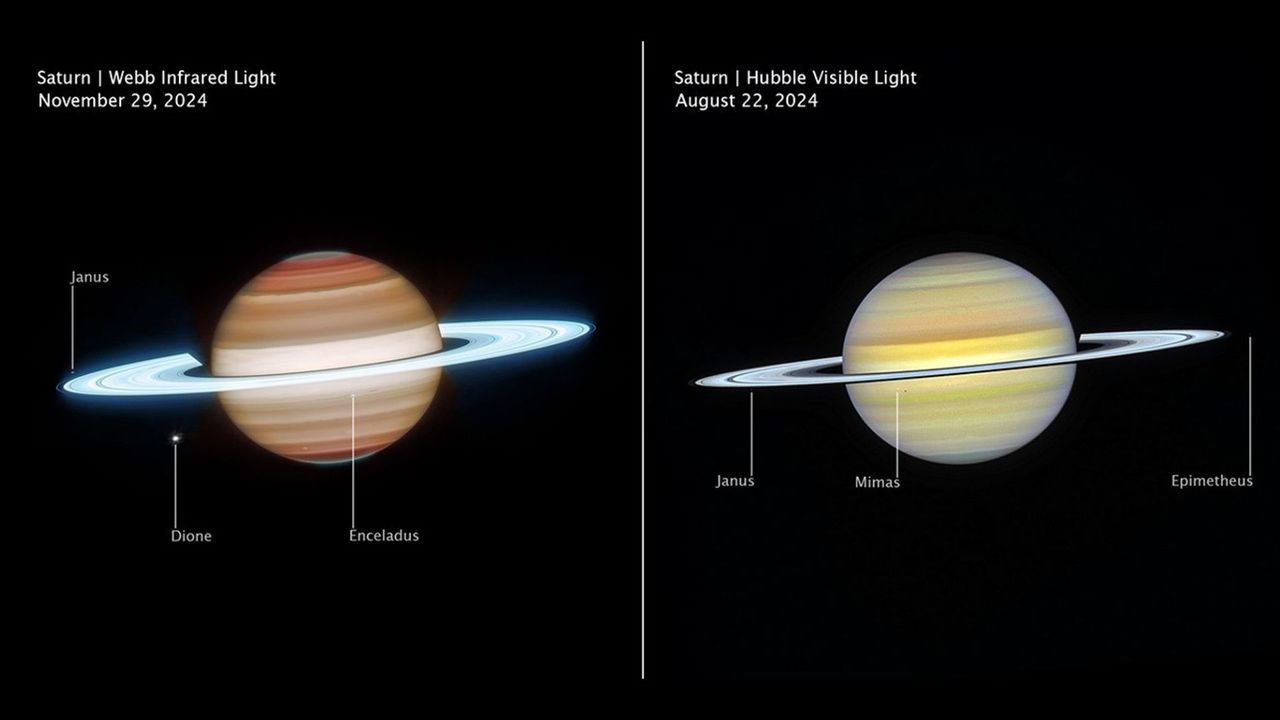
Saturn may be famous for its rings, but it has long fascinated scientists for another reason: its turbulent atmospherewhich is shaped by violent winds, stubborn megastorms and strange weather conditions that can persist for years.
Today, two new views from the James Webb and Hubble space telescopes peer through the ringed planet’s clouds, giving researchers what NASA calls “the most comprehensive view of Saturn to this day. » Together, the images allow researchers to “slice” Saturn’s atmosphere at different heights.
Article continues below
Studying Saturn’s atmosphere not only allows scientists to understand how large storms develop and develop, but also provides deeper insight into how the planet formed and evolved over billions of years.
A planet seen in two ways
In August 2024, Hubble took an image of Saturn in visible light as part of the Outer Planet Atmospheres Legacy program, a decade-long project that tracks the outer planets each year. THE James Webb Space Telescope (JWST) captured its infrared image a few months later, in November 2024. These observations, taken 14 weeks apart, showed the ringed planet moving from the northern summer toward its 2025 equinox.
The two telescopes saw very different Saturns.
While Hubble captured Saturn’s pale yellow bands and bright white rings, JWST’s infrared image revealed even more striking details. In the infrared view, Saturn’s rings turned bright blue “because they are made of highly reflective water ice,” NASA officials said in a statement. a declaration. Saturn’s poles also glowed a strange gray-green, emitting light at wavelengths of about 4.3 microns. These emissions could come either from light scattering by high-altitude aerosols or from the aurora borealis, NASA suggested. (The telescope recently captured giant auroras shining on Uranus.)
As Saturn tilts toward its southern spring, the two space telescopes will continue to keep eyes on its atmosphere, perhaps revealing more details about the planet’s weather dynamics. In the meantime, Saturn keeps some of its most interesting secrets hidden in the clouds.
Solar system quiz: How well do you know our cosmic neighborhood?
See how well you know the planets of our solar system with our quiz!


