
NEWYou can now listen to Fox News articles!
U.S. Education Secretary Linda McMahon responded to San Jose State University (SJSU) and the California State University (CSU) system after the institutions sued the federal government to challenge the findings of a federal Title IX investigation.
SJSU and CSU announced their lawsuit Friday after the Department of Education determined SJSU violated Title IX in its handling of a transgender volleyball player from 2022-24.
Now, McMahon is giving the institutions a deadline of 10 days to come to an agreement or risk federal funding cuts and a referral to the U.S. Department of Justice.
CLICK HERE FOR MORE SPORTS COVERAGE ON FOXNEWS.COM
“Protecting women’s sports is nonnegotiable. After we found SJSU in violation of Title IX, they refused to negotiate a resolution. SJSU, you have ten days to cease your discriminatory practices,” McMahon wrote on X Wednesday.
McMahon’s post included a letter sent to SJSU President Cynthia Teniente-Matson from ED’s Office of Civil Rights (OCR).
“Based on the recipient’s proactive refusal to voluntarily negotiate resolution of OCR’s concerns, OCR has determined that a voluntary agreement will not be reached and we are at impasse. OCR will issue a Letter of Impending Enforcement Action in 10 calendar days if a resolution agreement is not reached within that 10-day period,” the letter said.
“Enforcement action may include the initiation of an administrative process set forth in 20 U.S.C. § 1681, et seq.; 34 C.F.R. Parts 100, 101, 106; and 20 U.S.C. § 1234, et seq. to suspend, terminate, or refuse to grant or to continue Federal funding — or other means authorized by law, including referral to the Department of Justice. This letter does not constitute final agency action.”
Fox News Digital has reached out to SJSU and CSU for a response.
Teniente-Matson previously announced that the university would not agree to the Education Department’s proposed resolution agreement.
“Because we believe OCR’s findings aren’t grounded in the facts or the law, SJSU and the CSU filed a lawsuit today against the federal government to challenge those findings and prevent the federal government from taking punitive action against the university, including the potential withholding of critical federal funding,” Teniente-Matson said Friday.
“This is not a step we take lightly. However, we have a responsibility to defend the integrity of our institution and the rule of law, while ensuring that every member of our community is treated fairly and in accordance with the law. Our position is simple: We have followed the law and cannot be punished for doing so.”
‘HORRIBLE’ MOMENTS EXPOSED FOR UNR VOLLEYBALL PLAYERS WHEN THEY WERE ROPED INTO THE SJSU TITLE IX SCANDAL
Teniente-Matson affirmed the university’s commitment to defending the LGBTQ community in the announcement.
“Our support for the LGBTQ members of our community, who have experienced threats and harms over the last several years, remains unwavering. We know the attention the university has received around this issue and the investigative process that followed have been unsettling for many in our community,” she said. “We’ve heard the fear and anxiety that it has created and recognize that waiting for the university’s response has been difficult at a time already filled with uncertainty.”
The university and its volleyball program was thrust into the national spotlight in 2024 after it was revealed the team rostered trans athlete Blaire Fleming since 2022. Former SJSU co-captain Brooke Slusser joined a lawsuit and led her own, alleging she was never told Fleming was a biological male when she joined the team and shared bedrooms and changing spaces with Fleming without that knowledge.
Among the department’s findings, it determined that a female athlete discovered that the trans student allegedly conspired to have a member of an opposing team spike her in the face during a match. The department claims “SJSU did not investigate the conspiracy, but later subjected the female athlete to a Title IX complaint for ‘misgendering’ the male athlete in online videos and interviews.”
CLICK HERE TO DOWNLOAD THE FOX NEWS APP
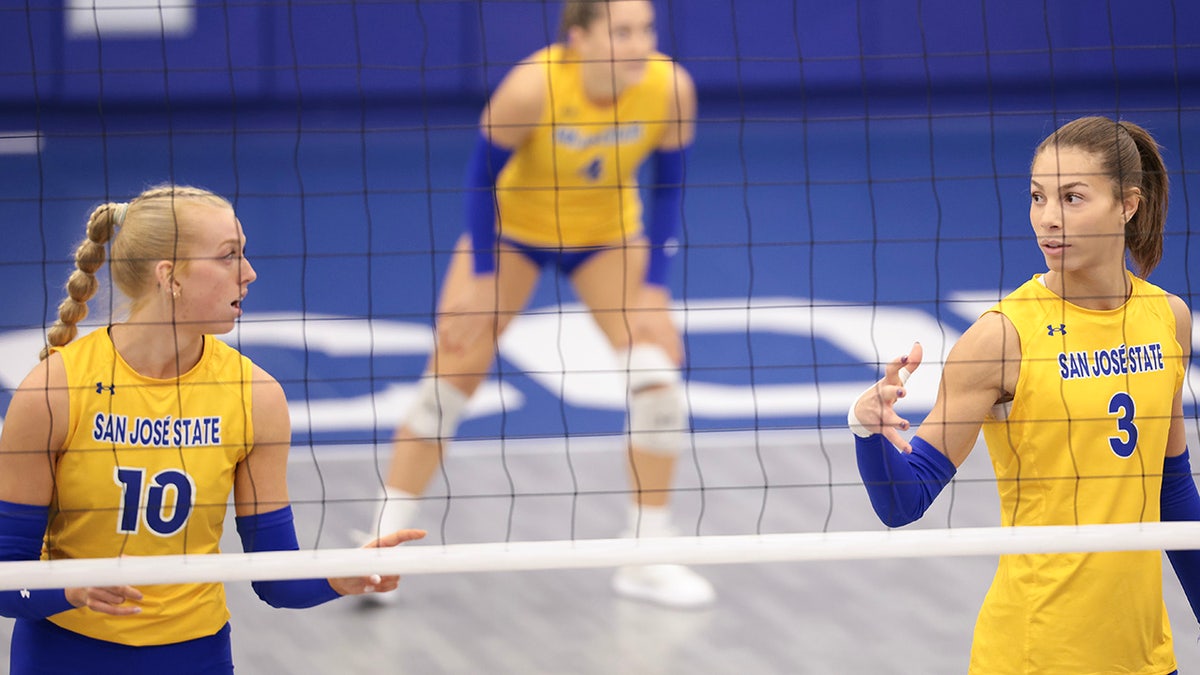
Brooke Slusser #10 and Blaire Fleming #3 of the San Jose State Spartans call a play during the first set against the Air Force Falcons at Falcon Court at East Gym on Oct. 19, 2024, in Colorado Springs, Colorado. (Andrew Wevers/Getty Images)
Slusser alleged in her November 2024 lawsuit against the Mountain West that she and former assistant coach Melissa Batie-Smoose were made aware of a meeting between Fleming and a Colorado State women’s volleyball player on Oct. 2, 2024, during which Fleming discussed a plan with Jones to have Slusser spiked in the face during a match the following night.
Slusser has since become a figure of viral controversy after an interview with Fox News Digital in which she revealed what it was like living with Fleming in the same apartment.
Follow Fox News Digital’s sports coverage on X, and subscribe to the Fox News Sports Huddle newsletter.


:max_bytes(150000):strip_icc()/Health-GettyImages-2203057908-cfe2fbf23ece4562af330d92447ce467.jpg?w=390&resize=390,220&ssl=1 "Blood Sugar Spikes After Meals May Raise the Risk of Alzheimer’s Disease")


:max_bytes(150000):strip_icc()/Health-tomato-sauce-recall-cd06a91b56e84372b8ad37fc90987982.png?w=390&resize=390,220&ssl=1 "FDA Announces Tomato Sauce Recall Over Possible Botulism Risk")
