A lock of hair may have just changed what we know about life in the Incan Empire : NPR


A cotton and a fiber of agave Inca kHipu are seen during an exhibition at the Smithsonian National Museum of the American Indian in 2015 in Washington, DC
Brendan Smialowski / AFP via Getty Images
hide
tilting legend
Brendan Smialowski / AFP via Getty Images
The Inca Empire in South America, one of the most powerful pre -Columbian companies, was known for many innovations – such as Machu Picchu’s architecture, a large road network and a system of terraces for agriculture. The most unique, however, was perhaps the method of the company of registers known as Khipu, which involves a nodes system to code the information.
It has long been supposed that Khipu’s production was the field of the ruling elites of this civilization, but a new analysis of a cord made from human hair notes that even low-class commoners may have engaged in this tradition.
Discovery can help researchers rewrite their understanding of this aspect of Inca civilization and propel more scientists to test other khipus seated in museum collections.

“The Incas had the largest empire in the new world at the time. He covered half a continent, roughly,” said Sabine Hyland, researcher at the University of St. Andrews in Scotland, who underlines that this massive empire of millions of people was fully understood on the strings tied to keep registers.
The Inca Empire is often quoted as the rare exception to the general rule according to which empires must have a form of written expression, explains Kit Lee, a research partner at university, but it is only because “Khipus is neglected as a form of writing”.
These unusual recording devices are clusters of nodes attached in long colored cords. As a rule, the cords hang like the pendants of a thick primary. The Inca Empire was won over by the Spanish in 1532, and only a small percentage of former Khipus survived.
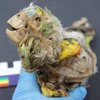
Recently, however, the University of Hyland acquired a Khipu, and the dating to the radiocarbon indicated that it was 1498. Hyland initially assumed that it was made of animal hair like llamas or alpacas.
But then she showed it in Lee. “Kit looked at me and said to me:” Sabine, this primary cord is human hair “”, remembers Hyland.

The dark brown primary cord of this khipu is made of human hair.
Sabine Hyland
hide
tilting legend
Sabine Hyland
The researchers knew that historically, the incorporation of hair could serve as a signature which indicated who had made the Khipu. And that meant that they had an unusual opportunity to know more about the creator of a historic Khipu.
The hair of it is about three feet long and represent years of growth. The researchers removed samples at each end of a strand and have made a laboratory analysis of elements such as carbon and nitrogen, to obtain clues on what this person had to eat during his life.
In the newspaper Scientific advancesThey and their colleagues report that the hair came from someone who was eating legumes, cereals and tubers. They did not see any evidence of an abundance of meat or corn beer, the typical ruling class.
If it is possible that a senior official can choose not to eat meat for any reason, says Hyland, it is unlikely that they can get out of it without drinking a lot of corn beer. “It is not really possible to escape from drinking it,” said Hyland. “Even today, in the Andes, when you participate in rituals, you need to drink what you are given.”

This capillary analysis adds another evidence to the growing belief that the production and literacy of Khipu could have been more widespread in the Inca empire than the Spanish colonizers supposed and recorded in their accounts.
This suggests a relationship between the Khipus of the Incan Empire and Khipus more modern made from 1800s to today, explains Lee.
“Modern Khipus tend to be manufactured by people from the lower statutes – Hacienda workers, peasant workers, breeders,” said Lee, explaining that modern khipus tend to have a different shape and structure of the old. Some modern khipus code agricultural files, while others are buried with dear beings in funeral rites.

“It was quite controversial to attract this continuity between Inca Khipus and Modern Khipus, partly because of the perception that the Inca Khipus were made by the elites,” said Lee.
Manny Medrano, Khipu researcher at Harvard University who was not part of this study, says that this study is “unprecedented” in the way she analyzed the hair.
While specialists have long noticed human hair in Khipus, he says, he is the only one in the Inca era where he knows who has the primary cord entirely made of human hair. “The main cord is really important in Khipus,” said Medrano.
Museums hold hundreds of khipus who have never been studied by specialists, he says, and this study is likely to inspire a new look at those who have been examined before.
“I would not be surprised if we found other khipus with substantial quantities of human hair in the future,” he said, and the hair could provide a way to understand the production of Khipu in the Inca Empire which is distinct from the stories written by the colonizers, who may not have fully understood what was going on.
“In the end, it brings us closer to being able to talk about Inca stories using Inca sources,” said Medrano. “We must tell a story of literacy and writing and holding files in the Inca Empire which is much more plural, which includes people who have not been included in the standard story.”


