Scientists Create 3.3 Trillion Degree Particle Soup to Mimic the Universe Just after the Big Bang


November 15, 2025
2 min reading
Scientists measure the temperature of the Universe just after the Big Bang
Quark-gluon plasma, a bizarre state of matter that mimics the early cosmos, is the hottest thing ever created on Earth
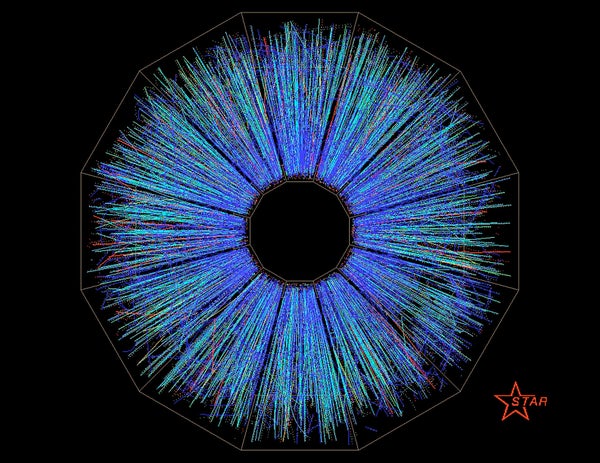
Image of two gold beams colliding at near the speed of light on June 14, 2000. The collision took place at the Relativistic Heavy Ion Collider (RHIC) operated by Brookhaven National Lab in Brookhaven, New York.
Over the past quarter century, scientists using a particle collider on Long Island have smashed the nuclei of gold atoms at near the speed of light to create the hottest matter ever created on Earth. The particle soup created by the collision mimics the universe as it was just after the big bang. For the first time, researchers have finally precisely measured the temperature of this material.
After the gold cores crushed, the protons and neutrons they contained melted into a bubbling cloud of quark-gluon plasma. This hell recreates conditions from the dawn of time, when the universe was too hot and too dense to form regular atoms, or even their ingredients such as protons and neutrons. Instead, the primordial cosmic soup would have been a blazing mix of fundamental particles called quarks, as well as gluons, which carry the powerful force that binds atomic nuclei together. “These are the building blocks of particles that make up the visible world, and we’re trying to understand how they work,” says physicist Zhangbu Xu of Brookhaven National Laboratory and Kent State University.
The experiment took place at the Relativistic Heavy Ion Collider (RHIC) at Brookhaven National Laboratory, within the STAR detector (Solenoidal Tracker at RHIC). There, the gold cores traveling in a 2.4-mile loop reach staggering speeds before colliding and disintegrating into quark-gluon plasma. Each primordial cloud lasts only a fraction of a second, producing many particles as it cools, including photons (particles of light) that decay into electron pairs and their antimatter counterparts, positrons.
On supporting science journalism
If you enjoy this article, please consider supporting our award-winning journalism by subscription. By purchasing a subscription, you are helping to ensure the future of impactful stories about the discoveries and ideas shaping our world today.

Physicists measured the mass ranges of these particle pairs to assess the energy of the photons that gave rise to them, which showed the temperature at which the photons were emitted. This revealed that the temperature reached an astonishing 3.3 trillion degrees Celsius (5.94 trillion degrees Fahrenheit), or about 220,000 times hotter than the sun’s core. The scientists reported their results in Natural communications.
Determining this temperature will help physicists understand when and how the fiery early universe went from plasma of quarks and gluons to the building blocks of atoms. These two states are different phases of matter, similar to the more familiar solid, liquid, and gas phases of everyday life. “We want to draw what might be called the most fundamental ‘phase diagram’ we know of,” says Frank Geurts of Rice University, a STAR spokesperson. “What could be more interesting than the phase diagram of the fundamental elements of the universe?”
The RHIC accelerator and its STAR experiment are in the final stages of final operation, having started 25 years ago. The machines will shut down in the coming months to make way for a larger facility called the Electron-Ion Collider, which is expected to open in the early 2030s. However, even after STAR closes, scientists will analyze its final batch of data over the next few years to further refine their measurement of this primeval cosmic fire.
It’s time to defend science
If you enjoyed this article, I would like to ask for your support. Scientific American has been defending science and industry for 180 years, and we are currently experiencing perhaps the most critical moment in these two centuries of history.
I was a Scientific American subscriber since the age of 12, and it helped shape the way I see the world. SciAm always educates and delights me, and inspires a sense of respect for our vast and magnificent universe. I hope this is the case for you too.
If you subscribe to Scientific Americanyou help ensure our coverage centers on meaningful research and discoveries; that we have the resources to account for decisions that threaten laboratories across the United States; and that we support budding and working scientists at a time when the value of science itself too often goes unrecognized.
In exchange, you receive essential information, captivating podcasts, brilliant infographics, newsletters not to be missed, unmissable videos, stimulating games and the best writings and reports from the scientific world. You can even offer a subscription to someone.
There has never been a more important time for us to stand up and show why science matters. I hope you will support us in this mission.


