Scientists Create First Antimatter Qubit


The very first QUBIT antimatter could help break the cosmic mysteries
The first antimatter qubit will help seek differences between material and antimatter

Sakkmesterke / Science Photo Library / Getty Images
Physicists have created a quantum bit, or qubit, the fundamental storage unit of a quantum computer, from the antimatter for the first time. The researchers used magnetic fields to trap a single antiproton – the antimatter version of the protons inside the atoms – and measured its spin changed the direction for almost a full minute. The results were published on July 23 in the journal Nature.
Quantum computers in antimatter qubits are still far and would be much more difficult to build than significant quantum computers, which is already extremely delicate. The feat is fascinating, however, because of such antimatter experiences could reveal on the universe itself.
The rotation of a particle can be in a “high” state or “down”, just like a computer bit can take a state of “0” or “1.” But when a classic bit is to be in one of the last two states, the rotation of the antiproton could be up, below or in any combination of the two at the same time. This fantastic capacity of qubits is what distinguishes them from conventional bits and promises that quantum computers will one day offer incredible improvements in speed and calculation capacity compared to today’s computers.
On the support of scientific journalism
If you appreciate this article, plan to support our award -winning journalism by subscription. By buying a subscription, you help to ensure the future of striking stories about discoveries and ideas that shape our world today.
Experience has demonstrated an unprecedented level of control over the antimatter, explains the physicist Vincenzo Vagnoni from the Italian National Institute of Nuclear Physics (INFN), which was not involved in the experience. “It is thanks to [the researchers’] Development of very effective antiproton magnetic traps, which can maintain antiprotons “alive” without destroying with material. While we are still far from the curvature engines of Star Trek Saga is the closest thing to them that has been developed on Earth so far, ”explains Vagnoni, referring to the Warp Drive engines of the science fiction franchise fed by the Antimatière.
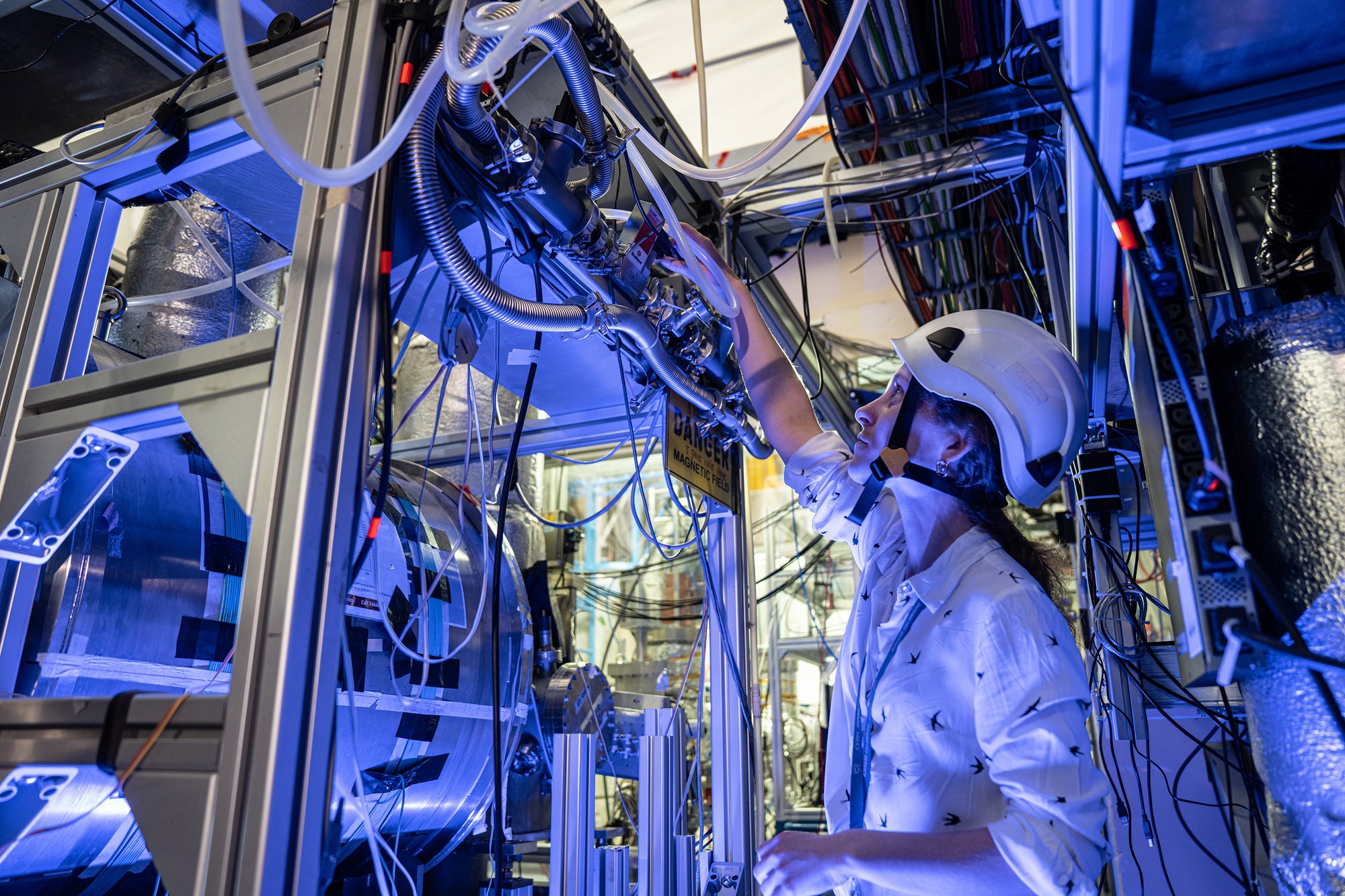
Physicist Barbara Latacz works on the basic experience, who compares the material to the antimatter.
By putting aside science fiction aspirations, the realization could help physicists to solve the mystery of the reason why the universe is dominated by matter and not antimatter – in other words, why the universe around us exists at all.
“If you just look at physics, there is absolutely no reason why there should be more material than antimatter,” explains Stefan Ulmer, physicist at CERN, the European laboratory for particles physics near Geneva and the spokesperson for his experience of antibary baryon symmetry (base). However, there is almost no antimatter in the cosmos, while the material is abundant. “The great motivation for these experiences is: we are looking for the reason why there could be an asymmetry of anti-antimatter matter,” explains Ulmer. A potential reason could be a difference between the proton and the antiproton in a property called magnetic moment.
Protons and antiprotons have an electrical load – the proton load is positive and that of antiproton is negative. These charges make particles act like small bar locks which point to different directions according to the orientation of their rotation. The strength and orientation of the magnet are called the magnetic moment of the particle. If it turns out that the magnetic moments of protons and antiprotons are not the same, this could explain why the material has conquered the antimatter in the universe.
Until now, the measures have not found any difference between the two to 1.5 parties in a billion. But scientists had never been able to measure the oscillation of the magnetic moment of unique protons or antiprotons – or any other fundamental particles. Similar previous experiences only measured the phenomenon in ions or charged atoms. “We can now have total control over the spin state of a particle,” explains the main author of the new study, Barbara Latacz, CERN and Riken Advanced Science Institute in Japan. “For fundamental physicists, this is a super exciting opportunity.” Researchers hope to use the technique to improve the precision of the magnetic moment measurement in protons and antiprotons by a factor of 25.
If they discover a difference or find another divergence between matter and antimatter, quantum antimatter computers could become valid, despite the difficulty. “If there is a surprise in the asymmetry of Antimatter, it could be interesting to make essentially the same calculations with quitting and antimatter qubits and comparing the results,” explains Ulmer, which is also based in Riken.