Scientists detect monster ‘coronal mass ejection’ from nearby star that could rip the atmosphere off a planet


A powerful explosion spotted by a dwarf star was powerful enough to destroy the atmosphere of any Earth-like planets that may have been hiding nearby, new research suggests.
The study, published Wednesday November 12 in the journal Naturewas the first to confirm a coronal mass ejection (CME) – a massive explosion of high-speed plasma – originating from a star other than the sun. As scientists search for habitable worlds, understanding the strength and frequency of star flares will be key to determining where to focus our search, the study authors say.
The star, called StKM 1-1262, is an M dwarf. Statistically, M dwarfs are smaller than the sun and much more active, meaning they send out more energy. solar flares and CMEs. M dwarves are nevertheless prime targets for searches for life, because they are common in our universe. It is also easier to spot the planets around these stars; Because M dwarfs are so small, planets tend to form much closer to them (and are therefore easier to detect) than those around larger stars like the Sun.
But there is a caveat: because M dwarves are more active and the “Goldilocks Zone“Where water could exist on a theoretical rocky planet, with the surface of a rocky planet being closer to the dimmer star than Earth is to the sun, any Earth 2.0 would likely be exposed to more CME than we experience with the Sun.
“One of the problems could be [that] “These CMEs occur so regularly and hit planets so regularly that they strip the atmosphere,” said the study’s lead author. Joe Callinghamradioastronomer at the Netherlands Institute for Radio Astronomy, told Live Science in an interview. “So, great, you’re in the Goldilocks zone, but you have no help here, because stellar activity has destroyed [the chances for life].”
A devastating storm
The researchers spotted the first burst of radio waves using the Low Frequency Array (LOFAR) radio telescope – a European array of antennas located mainly in the Netherlands – and were aided by new data processing methods developed by co-authors at the Paris Observatory. LOFAR is the most sensitive radio telescope ever built, Callingham noted, adding that the algorithms allowed researchers to “get lucky” in finding the small burst of light in the sky.
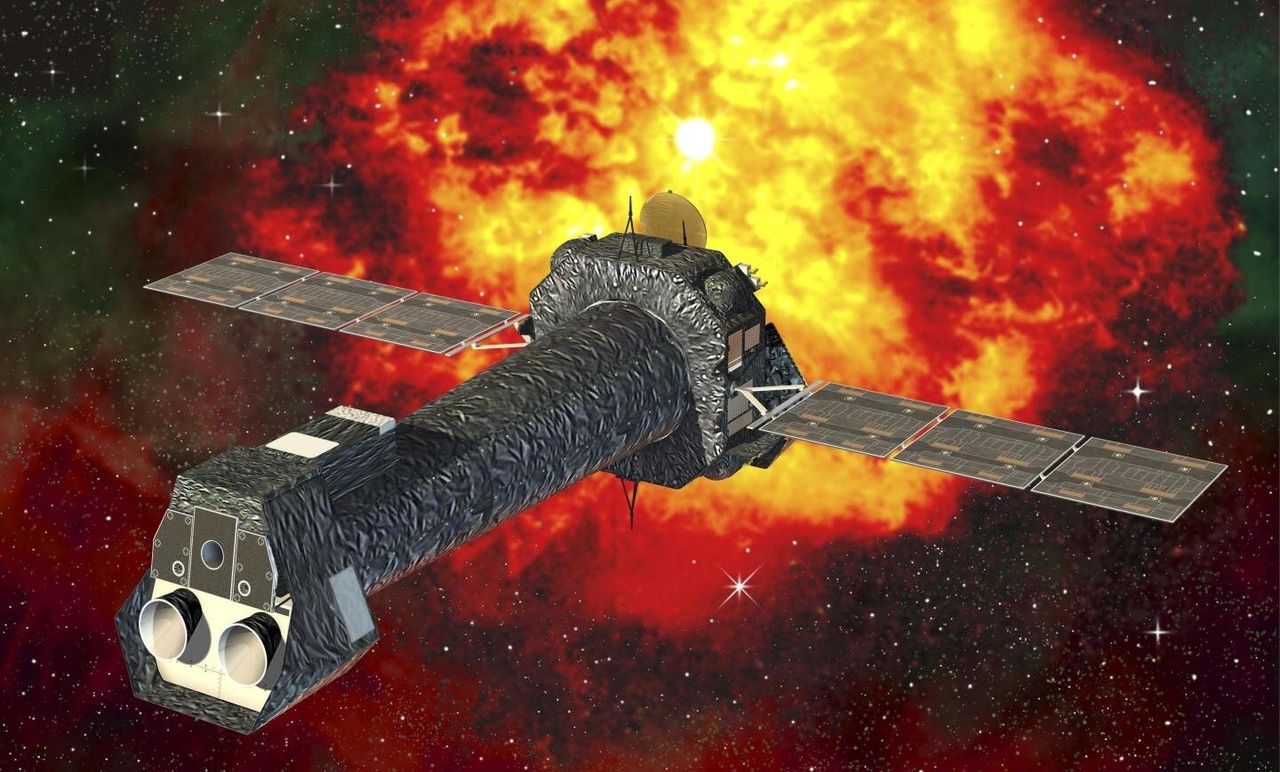
Follow-up observations with the European Space Agency’s XMM-Newton space telescope showed the star’s temperature, confirming it is an M dwarf, as well as its rotation (20 times faster than the sun) and its X-ray luminosity.
The rotation and brightness revealed the motion of the CME, which was moving at nearly 1,500 miles per second (2,400 kilometers per second) – a speed seen in only 5% of similar bursts occurring on the sun. The telescope’s combined observations also showed that the CME moves fast enough and with sufficient density to blow away the atmospheres of any planets orbiting close to the star.
Although LOFAR is powerful, Callingham said the challenge is that this observation (coupled with new data processing techniques) is approaching the telescope’s resolution limit. To see more extrasolar CMEs, the research team is looking forward to science operations at the Square Kilometer Array, a huge radio telescope project under construction in Australia and South Africa, in the 2030s.
Callingham said the Square Kilometer Array should be able to spot “dozens to hundreds” of extrasolar CMEs within the first year, which would allow the team to better map how often an atmospheric stripping hit would occur and how CMEs vary across star types.
“It’s so impactful,” he said of the research, “because we’re really trying, as astronomers, to find a habitable planet. … That’s one of the key goals of astronomy over the next decade, I hope. But maybe it will take longer, or maybe the rest of my life, to find Earth 2.0.”


