Scientists Identify ‘Astronomy’s Platypus’ with NASA’s Webb Telescope


After combing through NASA’s James Webb Space Telescope records of extragalactic cosmic fields, a small team of astronomers at the University of Missouri say they have identified a sample of galaxies with a combination of never-before-seen features. Lead researcher Haojing Yan likens this discovery to a strange, infamous phenomenon in another branch of science: the platypus defying the taxonomy of biology.
“It seems like we’ve identified a population of galaxies that we can’t categorize, they’re so strange. On the one hand, they’re extremely small and compact, like a point source, and yet we don’t see the characteristics of a quasar, an active supermassive black hole, which is what the most distant point sources are,” Yan said.
The research was presented at a news conference at the 247th meeting of the American Astronomical Society in Phoenix.
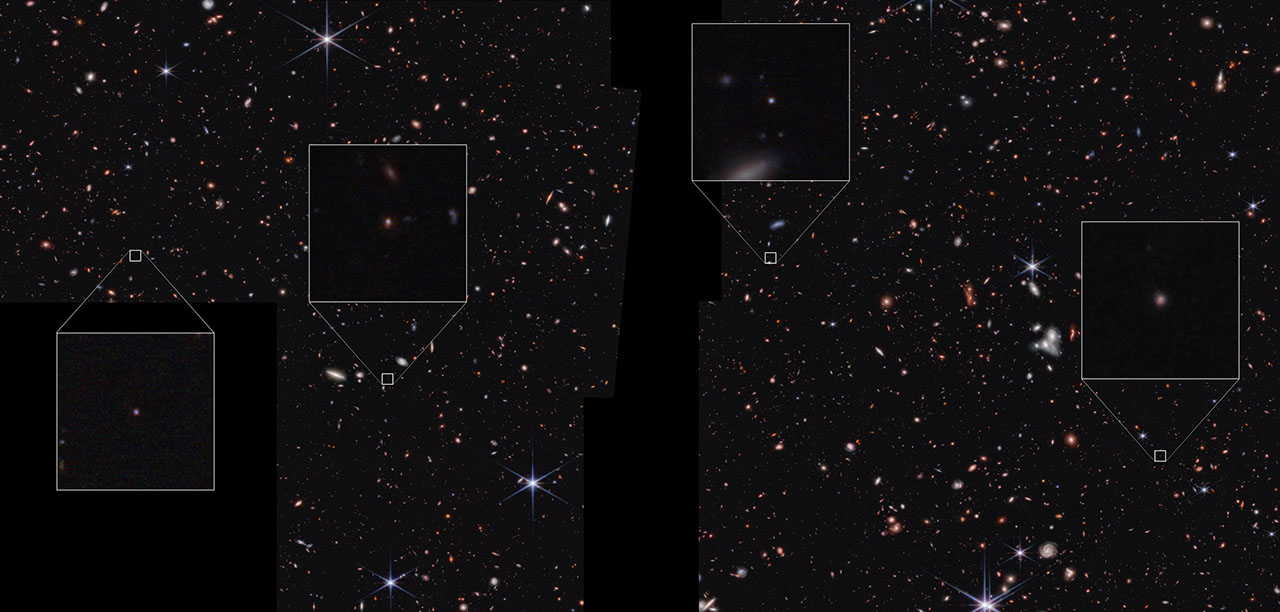
Four of the nine galaxies in the newly identified “platypus” sample were discovered as part of NASA’s James Webb Space Telescope’s Cosmic Evolution Early Release Science Survey (CEERS). A key feature that sets them apart is their pinpoint appearance, even for a telescope capable of capturing as much detail as Webb.
Image: NASA, ESA, CSA, Steve Finkelstein (UT Austin); Image processing: Alyssa Pagan (STScI)
“I looked at these features and thought it’s like looking at a platypus. You think these things shouldn’t exist together, but there they are, right in front of you, and it’s undeniable,” Yan said.
The team narrowed a sample of 2,000 sources across multiple Webb surveys to identify nine point sources that existed 12 to 12.6 billion years ago (relative to the age of the universe of 13.8 billion years). Spectral data provides astronomers with more information than they can get from a single image, and for these nine sources, it does not fit existing definitions. They are too distant to be stars in our own galaxy, and too faint to be quasars, which are so bright that they eclipse their host galaxies. Although the spectra resemble the less distant “green pea” galaxies discovered in 2009, the galaxies in this sample are much more compact.
“Like spectra, a platypus’s detailed genetic code provides additional information that shows how unusual the animal is, sharing genetic characteristics with birds, reptiles and mammals,” Yan said. “Together, the imaging and Webb spectra tell us that these galaxies exhibit an unexpected combination of features.”
Yan explained that for typical quasars, the peaks of their characteristic spectral emission lines look like hills, with a broad base, indicating the high speed of gas swirling around their supermassive black hole. Instead, the “platypus population” peaks are narrow and sharp, indicating slower gas movement.
Although there are narrow-line galaxies that host active supermassive black holes, they do not exhibit the point feature of the sample identified by Yan’s team.
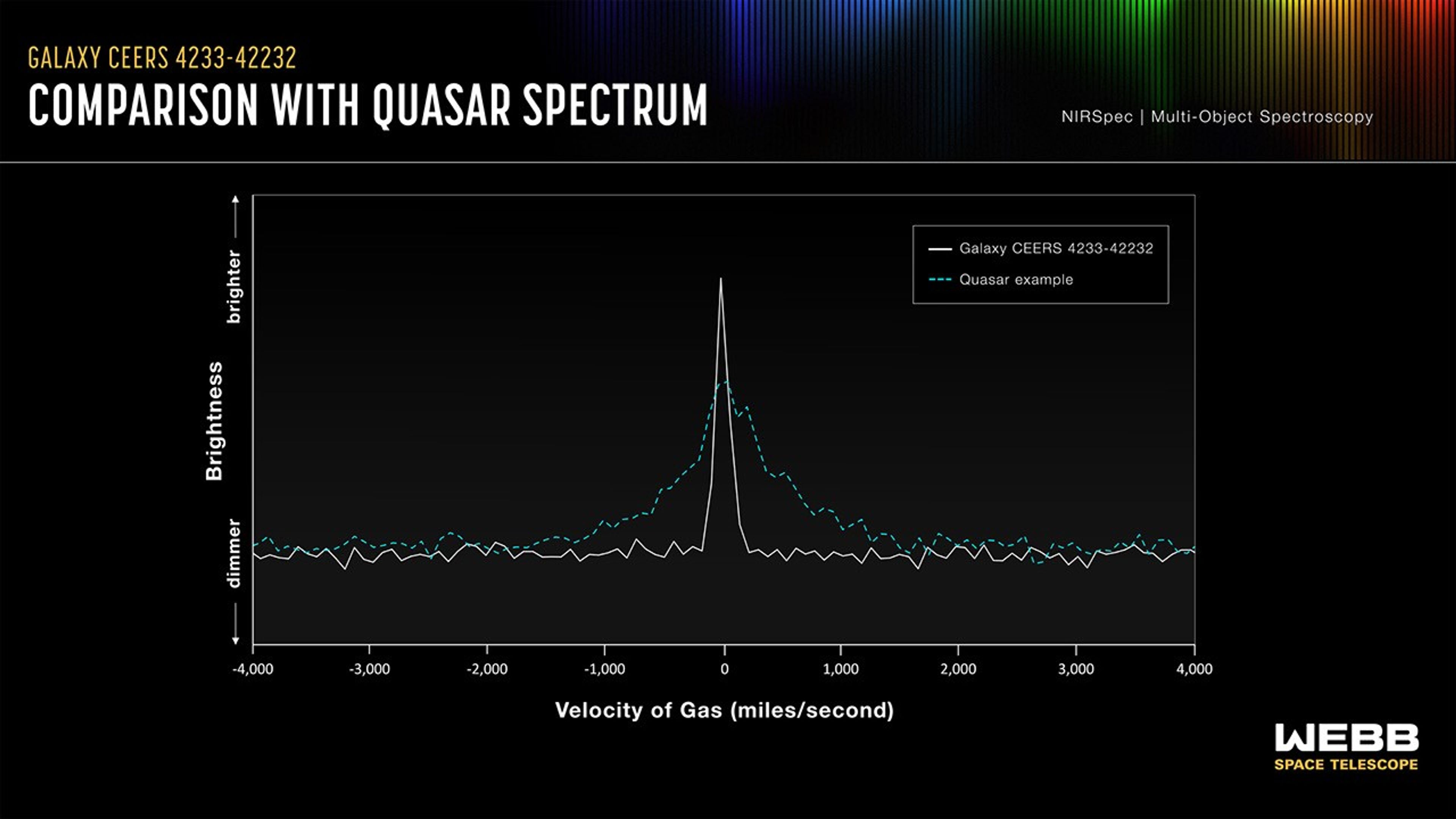
This graph illustrates the sharp, narrow peak in the spectrum that has caught the attention of researchers in a small sample of galaxies, represented here by the galaxy CEERS 4233-42232. Typically, distant point light sources are quasars, but quasar spectra have a much broader shape.
Illustration: NASA, ESA, CSA, Joseph Olmsted (STScI)
Has Yan’s team discovered a missing link in the cosmos? Once the team determined that the objects did not fit the definition of a quasar, graduate student researcher Bangzheng Sun analyzed the data to see if there were signatures of star-forming galaxies.
“Based on the low-resolution spectra we have, we cannot rule out the possibility that these nine objects are star-forming galaxies. These data match,” Sun said. “What’s strange about this is that the galaxies are so small and compact, even though Webb has the resolving power to show us a lot of detail at this distance.”
One proposal suggested by the team is that Webb, as promised, reveals earlier stages of galaxy formation and evolution than we have ever been able to see before. It is generally accepted in the astronomy community that large, massive galaxies like our own Milky Way developed from many smaller galaxies merging together. But, Yan asks, what precedes small galaxies?
“I think this new research asks us the question: How does the process of galaxy formation begin? Can such small, constituent galaxies form silently, before chaotic mergers begin, as their point-like appearance suggests?” Yan said.
To begin to answer this question, as well as to learn more about the nature of their strange platypuses, the team says they need a much larger sample than nine to analyze, and with higher resolution spectra.
“We cast a wide net and found a few examples of something incredible. These nine objects weren’t the center of attention; they were just in the background of larger Webb investigations,” Yan said. “Now is the time to think about the implications of this and how we can use Webb’s abilities to learn more.”
The James Webb Space Telescope is the world’s first space science observatory. Webb solves the mysteries of our solar system, looks beyond distant worlds around other stars, and probes the mysterious structures and origins of our universe and our place in it. Webb is an international program led by NASA with its partners, ESA (European Space Agency) and CSA (Canadian Space Agency).
To learn more about Webb, visit:
https://science.nasa.gov/webb
The following sections contain links to download the images and videos in this article in all available resolutions, followed by related information links, media contacts, and, if available, research materials and Spanish translation links.


