Scientists measure the ‘natal kick’ that sent a baby black hole careening through space for the first time


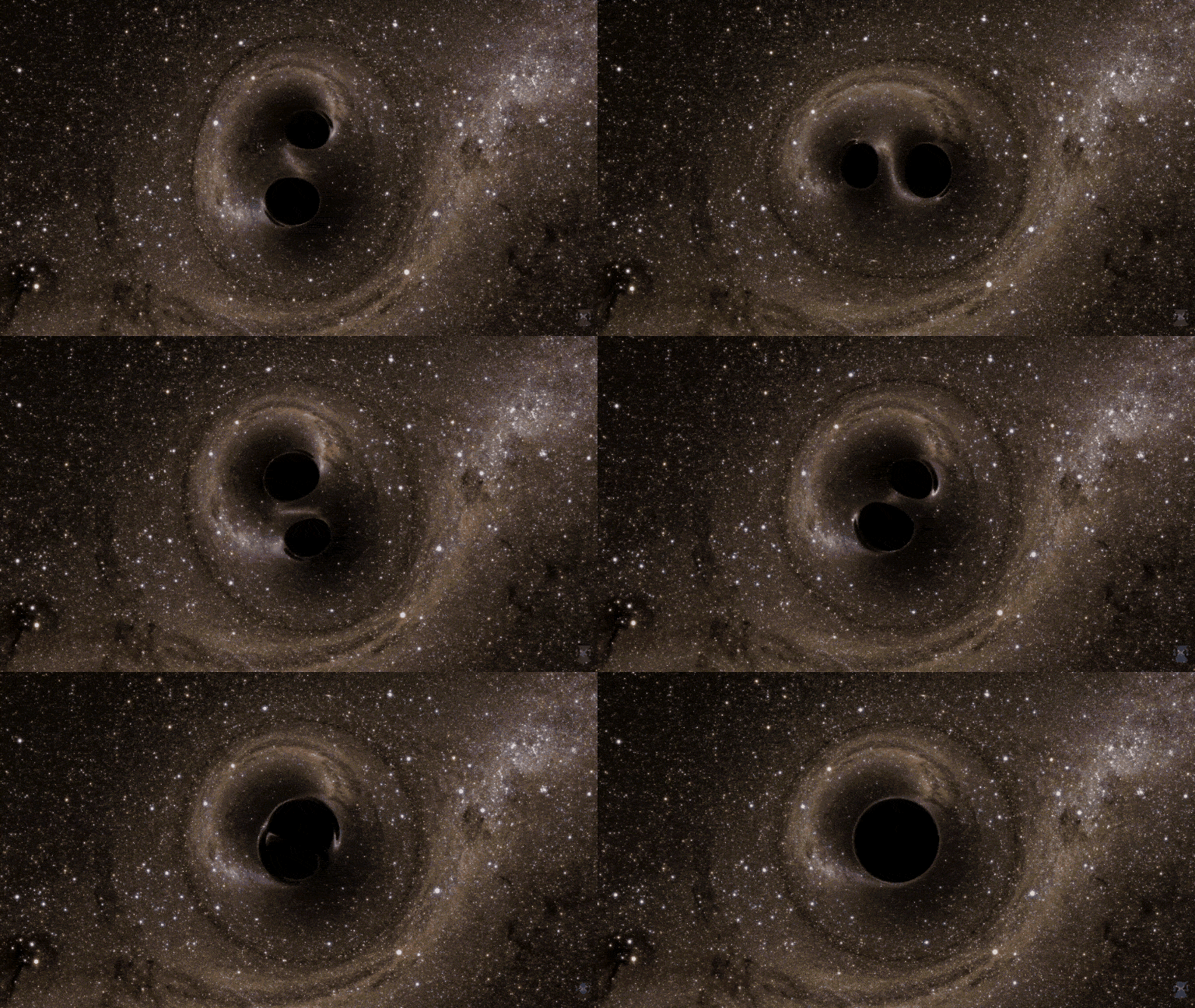
Scientists measured the speed of perspective from a cataclysmic collision between two black holes for the very first time.
Gravitational waves are undulations in the space-time proposed to exist by Albert Einstein, and Detected for the first time in 2015. Another first came in 2019, when scientists picked up a gravitational wave signal resulting from a future fusion between a very different size black holes. The size imbalance has made the newborn black hole in the universe in a phenomenon known as “native kick”.
Now, astronomers have deciphered this gravitational wave signal, called GW190412, revealing that the collision caused the newly melted black holes in more than 31 miles per second (50 kilometers per second) – fairly quickly to catapult it from its original group, reported researchers in the study, published on September 9 Natural astronomy.
“This is a remarkable demonstration of what gravitational waves can do”, co-author of the study Kouttav ChandraAn astrophysicist at the Pennsylvania State University said in a statement.
Collision signals
When black holes hide towards each other, they produce gravitational waves. But when a black hole is much more massive than the other, the gravitational waves produced in relation to the angle from which they are observed.
Looking at different angles, researchers can find the direction of the kick. Then, the speed of the kick can be determined by measuring the mass ratio and the spin of the two original black holes – information which can also be determined of the study of gravitational waves.
In relation: Scientists never detect the fusion of the most massive black holes – and he has born of a monster 225 times as massive as the sun
If the decline in the collision is strong enough to toll the merged black hole of its star cluster, this prevents this new black hole from merge later with other black holes and potentially form a supermassive black hole – which can be 100,000 to 50 billion times the mass of the sun. This makes understanding of the speed and the direction of essential kicks to follow the formation of supermassive black holes.
In 2018, co-author of the study Juan Calderón Bustillo And his colleagues understood exactly How to measure the native kick based on these gravitational wave signals. But their model was to rely on simulations, because no fusion of black hole causing a decline had been detected at that time.
Then, on April 12, 2019, the Advanced Ligo detectors in Louisiana and Washington state and the virgin detector in Italy Save the GW190412 Picked up a signal resulting from two black holes of stellar mass fusing: a 29.7 times as massive as the sun and the other 8.4 times as massive.
Although they occur at more than 2.4 billion light years from the earth, the researchers used two angles compared to the earth to determine where the kick sent the newborn black hole. He moved away from his birth site, probably a dense group of stars called globular clusters, an astonishing 111,600 miles per hour (179,600 kilometers per hour). This speed would be more than sufficient to allow him to escape the cluster and become a black hole on the run.
“This is one of the few phenomena in astrophysics where we are not only detecting something,” said Chandra. “We reconstruct the complete 3D movement of an object which is billions of light years, using only undulations in space-time.”
The next stages of the team will be to look for more black holes to measure both with gravitational waves and visible light, a search that could give deeper information on the growth of cosmic monsters.


