Scientists Might Soon Predict the Ocean’s Rogue Waves


November 13, 2025
3 min reading
Dangerous rogue waves aren’t random, they’re predictable
An 18-year dataset of the North Sea reveals that rogue waves are not freak accidents but peculiar products of the accumulation of ordinary swells – an idea that could make prediction possible.
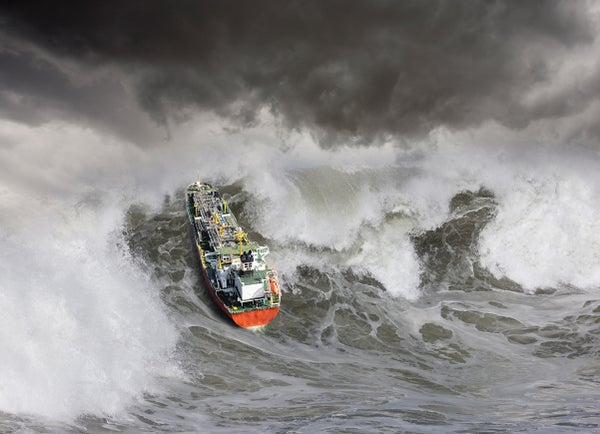
Under gray, hazy skies on the first day of 1995, the Draupner gas platform in the North Sea was hit by something that had long been relegated to maritime folklore: an 84-foot wall of water that threw enormous equipment onto the deck and buckled steel supports. The “Draupner wave” provided the first concrete proof of the reality of rogue waves.
Three decades later, scientists have revealed some of the physics behind these anomalies. A recent analysis of 27,505 North Sea wave measurements, recorded over 18 years by laser sensors on an oil and gas platform, reveals how the strange natural physics of ocean waves can produce a solitary giant when multiple sets (or “trains”) of waves intersect. The study, published in Scientific reportsdescribes how this phenomenon can amplify the height of a specific wave compared to that of its neighbors. It also identifies a distinct “fingerprint” in wave data – a repeating interference pattern that appears when two or more wave trains converge and reinforce each other – signaling when a rogue giant is most likely to emerge.
If scientists can detect these signatures early, extreme waves could go from an unpredictable terror to a predictable danger. “Our civilization is critically dependent on shipping and offshore activities, and there is a massive international research effort aimed at understanding rogue waves,” said Victor Shrira, a physical oceanographer at Keele University, who was not involved in the study. “Even the largest ships and structures are not safe. »
On supporting science journalism
If you enjoy this article, please consider supporting our award-winning journalism by subscription. By purchasing a subscription, you are helping to ensure the future of impactful stories about the discoveries and ideas shaping our world today.
Above all, the new study helped clarify what rogue waves are. not. Researchers have often generated them in the laboratory by inducing “modulation instability”: channeling artificial waves into narrow channels until they accumulate catastrophically. The study’s lead author, Francesco Fedele, an applied mathematician at the Georgia Institute of Technology, revised these models in previous work and his findings suggest that this laboratory process does not explain what is happening in the deep sea.
“Imagine a stadium crowd exiting down a long, narrow corridor,” says Fedele. “The people at the back push forward, and some even climb on top of others, crowding into the crowd,” he says. “It’s like a rogue wave in a wave pool. But if the stadium gates open out into a wide field, people spread out and there’s no stacking. It’s the open ocean: rogue waves don’t follow the same physics.”
Instead, rogue waves imply a subtle quirk of nature. Real ocean waves are not perfectly smooth sinusoidal curves; their peaks tend to become steeper and more pointed while their valleys become wider and flatter. Scientists call this inherent imbalance “linked wave asymmetry,” and they have been aware of it since at least the 1980s, but they have often dismissed it as a minor detail, according to Fedele. The new analysis suggests that when swells from multiple wave trains overlap in certain patterns, these sharp crests can stack up dramatically to build a single, towering wall of water. The study also proposes a measurable precursor model for this type of stacking.
According to the new research, detecting a particular swell footprint that could lead to a rogue wave could help scientists and sailors predict these monsters up to a minute before they hit. Such signatures have been spotted in more recent data: during a North Sea storm in 2023, for example, cameras captured a 55-foot wave whose growth could be attributed to these telltale interference patterns.
“I think this study can be a further step in predicting rogue waves and helping ships that might be exposed to them,” says Coral Moreno, an engineer at maritime logistics company EDT Offshore, who was not involved in the study. It also suggests that a wide range of floats or buoys could be used to collect longer-term data for forecasting purposes. The study’s researchers hope that as artificial intelligence, data collection and satellites improve, they will be able to detect these fingerprints in the world’s oceans, transforming what once seemed like freak accidents into something predictable and reliable.
It’s time to defend science
If you enjoyed this article, I would like to ask for your support. Scientific American has been defending science and industry for 180 years, and we are currently experiencing perhaps the most critical moment in these two centuries of history.
I was a Scientific American subscriber since the age of 12, and it helped shape the way I see the world. SciAm always educates and delights me, and inspires a sense of respect for our vast and beautiful universe. I hope this is the case for you too.
If you subscribe to Scientific Americanyou help ensure our coverage centers on meaningful research and discoveries; that we have the resources to account for decisions that threaten laboratories across the United States; and that we support budding and working scientists at a time when the value of science itself too often goes unrecognized.
In exchange, you receive essential information, captivating podcasts, brilliant infographics, newsletters not to be missed, unmissable videos, stimulating games and the best writings and reports from the scientific world. You can even offer a subscription to someone.
There has never been a more important time for us to stand up and show why science matters. I hope you will support us in this mission.


