Sea Cow Communities Have Engineered Arabian Gulf’s Seagrass Ecosystems for Over 20 Million Years


Paleontologists have unearthed a dense assemblage of dugong remains at the Al Maszhabiya site in the Lower Miocene Dam Formation of Qatar. This fossil site shows that the Persian Gulf has repeatedly developed communities of sea cows of different species over the past 20 million years. One of these species, named Salwasiren qatarensisis new to science.
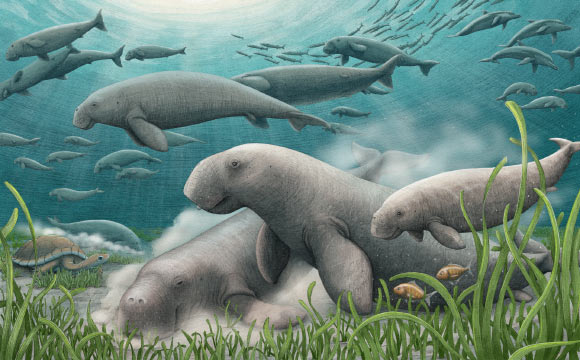
An artistic reconstruction of a flock of Salwasiren qatarensis searching for food on the seabed. Image credit: Alex Boersma.
Robust in constitution and with a lowered snout lined with sensitive hairs, dugongs (Dugong dugon) today resemble their relatives, the manatees.
The only key difference between these aquatic herbivores, often called sea cows, is their tails: a manatee’s tail is rounded like a paddle while a dugong’s forked tail is more like that of a dolphin.
Dugongs inhabit coastal waters from West Africa to the Indo-Pacific and as far north as Australia.
The Arabian Gulf is home to the world’s largest herd of dugongs, where sea cows play an important role in engineering the ecosystem.
By munching on seagrass beds, dugongs reshape the seafloor, creating feeding trails that release buried nutrients into the surrounding water for other aquatic animals and plants to use.
“We discovered a distant relative of dugongs in rocks less than 10 miles (16 km) from a bay with seagrass beds that are their main habitat today,” said Dr Nicholas Pyenson, curator of fossil marine mammals at the National Museum of Natural History.
“This part of the world has been the primary habitat of sea cows for 21 million years. It’s just that the role of sea cows has been occupied by different species over time.”
Few places preserve as many of these bones as Al Maszhabiya, a fossil site in southwest Qatar.
The bone bed was first discovered when geologists conducted mining and oil surveys in the 1970s and noted abundant “reptile” bones scattered across the desert.
In the early 2000s, paleontologists returned to the area and quickly realized that the fossils came not from ancient reptiles but from sea cows.
Based on the surrounding rocks, Dr. Pyenson and his colleagues dated the bone bed to the early Miocene, about 21 million years ago.
They discovered fossils that revealed that this area was once a shallow marine environment inhabited by sharks, barracuda-like fish, prehistoric dolphins and sea turtles.
They identified more than 170 different locations containing sea cow fossils throughout the Al Maszhabiya site.
This makes the bone bed the richest assemblage of fossilized sea cow bones in the world.
The fossilized bones of Al Maszhabiya resembled the skeletons of living dugongs. However, ancient sea cows still had hind limb bones, which modern dugongs and manatees lost during their evolution.
The site’s prehistoric sea cows also had straighter snouts and smaller tusks than their living relatives.
Researchers have described the Al Maszhabiya fossil sea cows as a new species, Salwasiren qatarensis.
“It seemed very appropriate to use the country name for the species, as it clearly indicates where the fossils were discovered,” said Dr Ferhan Sakal, a researcher at Qatar Museums.
With an estimated weight of 113 kg (250 pounds), Salwasiren qatarensis would have weighed as much as an adult panda or a heavyweight boxer.
But it was still among the smallest sea cow species ever discovered. Some modern dugongs are almost eight times heavier than Salwasiren qatarensis.
Based on the fossils, the researchers posit that this region contained abundant seagrass beds more than 20 million years ago, during a time in Earth’s history when the Gulf was a hotspot for biodiversity. Sea cows tended these aquatic pastures.
“The density of the Al Maszhabiya bone bed gives us an important clue that Salwasiren qatarensis played the role of engineer of the seagrass ecosystem in the early Miocene, as dugongs do today,” Dr Pyenson said.
“There has been a complete replacement of evolutionary actors but not of their ecological roles.”
The team’s discovery is reported in a paper published online in the journal PeerJ.
_____
ND Pyenson and others. 2025. High abundance of seacows from the early Miocene of Qatar shows repeated evolution of seagrass ecosystem engineers in the eastern Tethys. PeerJ 13:e20030; doi:10.7717/peerj.20030


