
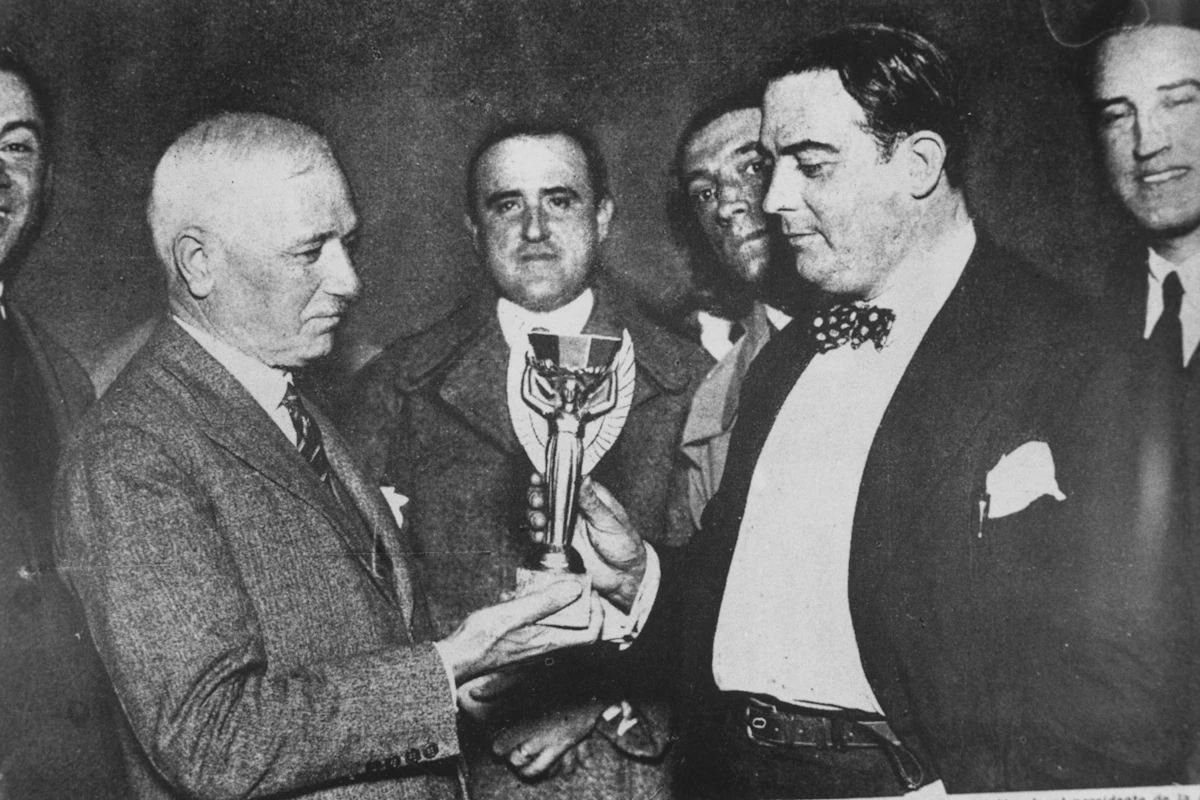
With the war over, Rimet could focus on what mattered: the World Cup. In 1946 a FIFA congress in Luxembourg renamed the trophy the “Coupe Jules Rimet”—”to my great confusion,” he writes modestly.
For the first post-war World Cup, in Brazil in 1950, Rimet repeated the transatlantic crossing that he had made for the inaugural tournament twenty years earlier. He aimed to restore the comity of the pre-Fascist world. The Axis powers Germany and Japan had been banned from FIFA, but Rimet was smoothing the path for their swift return. In 1950, Bauwens became president of the German football federation. A FIFA congress in Rio de Janeiro, held on the eve of the World Cup, agreed “to not let politics introduce itself into sports.”
Travelling around Brazil during the tournament, Rimet observed that the country “seems to live only for football and the cup.” When the Coupe Rimet itself was exhibited in a shop in Rio, the crowds flocking to see it were so large that a security firm had to be hired. The Brazilians were certain that they would keep the cup. As Rimet noted: “By a curious phenomenon of collective psychosis, all the city was celebrating victory before it was won.” FIFA officials weren’t invited to the opening ceremony in the new stadium, the Maracanã. Rimet explains in his memoir that for the Rio authorities, “the World Cup is a strictly Brazilian affair.” The stadium with its 200,000-person capacity was so packed for matches that even VIPs had to fight their way to their seats. Rimet was told that the Archbishop of Rio, “caught in a besieging crowd, could not free himself except by roughly knocking over his nearest neighbors.”
The 1950 tournament had no official final, just a second stage of group matches. But the de facto final turned out to be the Brazil-Uruguay game. A draw would be enough to make the Brazilians world champions, and a grandiose victory ceremony was planned. While their national anthem played, the Brazilian team were to walk to the centre of the pitch through a guard of honour to receive the Coupe Rimet. With the match tied at 1-1 and only a few minutes remaining, Rimet descended with the trophy through the innards of the Maracanã to the touchline, ready to make his congratulatory speech for the hosts. But by the time he emerged from the tunnel, the crowd was silent. During his descent, Uruguay had scored the winning goal.
Rimet writes: “There was no longer a guard of honor, nor a national anthem, nor a speech in front of a microphone, nor a solemn awarding of the trophy.” Instead he found himself jammed amid a throng of pitch invaders, the cup in his hand, not knowing what to do with it. He was forced to repeat the rushed handover of 1930: “I end up spotting the Uruguayan captain, and I give him the cup while shaking his hand, as if in secret, without being able to say a word to him.”
It was Rimet’s last official act at a World Cup. Aged seventy-six, he was being phased out as president. At the FIFA congress in Bern, on the eve of the 1954 tournament, he was replaced by the Belgian Rodolphe Seeldrayers (who would die the following year).
The peasant boy from Theuley had overseen the growth of the World Cup into an event that moved the white world. During his thirty-three-year reign, the federation’s membership had grown from twenty-nine countries to eighty-five. His associates at FIFA proposed him for the Nobel Peace Prize. In 1956, while they were assembling the supporting dossier, Rimet died, aged eighty-two. Though he lies forgotten in his suburban grave, his obsessions still mark the World Cup.


