See Mars and Mercury shine in the glow of the setting sun on Nov. 12

When you purchase through links on our articles, Future and its syndication partners may earn a commission.

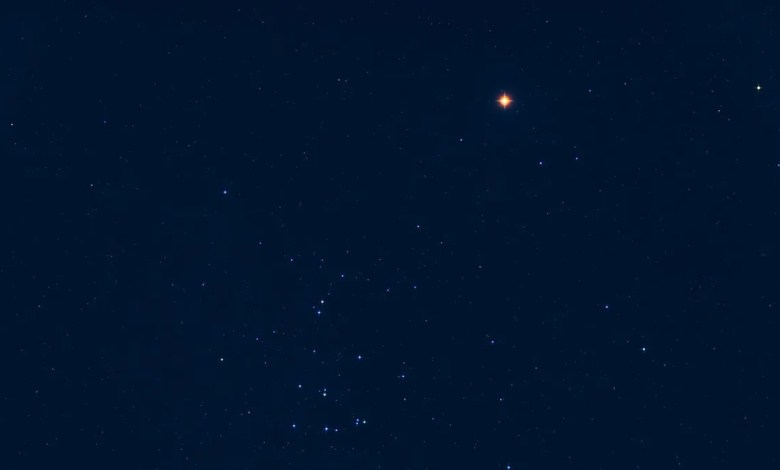
A telescopic view of Mars near the Beehive star cluster. | Credit: Alan Dyer/VWPics/Universal Images Group via Getty Images
Look low on the southwest horizon at sunset on November 12 for a chance to see Mercury fast near the red glow of Mars in the evening sky, but be careful: You’ll need to be quick to spot the elusive planets before they quickly disappear from view.
Mercury will be positioned approximately 5 degrees above the horizon at sunset on November 12, with March bright about 1 degree at top right. Remember: the width of your three middle fingers held at arm’s length represents 5 degrees in the night sky, while the span of your little finger is about 1 degree.
Both objects will be difficult to spot in the light of the setting sun, becoming more visible as the sun passes deeper below the horizon. As such, you’ll need to find a clear view to the southwest to have the best chance of seeing the planets before they set, less than an hour after the sun.
Mercury will have jumped to the right of Mars the next evening and will continue its journey westward in the nights that follow. Mars and Mercury are positioned close to the sun in November and therefore great caution should be exercised not to point a telescope or binoculars in their direction until the sun is safely below the horizon. You can check sunset times for your location using the website Time and date.

Mars and Mercury meet in the night sky. | Credit: Chris Vaughan/Starry Night
Last month, Mercury and Mars performed a delicate dance, during which the innermost planet followed a right-to-left path beneath the Red Planet in Earth’s sky, before appearing to retrace its steps, as its tight orbital leash brought it closer to the sun. This visual effect is known as retrograde motion and occurs in November when faster-moving Mercury approaches and overtakes Earth in its orbit, causing the planet to temporarily travel from east to west in our sky. Mars, meanwhile, continues its apparent “prograde motion,” moving from west to east across the star field beyond.
Both worlds will gradually appear lower on the horizon at sunset in the coming months before their respective solar conjunctions, when they will be closest to the sun in Earth’s sky – an event that will occur on November 20 for Mercury and in January 2026 for Mars.
Editor’s note: If you would like to share your planetary astrophotography with Space.com readers, please send your photo along with your comments, your name and the location of your photoshoot to spacephotos@space.com.