Senate votes on dueling health care bills with price hikes on the horizon


27 months ago
Senate begins voting on GOP-led measure to cut health care costs
The Senate is currently voting on Republicans’ proposal to cut health care costs, led by Senators Bill Cassidy of Louisiana and Mike Crapo of Idaho.
The bill is unlikely to get the 60 votes needed to advance, and comes ahead of a highly anticipated vote on a Democratic bill that would extend enhanced tax credits under the ACA. This vote is also expected to fail.
10:56 a.m.
Shaheen encourages senators to ‘sit down and reach a compromise’ after votes
Sen. Jeanne Shaheen, a New Hampshire Democrat who negotiated the deal with Republicans to end the shutdown, indicated she was open to continuing work to address health care on a bipartisan basis after today’s votes.
Speaking on the Senate floor following the majority leader, Shaheen said much of what Thune said about “costs, fighting fraud and reducing the cost of health care is something we should all support.”
“I’m willing to come to the table and I think we would be better served if, after passing these votes, we sat down and came to a compromise to address the real costs that people face in terms of health care,” Shaheen said. “And I’m ready to do it.”
Shaheen said “there are members in both parties who want to find a responsible path forward.”
“I welcome discussion on where we can find common ground,” she said. “But first we must prevent millions of Americans from losing coverage in the months to come. Extending these credits is the simplest, most direct way to protect families.”
10:35 a.m.
Thune says Democrats want to ‘extend status quo’ without any anti-fraud reforms
Senate Television 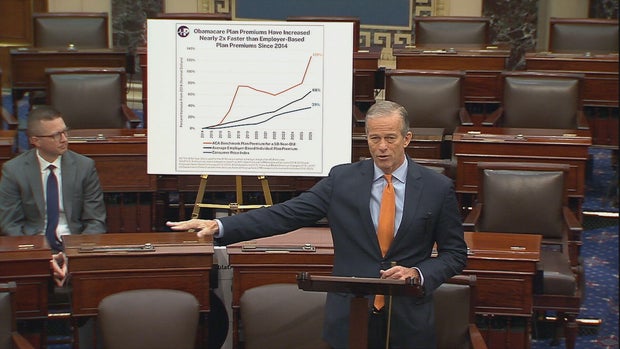
Speaking on the House floor, Thune reiterated Republicans’ argument against an outright expansion of tax credits, saying the subsidies create “perverse incentives” that distort the insurance market and encourage fraud.
“The Democrats’ so-called plan is a three-year extension of the status quo. No reforms, no overhauls, no overhaul of how Obamacare works. Just a three-year extension of the status quo,” Thune said.
The Republican leader said the Democratic plan “would do nothing to address the perverse incentives that are pushing Americans out of employer-funded health care and into taxpayer-subsidized plans.”
“It will do nothing to combat the perverse incentives that encourage insurance companies to enrich themselves at the expense of taxpayers, and it will do nothing to address the waste, fraud and abuse rampant in Obamacare. And most importantly… it will do nothing to reduce health care costs. Nothing. Zero. Under the Democrats’ plan, insurance premiums will continue to skyrocket,” he said.
“The Democrats don’t have a health care plan. They want to prolong the status quo,” Thune added.
10:02 a.m.
Schumer says ‘ridiculous’ GOP health care bill ‘can’t be taken seriously’
Senate Television 
Speaking on the Senate floor, Minority Leader Chuck Schumer blasted the Republicans’ health care proposal, saying it would do little to address rising costs for consumers.
“The Republicans had so many differences among themselves that for a while it looked like they weren’t going to introduce a bill at all. But after that became too embarrassing an option for the Republicans, they used scotch and glue to come up with this ridiculous proposal that cannot be taken seriously, and does nothing – nothing – to avert the looming health care crisis,” he said. “Even calling this Republican bill a proposal is generous, because the Republican bill is little more than junk insurance. It’s not a real plan at all.”
He said that “the Republicans’ big idea is basically to give people about $80 a month and wish them well. And even to qualify for this check – listen to how bad this is – Americans would be forced to adopt rudimentary bronze plans with exorbitant deductibles. »
Schumer said there remains “only one option to avoid falling off this health care cliff that Republicans have brought us to: a clean, simple, straightforward expansion of the current ACA appropriations. All Democrats are united behind this proposal. I urge Republicans to abandon their divisions and join us.”
9:32 a.m.
Senate meets before vote on health bills
The Senate went into session at 9:30 a.m. ahead of procedural votes on competing health care bills later in the morning.
Majority Whip John Barrasso’s office said the chamber will take votes at 11:30 a.m., starting with the GOP bill and followed by Democratic legislation. Technically, both votes will be on invoking cloture motions to proceed with passage of the bill and will require 60 votes to succeed.
Updated at 9:11 a.m.
Schumer says vote is ‘moment of truth’ for Republicans
Aaron Schwartz/Bloomberg via Getty Images 
The long-awaited vote on the ACA tax credits comes a day after the shutdown, when Republicans agreed to allow a vote on a Democratic bill in exchange for reopening the government. The subsidies, which helped about 22 million low- and middle-income Americans pay for health care in 2025, are set to expire at the end of the year. Annual premiums for those who purchase coverage through the ACA exchanges are expected to more than double without an extension, according to KFF, straining the already strained budgets of several million people.
Given the opportunity to introduce any bill they wanted, Democrats opted to propose a net three-year extension of the subsidies, a bill known as the Health Care Cost Reduction Act. The move virtually guaranteed the effort would fail, since Republicans generally oppose an extension without significant reforms to combat fraud and impose revenue caps. But Democrats are more than willing to force their Republican colleagues to vote against extending the subsidies, viewing the coming price hike as a major political issue as next year’s midterm elections approach.
Senate Minority Leader Chuck Schumer called Thursday’s vote on extending the tax credits a “moment of truth for Republicans,” noting that the credits are set to expire in a few weeks.
“Congress should have solved this problem months ago,” Schumer said at a news conference Wednesday. “Hakeem Jeffries and I have repeatedly asked Republican leaders and Donald Trump to sit down and find a solution to the crisis. They have refused.”
Updated at 9:11 a.m.
What the Republican health care bill would do
Republicans have argued that the current structure of tax credits, which involves sending funds directly to insurance companies, encourages fraud, as brokers and agents are incentivized to sign up customers who may not qualify. GOP lawmakers pointed to a recent Government Accountability Office report in which investigators submitted applications for coverage through exchanges using fictitious personal data, most of which were approved anyway.
Republicans have sought for years to reform what they see as a broken health care system, but have failed to unite behind a strategy to implement meaningful change.
After weeks of discussions, Senate Republicans announced this week that they would bring their own bill forward for a side-by-side vote, hoping to ease the political pressure that would come from voting against the Democratic proposal.
The Republican bill, titled the Health Care Freedom for Patients Act and led by Senators Mike Crapo and Bill Cassidy, takes another approach to reducing health care costs. Rather than expanding enhanced tax credits, it would redirect funds to health savings accounts for those using bronze plans on state exchanges. Supporters argue that this would allow people to save on premiums by downgrading to lower-tier plans, while also being able to use HSA funds toward their deductibles.
Senate Majority Leader John Thune announced Tuesday that Republicans will introduce the Crapo-Cassidy bill, which he said “reflects the views of Republicans here in the United States Senate.”
Democrats have largely rejected the Republican plan because it doesn’t address tax credits, leaving millions with higher premiums in the short term.
Updated at 9:11 a.m.
Thune: Democratic bill is a “partisan messaging exercise”
On the Senate floor Wednesday, Senate Majority Leader John Thune called the Democratic approach an “exercise in partisan messaging,” saying they “seem to be straining to do it.”
“I probably don’t expect us to get any Democratic votes for our proposal, but we are proposing something that actually reduces health care costs and premiums, puts the power back in the hands of individuals, and that’s really what it should be about,” Thune said.
As both sides seemed aware of the likelihood that the bills would fail in Thursday’s votes, Thune did not rule out extending the tax credits in the future.
“There is interest in solving this problem,” Thune told reporters Wednesday. “Obviously we don’t have a lot of time to do it, but I think there are ways to do it, where there is a will and there are two parties willing to come together.”