US sanctions Russian oil companies after failed Putin talks


Bernd Debusmann Jr,at the White House And
Max Matza
The United States has announced new sanctions targeting Russia’s two largest oil companies – Rosneft and Lukoil – in a bid to pressure Moscow into brokering a peace deal in Ukraine.
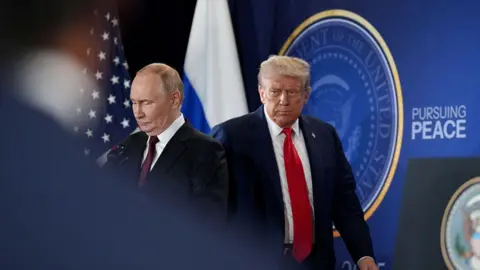
“Every time I talk with Vladimir, I have good conversations and then they go nowhere. They go nowhere,” President Donald Trump said, after a meeting with NATO Secretary General Mark Rutte to discuss peace negotiations.
The sanctions announcement comes a day after Trump said a planned meeting with Russian President Vladimir Putin in Budapest would be postponed indefinitely.
Earlier on Wednesday, Russia unleashed an intense bombardment on Ukraine that killed at least seven people, including children.
US Treasury Secretary Scott Bessent said the new sanctions were necessary because of “Putin’s refusal to end this senseless war.” According to him, these oil companies finance the Kremlin’s “war machine”.
“Now is the time to stop the massacres and establish an immediate ceasefire,” Bessent said in a statement.
Speaking alongside Rutte in the Oval Office on Wednesday, Trump criticized Putin for not being serious about making peace and said he hoped sanctions would contribute to a breakthrough.
“I just felt like it was time. We’ve waited a long time,” Trump said.
He called the package of sanctions “enormous” and added that he hoped they could be quickly lifted if Russia agreed to stop the war.
Rutte also welcomed the move, saying it “put more pressure” on Putin.
“You have to put pressure on, and that’s exactly what he did today,” Rutte said.

 Getty Images
The move comes as key differences between U.S. and Russian peace proposals have become increasingly clear this week. Trump said a key sticking point was Moscow’s refusal to stop fighting along the current front line.
Last week, the UK imposed a similar set of sanctions on Rosneft and Lukoil.
“There is no place for Russian oil on world markets,” British Chancellor Rachel Reeves said in announcing the decision.
In response to the UK, the Russian embassy in London said targeting its country’s major energy companies would disrupt global fuel supplies and drive up costs globally.
He also said sanctions would have “a detrimental impact on the energy security” of developing and underdeveloped countries, adding that “pressure only complicates peaceful dialogue and leads to further escalation.”
The two Russian oil companies export 3.1 million barrels of oil per day. Rosneft is responsible for almost half of Russia’s oil production, or 6% of global production, according to British government estimates.
Oil and gas are Russia’s main exports, and Moscow’s biggest customers are China, India and Turkey. Trump also urged those countries to suspend purchases of Russian oil in a bid to put economic pressure on the Kremlin.
Trump’s decision was welcomed by British Foreign Secretary Yvette Cooper, who said the US sanctions were “strongly welcome”.
European Commission President Ursula Von der Leyen said on X that she spoke by telephone with Bessent on Wednesday about Russia’s “lack of engagement in the peace process.”
She also welcomed the new sanctions package approved by the European Union on Wednesday, which includes a ban on imports of Russian liquefied natural gas.
“With the imminent adoption of the 19th EU package of measures, it is a clear signal on both sides of the Atlantic that we will maintain collective pressure on the aggressor,” she wrote.
Earlier this year, the UK and US also sanctioned major Russian energy companies Gazprom Neft and Surgutneftegas.
At the White House, Rutte was expected to discuss a 12-point plan formulated by European allies NATO and kyiv, which includes freezing current front lines, returning deported children as well as an exchange of prisoners between the two warring countries.
The plan also includes a war recovery fund for Ukraine, as well as security pathways and a clear path for Ukraine’s EU membership, as well as increased military aid to kyiv and economic pressure on Moscow.
Earlier this week, Trump said he did not want an “unnecessary meeting” with Putin in Budapest, and suggested that one of the main points of contention was Moscow’s refusal to cease fighting along the war’s current front lines.
He last met with Putin in Alaska for a summit that the White House hoped would lead to an end to the conflict. Instead, the fighting continued.
A preparatory meeting between US Secretary of State Marco Rubio and Russian Foreign Minister Sergei Lavrov was also suspended. This week’s meeting was no longer “necessary” after a “productive” call, the White House said.
Trump has repeatedly supported proposals to freeze fighting along the current front lines.
“Let this be reduced as it is,” he said Monday. “I said, cut and stop at the battle line. Go home. Stop fighting, stop killing people.”
Russia opposed the idea, with Kremlin spokesman Dmitry Peskov saying “the consistency of Russia’s position does not change” – a reference to its desire to see Ukrainian troops leave the Donbass region of eastern Ukraine.
On Wednesday, Trump also objected to Wall Street Journal reports that the United States approved long-range Ukrainian missile strikes against Russia, calling them “fake news.”
Ukrainian President Volodomyr Zelensky expressed a desire for the United States to supply his forces with long-range American Tomahawk missiles and suggested that the threat of their introduction into the war theater could bring Russia to the negotiating table.


