Sharks Show How Animals Scale Like Geometric Objects



Explore
IIt is a universal fact that as any 3D object, from a Platonic sphere to a cell to an elephant, grows outward in all directions, its total surface area will increase more slowly than the space it occupies (its volume). If the geometry and shape of the object remains the same as it grows, then its surface area will increase about as fast as its volume to the two-thirds power. For centuries, biologists have wondered whether life forms also follow this two-thirds scaling law, even though they come in an astonishing variety of shapes and sizes. If so, this would suggest that there are fundamental underlying constraints on evolution that could influence how life interacts with the world around it.
Recently, researchers used CT scans and digital tools to calculate the surface areas and volumes of an ancient and diverse animal lineage: sharks. The team’s analysis, published in Royal Society Open Scienceincluded more than 50 species of sharks and provides some of the best empirical evidence to date of a kind of firm scaling rule in zoology. As with a sphere, the surface area and body mass of sharks indeed follow a two-thirds scaling law, the team discovered. If this is true in other groups of animals, it likely reflects underlying rules of heat exchange, metabolism, or development that constrain evolution.
If you’re looking for a group of animals in which to study the biological scale, it’s hard to do better than sharks, according to Joel Gayford, a shark biologist at James Cook University in Australia who led the new study. They share a general shape, but come in many sizes, occupy a multitude of niches, and have enormous variation in body shape. In his research into the morphological evolution of sharks, Gayford noticed what appeared to be scaling relationships between parts of their bodies, such as the size of their fins. This made him wonder if there might be more fundamental rules limiting the forms sharks can take.
ADVERTISEMENT
Nautilus members enjoy an ad-free experience. Log in or register now.
However, he could find little high-quality research on scaling in large animals. Single-cell research has revealed many deviations from expected rules; rare studies of smaller animals such as insects and snakes have found evidence of two-thirds scaling. But few studies included larger animals, and most of them were conducted decades ago. Additionally, Gayford found that the existing data on animals was somewhat confusing. Due to technological limitations in the 19th and 20th centuries, attempts to accurately measure the surface area and volume of animals were “error-prone and also quite ethically questionable”, he said.
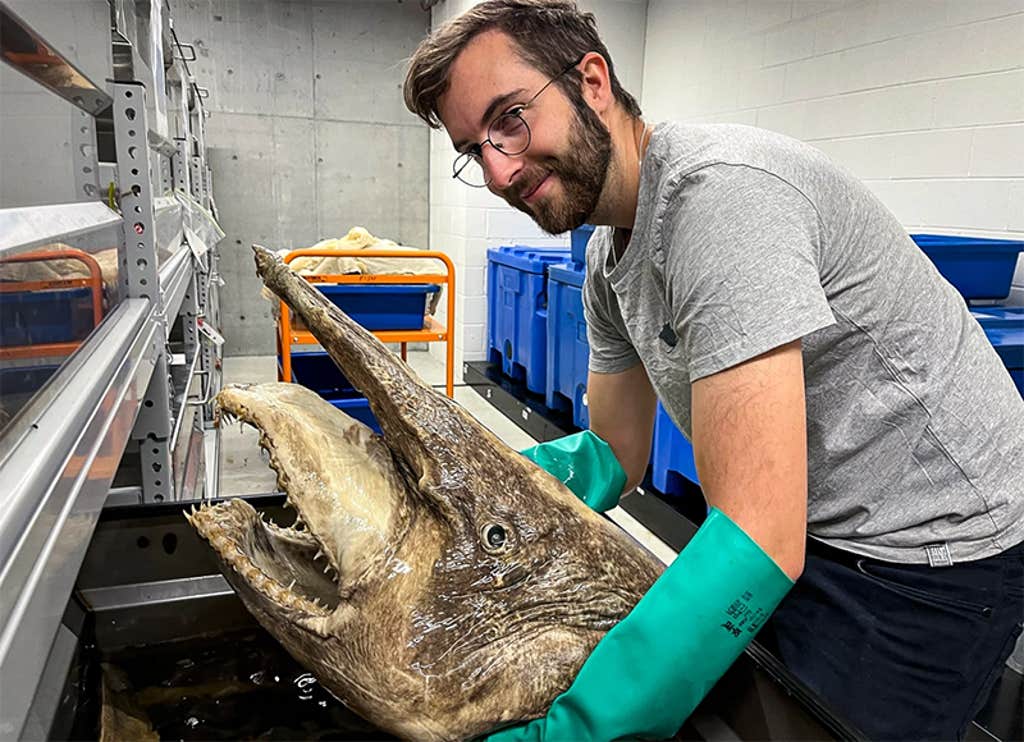
He wasn’t the only one who thought so. “One of the big limitations, especially if you read these early biology studies, is how do you measure the surface area of a cow? said Brian Enquist, an evolutionary biologist at the University of Arizona who was not involved in the study.
ADVERTISEMENT
Nautilus members enjoy an ad-free experience. Log in or register now.
Until recently, options were limited. Researchers could run a measuring wheel over an animal’s skin and mark units with chalk, or skin the creature and measure its surface area by hand. To calculate its volume, they could place the animal in a bathtub filled with water and see how much liquid it displaced; some went further and poured water directly into the freshly released skins.
Gayford’s team had much more advanced technology. They measured the surface area and volume of 54 different shark species, ranging from the 9-inch pygmy shark, one of the smallest in the world, to the whale shark, the largest living fish. But rather than skin them, they took high-quality CT scans of museum specimens to create detailed virtual reconstructions. For species too large to fit in a scanner, they used photogrammetry software, which stitches together many photos of an object’s surface to create a 3D model. (In one case, the object in question was a 37-foot-long whale shark that lives at the Georgia Aquarium.) They then loaded the models into 3D processing software called Blender, originally developed for rendering objects in video games. To calculate the surface area of a shark, Gayford only had to click a button.

ADVERTISEMENT
Nautilus members enjoy an ad-free experience. Log in or register now.
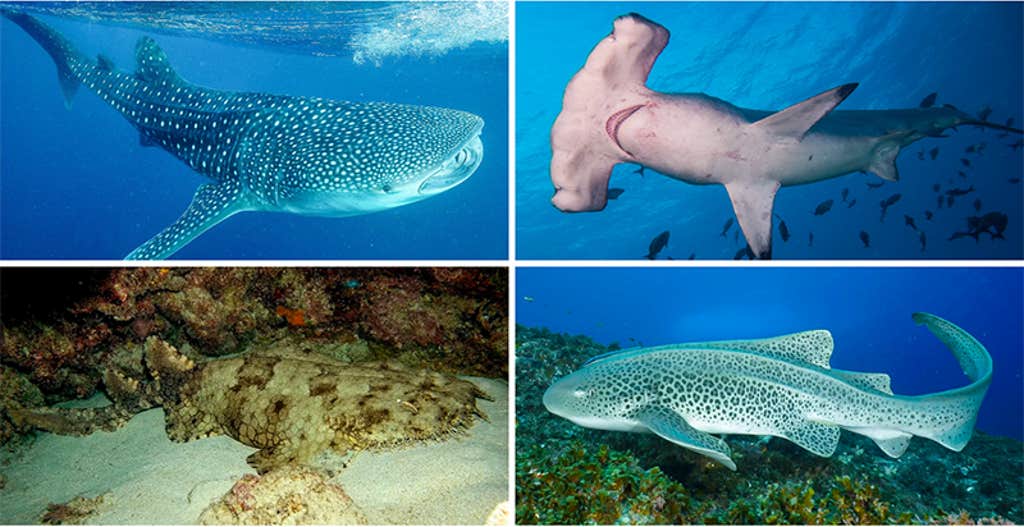
In addition to reflecting a huge range of animal sizes, the dataset also represented sharks that occupy diverse ecological niches, from reef dwellers to deep-sea predators to bottom predators. They came “in a ton of different unique morphologies,” Gayford said, including several species of oblong-faced hammerhead sharks; the common fox, whose caudal fin is almost as long as the rest of its body; and the flat, frilly wobbegong, as well as your more standard shark-shaped sharks. And although most sharks are cold-blooded or ectothermic, a few species (including great white sharks) can generate their own heat. Gayford’s team included one of these regionally endothermic sharks, the thresher, in the dataset.
Despite this diversity in size, shape, lifestyle and metabolism, sharks fit the two-thirds rule almost perfectly. “They showed that there wasn’t a lot of variability, so that’s really cool,” Enquist said.
The analysis suggests that this two-thirds scaling rule could be universal for animals. Certainly, more research is needed on other groups of animals, including terrestrial animals, which can have complex external geometries such as feathers and hair, and warm-blooded or endothermic animals, such as mammals and birds. To that end, Gayford’s team is collecting more data; he hopes other researchers will further test biological scaling in the animals they study.
ADVERTISEMENT
Nautilus members enjoy an ad-free experience. Log in or register now.
However, the surface measurements could still be considered incomplete because they only include the sharks’ external features. Even though structures such as gills are hidden inside animals’ bodies, their surfaces are actually external from a topological perspective, said Karl Niklas, professor emeritus of biomechanics at Cornell University. If the researchers had also analyzed the sharks’ gills, Niklas hypothesized, they would have found a scale ratio closer to three-quarters. Nevertheless, the consistency of the numbers for many different shark species suggests that the rule is not accidental. “We have to look at this as a kind of reflection of adaptive evolution,” Niklas said.
Scientists aren’t sure what fundamental mechanisms might limit the size and shape of sharks and other animals, but they have hypotheses. One concerns tissue allocation during early growth. To visualize this, imagine a developing animal as a ball of clay. “There are only a limited number of ways to stretch clay to create different shapes without incurring energy costs,” Gayford said. In this case, the scaling relationship is important to the embryo and limits the potential forms the adult organism can take.
ADVERTISEMENT
Nautilus members enjoy an ad-free experience. Log in or register now.
Alternatively, the ratio could reflect a fundamental constraint on heat exchange. In animals, which can absorb external heat and generate it through metabolism or movement, a scaling principle in which surface area grows more slowly than volume would create an insulating effect when moving from a small species to a larger one. “Area versus volume is really important for heat exchange,” said Van Savage, a computational biologist at the University of California, Los Angeles, who was not involved in the study. This may explain why arctic species tend to be large and bulky, while those living in tropical climates can be slender: a larger body is harder to cool than a smaller body. This even applies to ectothermic animals, which may need to conserve heat when moving between warm and cold environments, such as when whale sharks dive into deeper, colder waters.
The study offers insight into the mathematical limits of evolution and could help identify fundamental mechanisms that constrain the topology of life. But calculating the scale of organisms also has practical value. This can help veterinarians determine how much anesthesia to give to a cat versus a Great Dane, for example, or help doctors determine medication doses for infants versus adults.
For Gayford, this highlights the need for continued empirical studies of biological scaling. “It’s really important that people actually test these laws,” he said. “Because a lot of times we just assume they’re correct.”
ADVERTISEMENT
Nautilus members enjoy an ad-free experience. Log in or register now.
This article was originally published on Quanta.
Main image: Samantha Mash for Quanta Magazine


