‘Shocking’: Black hole found growing at 2.4 times the theoretical limit


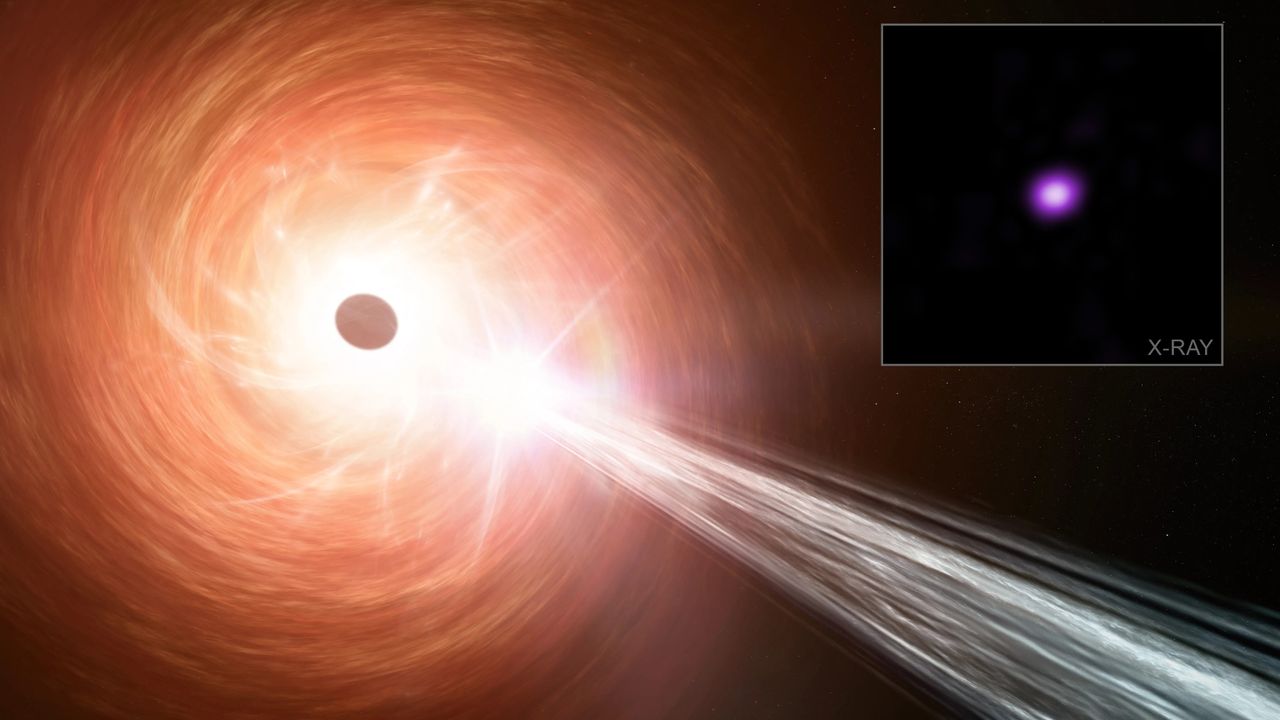
Astronomers have spotted a monster black hole In the early universe that throats more than double the theoretical limit. The discovery deepens the mystery of the way in which certain black holes born shortly after the Big Bang managed to grow so tall, so quickly.
Use of the NASA Chandra X -ray observatory – a powerful X -ray telescope at the risk of being terminated By the budget proposed by the Trump administration in 2026 – Astronomers have zoomed out on an old black hole called Racs J0320-35, which was born only 920 million years after the Big Bang.
According to a new analysis of X -rays, infrared and optical radiations that pour out of the black hole, the supermassive monster seems to grow faster than theoretically possible, 2.4 times the eddington limit – a theoretical ceiling for speed with black holes, as a function of the relationship between their external radiation pressure and gravitational pressure.
Beyond the limit
Black holes are cosmic objects formed from the collapse of giant stars, which effectively create gravitational chasms in space. They grow up by merging with other black holes and gorging over the large quantities of matter that pour over their horizon of events – the point beyond which nothing, not even light, can escape.
In relation: “Dramatic” changes identified in the first black hole never imagined
While the biggest black holes are getting their importance Giant jets and laser lighting who pierces the cosmos. The brightest of these dyspeptic black holes are called quasars, and they can surpass whole galaxies with their radiation.
This makes ideal quasars targets for astronomers – and RAC J0320-35 are no exception. Discovered for the first time in a radio survey before being targeted by Chandra in 2023, the brilliant emissions of the black monster through the electromagnetic spectrum make it a “perfect laboratory” to study the growth of the black hole, the researchers wrote in the study.
The researchers observed the intensity of the light of X -rays exploding from the black hole at different wavelengths, then compared it to infrared and optical data to estimate the mass and growth rate of the object. They found that the black hole was to increase by 300 to 3,000 suns of material each year, putting it beyond the eddington limit for a black hole in its size. The way in which the black hole can exceed this limit without becoming unstable remains a mystery.
With an idea of the growth rate and the age of the black hole, the researchers then worked back to make assumptions about how the monster was originally formed. They found that, given its ultra -fast growth, it could have started life as many typical black holes do in the local universe – the collapse of a large star with a mass less than that of 100 suns.
This discovery, as well as those of other potential black holes Super-Eddington Spotted by the James Webb space telescope In the early universe, them suggests that fast -growing black holes can be a more common characteristic of the old cosmos than our models suggest. Rapid eaters like these can also be more likely to issue gargantuan energy jets, as does RAC J0320-35, added the researchers.
More in-depth research on this black hole and others as will help researchers unlock the mysteries of the first black holes in the universe-to know, where did they come from and how have they become so fast?
“How did the universe create the first generation of black holes?” Co-author of the study Thomas ConnorAlso the Harvard and the Smithsonian Center for Astrophysics, said in the press release. “This remains one of the biggest questions in astrophysics and this only object helps us to chase the answer.”


