Shohei Ohtani’s return to two-way role going (mostly) well a month in

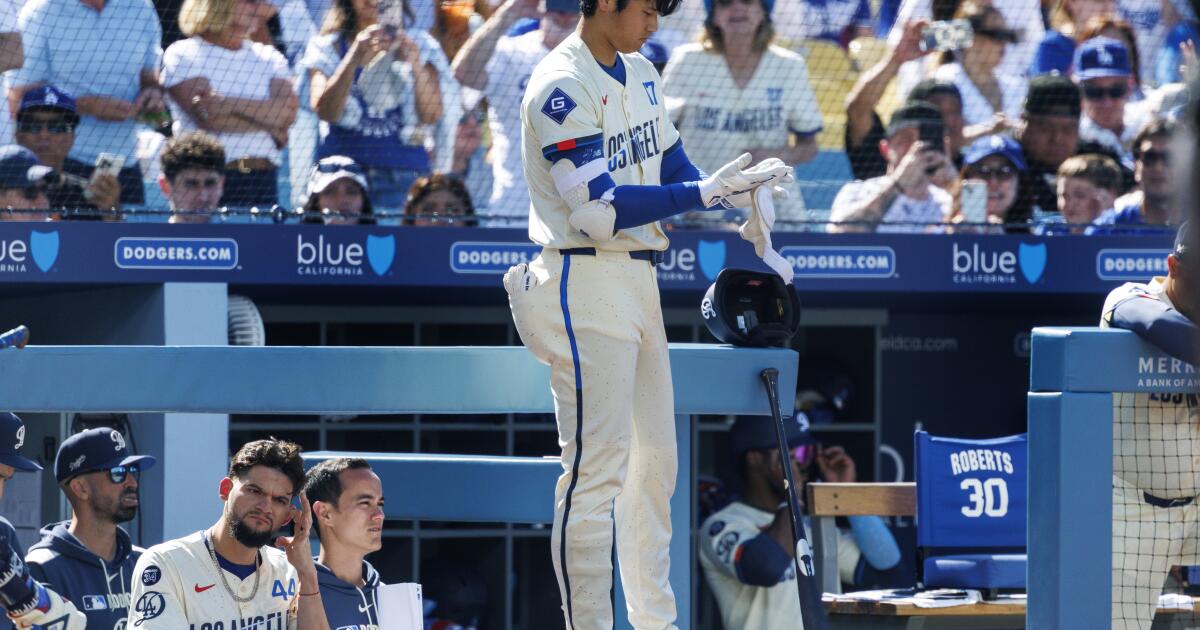

Milwaukee – His breaths were heavy. His answers were interrupted by deep inhales. And sweat pearls flowed from his forehead.
Fatigue? Maybe.
But personally invigorated? There was little doubt.
For the 31 -year -old new one, Shohei Ohtani, deep breaths and drops of sweat were only a sign of another day of work in his return to full -time bidirectional tasks, coming when he spoke to journalists after his last game as a starting launcher and designated striker for the Dodgers on Saturday.
“As long as I can play as I want to play,” said Ohtani through the interpreter Will Ireton when he celebrated his birthday: “I usually spend my birthday like any other day.”
The way Ohtani wants to play, of course, is exactly how it does it last month. After having been unable to present for the first and a half year of his Dodgers mandate – limited only to the strike while recovering from a second Tommy John surgery in career – he is finally back to a bidirectional star entirely in good health, taking the mound once a week in addition to taking off every day.
Four weeks after his return to pitching, the results were (mainly) positive for the title MVP of the National League.
In six rounds as a launcher, he only abandoned one point, four strokes and four walks while removing six strikers (a start of quality by any definition of the term, if he is considered to be an outburst).
And as a hitter, he still displays MVP caliber figures, entering the national league on Monday with 30 circuits and a percentage of strikes from .610, while ranking second in ops (0.990, behind his teammate Will Smith), 13th in Rbis (56) and 23rd on average in the stick (0.278).
“He is only manipulating him in the right direction,” said manager Dave Roberts a few weeks ago, personally surprised to watch Ohtani’s bidirectional talents closely for the first time. “It is simply imperturbable.”
The most encouraging signs of last month were with the progression of Ohtani on the mound.
Even after a second major elbow surgery, he always eclipses at 100 mph with his quick ball, while ordering it in different parts of the striking area. He quickly rediscovered the feeling of his breakage stuff, generating puffs with his sweeper and his traditional cursor. He also does it with a new slightly lowered arm angle, the one Roberts said he had not developed an accident.
“He understands his delivery and what he tries to do,” said Roberts. “So obviously when leaving the second Tommy John, I think it probably puts his arm in the best position, [where he] feels best. I like where it is.
The only missing part of Ohtani’s pitching remains the length of its outings.
So far, he has not yet passed the second round. And while Roberts called him “achievable” so that he stretches five or six innings, the team still “still does not know what it will be,” he said.
“In a rehabilitation progression, it is really important to take a step at a time,” resolved Ohtani. “There are times when I can be able to do another round, but it is really important not to take unnecessary risks and to make sure that I can progress in a coherent manner. It is always in terms of rehabilitation progression. So I’m also what the team asks me too. ”
The big question, at this stage, is how the return of Ohtani to pitch had an impact on its power with the bat.
At various times since June 10, when Ohtani increased up to three rounds during his last live session before returning to the playing action as a launcher, Roberts noted normal fatigue cases that Ohtani felt.
The slugger’s strike numbers also shot in this period, with the Ohtani hitting only. 239 since that day – although with seven circuits in 24 games and a robust Ops .919.
On the days he launches, Ohtani has always taken 5 for 16 with a double, a triple and a circuit. The days immediately after a pitch outing, however, it is 0 for 12 with a less hard contact than its thunderous swing.
There have also been increasing declines in some of the underlying numbers of Ohtani, including the output speed (average of 95.5 MPH before May 10; average of 93.3 MPH since) and the swing speed (76.3 MPH before; 75.8 MPH since) according to data from baseball scientist.
The decline was not lost on Ohtani.
On Saturday, he said that he “did not feel too bad on the plate” physically, but recognized that he had not punished the errors as well as he generally does.
“Usually, it’s a question of a little difference in the way I swing,” he said. “So just find it in the work in a cage, and hope to be able to apply it in the field.”
Roberts also minimized the concept as the product of a small sample size, insisting that he has not seen “much difference” to Ohtani in marble since he resumed his dual -way duties.
“I think he is still taking good at-bats,” said Roberts. “I still don’t mind where he is right now.”
It will nevertheless be a dynamic that the dodgers will monitor closely while Ohtani continues to try to maximize his double talents. The longer its offensive figures, the more the club cautious that the club could exercise in its long -term pitching plan.
His bat, after all, remains the only most precious tool on the whole list of the team – the Dodgers wishing to ensure that, above all, he can be a force on the plate when they try to defend their World Series title.
But, overall, its print progress has been struck during its first month as a double -meaning player, and its overall production is still among the best in baseball; With its 4.4 wins above the replacement, according to Fangraphs, the Breakout star Cubs Pete Crow-Armstrong for the best brand in the NL.
“”[I’ve been] Really, really impressed, “said Roberts on Saturday, after taking his last overview of the double -meaning Ohtani,” how he continues to improve each time each time. “”


