Swap your boiler for a money-saving heat pump


A colder weather approaches quickly, which means it is time for many people to start putting up the heat in their homes and apartments. But for many Americans, the heating of their house is an expensive affair – and it only becomes more expensive. New research from the National Energy Assistance Directors Association (NEADA) estimate that the heating prices of a house will increase by around 7.6% compared to the average winter heating of last year.
An often praised of Glind on your energy consumption is to switch to a heat pump instead of using an old -fashioned oven or a boiler. This exchange can be very profitable, saving about $ 370 per year. Air-to-air heat pumps can also be profitable even without subsidies in 59% of households, and energy and money saving services are amplified when using high efficiency and insulation equipment. An article of 2021 revealed that 32% of American houses would economically benefit from the installation of a heat pump and that 70% of American houses would see emission discounts. The average savings for an American house that makes the change have nothing to make fun, with even greater savings when manufacturing the exchange from fuel oil, propane or traditional electric heating.
While heat pumps in the United States are traditionally associated with warmer locations, they are starting to become more feasible for colder climates. “You can almost buy a heat pump for most climates in the United States and this can reduce your energy bills,” explains Allison Mahvi, professor of mechanical engineering at the University of Wisconsin-Madison, explains Popular science. Some of Mahvi’s research focuses on how to manufacture more effective heat pump systems for cold climates.
Here’s how a heat pump works and why it is a technology to keep an eye on even if your CVC is in the shape of a picture.
[ Related: Heat pumps still get the job done in extreme cold. ]
How heat pumps work
The heat pump itself is not a new invention – its roots date back to the 1850s. You probably already have one in your home – inside your refrigerator, explains Ian Shapiro, professor at the University of Syracuse who specializes in research on heat pumps. A refrigerator works by removing the heat of the pepper last night and a basket of half-finished berries and by moving it in your kitchen, he adds. This then maintains your leftovers at a cool temperature and bacteria resistant. This process works via a very simple law of nature – the heat will always move from a high temperature to a low temperature, even if the two temperatures in question are quite low.
In terms of heat pump that warms a house, it requires a super cold refrigerant which is usually about 30 degrees colder than outside air, adds Shapiro. Even when the outside temperature is a windy fahrenheit at 30 degrees, the heat always moves in a refrigerant which is at 0 degrees Fahrenheit. When this happens, the refrigerant evaporates and compresses at a very high pressure – typically several hundred pounds per square inch.
“And what happens when a gas is compressed? It becomes hot,” he adds.
This hot air is then dissipated in the house. Heat pumps can also operate upside down, taking hot air from the inside of the house and sending it outside, as well as a traditional air conditioner.

What are the types of heat pumps?
These air-to-air heat pumps are the most common type. They work by pulling the heat from the air inside or outside the house, then placing this heat in the opposite direction, depending on the season.
The heat of the air from the air in the water always take the heat of the outside air, but instead of heating the air in a house, it is introduced into a wet central heating system which works a bit like central gas heating.
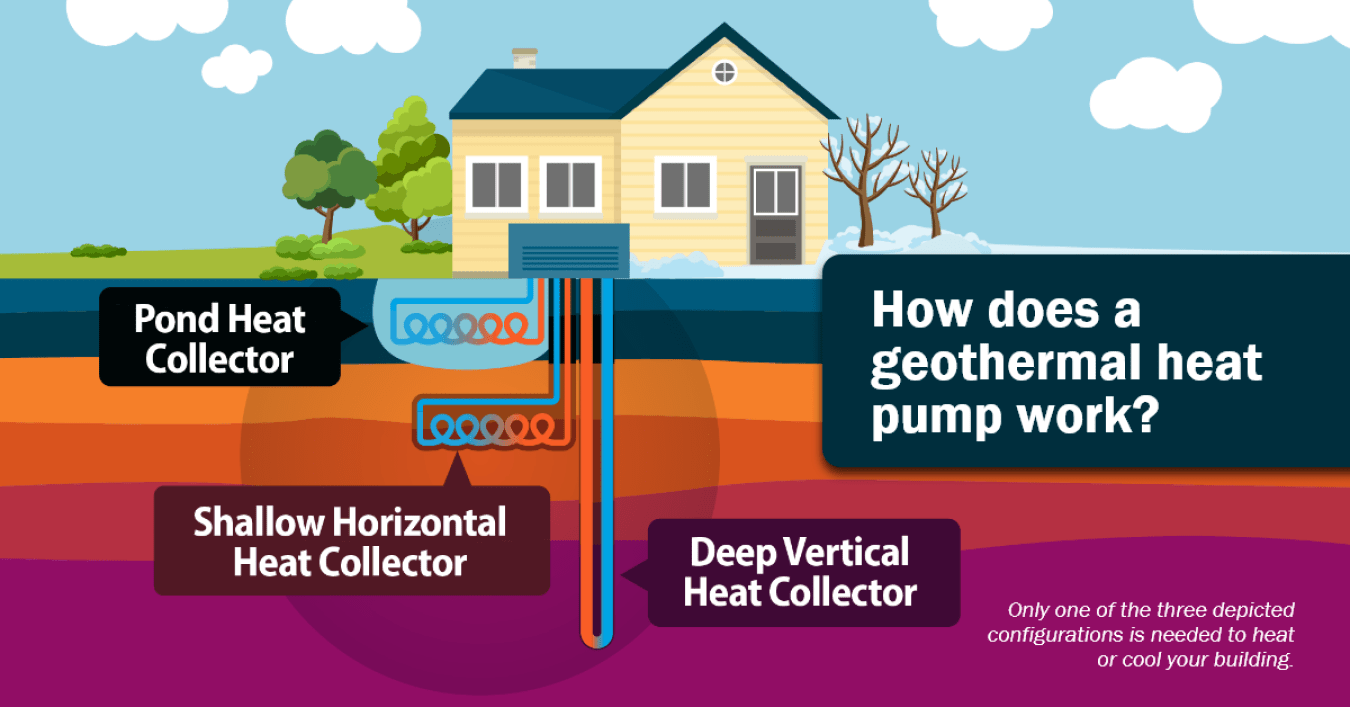
Heat pumps at the terrestrial source or geothermal heat pumps extract the heat from the basement to heat a house during the cold seasons and reversed when it warms up. There are even systems, nicknamed hybrid heat pumps, which operate in the same way as traditional heat pumps, but stay connected to a furnace system in the event of extremely cold time
The advantages of a heat pump
Energy efficiency is the main advantage of a heat pump, because it takes heat and moves it instead of generating it from zero like the boiler or the oven. According to the International Energy Agency, the performance coefficient (the electricity report in thermal energy) is around four, which makes current models 3 to 5 times more energy efficient than gas boilers.
The most exciting thing about heat pumps is that there is still an important place for improvement, when we have about maximum how to make the combustion heating systems more effective.
“We have done everything we are going to do with the fossil fuel, and this is not the case with the heat pumps,” explains Shapiro.
A major development that we have already seen in recent decades is the development of a heat pump at variable speed. These help to amplify the effects of a heat pump in extra-circular weather without having to execute it at high speed all year round, adds Shapiro. But there is still a lot to improve heat pumps, which leaks in heat exchangers, control of compressors’ speed, setting up defreshed to thaw only if necessary, and even testing how the implementation of thermostats and other equipment in the house can have an impact on the efficiency of a heat pump.
“We are looking for all these little savings, and I think they will add up,” he adds.
Until recently, there were important federal tax credits to help ordinary Americans obtain heat pumps and other energy efficiency in their homes. The changes in politics due to these advantages are now limited until the end of 2025. Some states, including California, New York, Maine, Georgia and New Mexico, still have advantages that residents can also benefit from. Although the loss of federal tax credits is not excellent, Mahvi says that these policy changes are more a slowdown than a car accident.
Installation costs are also still a high obstacle to entry, as it costs an average of $ 10,750. But the word on this technology continues to spread. The Americans bought 32% heat pumps at air source that gas ovens in 2024, according to data from the air conditioning, heating and refrigeration institute. Mahvi says costs continue to drop over time, but the key is to start thinking about the reality of getting a heat pump in your home now, even if your CVC is in perfect condition.
“If your heating system dies in the middle of winter, you will not spend three weeks getting good entrepreneurs,” says Mahvi. “I would recommend that people spend a little time thinking about what they want to do in the future with their house.

More offers, reviews and purchasing guides


