So long, plastic wet wipes




Jonah FisherEnvironment correspondent
 Jonas Fisher/BBC
Long the scourge of water companies for blocking pipes, a ban on the sale of plastic wet wipes has been promulgated.
The new rules will come into force in 2027 and will bring England in line with legislation in the rest of the UK.
Plastic wipes do not disintegrate when flushed down the toilet. So when oil and grease congeal on them, “fatbergs” form in the sewers, which water companies estimate costs £200 million a year to clean.
Most wipes sold in the UK are now made from non-plastic materials, but the government and water companies say they should not be labeled as “flushable” as they can still cause blockages.
Wet wipe manufacturers contacted by the BBC said their non-plastic ‘flushable’ wipes had been thoroughly tested and complied with all the rules.
 PA Media
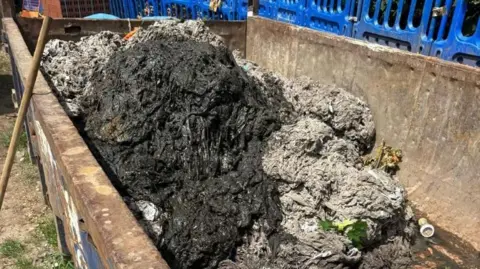
Fatbergs can become huge if the blockage is not cleared.
Last month a huge, stinking pile of wet wipes, grease and oil was removed from a west London sewer. It weighed the same as eight double-decker buses and it took a specialist team more than a month to dismantle it.
The wet wipes market has been growing steadily for years. According to government figures, in 2023, 32 billion wipes were sold to UK consumers, of which around 12 billion contained plastic. If they were all laid out flat, it would be enough to cover 2,200 football fields with plastic wipes.
Although they welcomed the new legislation for England, water industry sources were quick to point out its limitations.
UK companies will still be able to manufacture and export plastic wet wipes, and they will still be able to be bought from pharmacies in person (behind the counter) and online. Businesses such as hotels will be allowed to purchase the wipes, without restrictions.
The medical profession has successfully advocated for an exemption from the wet wipes ban, arguing that non-plastic wipes absorb too many detergents and disinfectants impregnated into them, with potential consequences for patient safety.
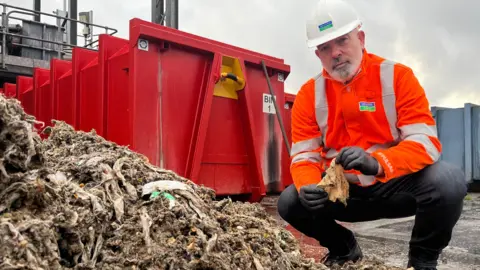
At the wastewater treatment plants in Minworth, in the Midlands, the scale of the current problem can be both seen and felt.
Minworth serves a population of more than two million people in Birmingham and the Black Country and Severn Trent, who runs the facility, says 10 tonnes of wet wipes a day end up here.
“It’s a nightmare,” says Grant Mitchell, head of blockages at Severn Trent, as we examine a small mountain of wipes.
He just showed us the area where the “non-disposables” are filtered from the wastewater. This is vile stuff. There are dead rats, a rubber ducky and a huge ball of soiled wipes.
“Wet wipes are problematic because they are designed not to break down like toilet paper,” he says. “So they stay in one piece, and they collect with the grease, oil and grease from the kitchens, congeal and create a fatberg that causes flooding.”
Emma Hardy, Minister for Water and Floods, is also present in Minworth.
“It’s going to make a huge difference,” Emma Hardy, the Minister for Water and Flooding, said of the ban as we sheltered from the rain in Minworth. “I think people may underestimate the amount of problems these wet wipes cause.”
 Daniel Jolly/University of East Anglia
While many brands claim their wipes are “flushable” and environmentally friendly, there are questions about whether they can and should be flushed down the toilet.
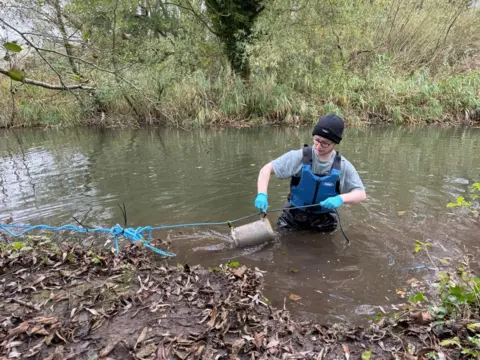
Daniel Jolly is studying how quickly these biodegradable wet wipes break down. In a laboratory at the University of East Anglia in Norwich, we watch him simulate the effect of a toilet flush on a wipe.
“It’s not toilet paper,” he says as the wipe slowly breaks into fibers as he stirs the water inside a tank. “Even though it’s the same basic materials, this one is constructed completely differently and it’s much stronger.”
Jolly carried out tests on the banks of the River Yare to see how quickly the plastic-free wipes disintegrate.
“It’s a period of several months to a year, even two years, depending on the environmental conditions they’re in,” he says.
“This is much slower than toilet paper, which lasts between a few weeks and several months, but much better than a plastic wipe which can last hundreds or even thousands of years in some situations.”
Government-commissioned research found that some non-plastic wipes failed tests for how quickly they disintegrated, meaning they could still block drains.
Jolly is now studying the impact of biodegradable wipes on aquatic life when they break down.
 Jonas Fisher/BBC
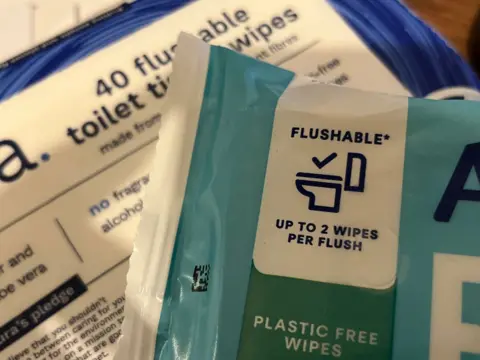
Until March 2024, water companies operated a certification system which gave the green light for the use of certain wipes in toilets, called “Fine to Flush”. But this was discontinued over fears it would cause confusion among consumers and replaced with a new slogan “Bin the Wipe”.
Now the advice from the government and water companies is very clear. Only the three Ps: pee, paper and poop should be flushed down the toilet.
“Restricting the sale of wet wipes containing plastic is a step in the right direction,” said a spokesperson for Water UK, the industry’s trade body. “But we really need a ban on their manufacture and mandatory ‘do not throw away’ labeling on all wet wipes.”
Some manufacturers who sell ‘flushable’ wipes have told the BBC they are in fact wet toilet paper, but Water UK said it still regards them as wet wipes and should therefore not be flushed down the toilet.
“I would encourage them [the wet wipe manufacturers] show leadership on this issue now,” said Minister Hardy.
“Instead of marketing them as flushable, provide labeling to inform the public that they should throw them in the trash and not flush them down the toilet.”
Additional reporting by Gwyndaf Hughes


