Social Security workers face crunch to help cut phone waits : NPR

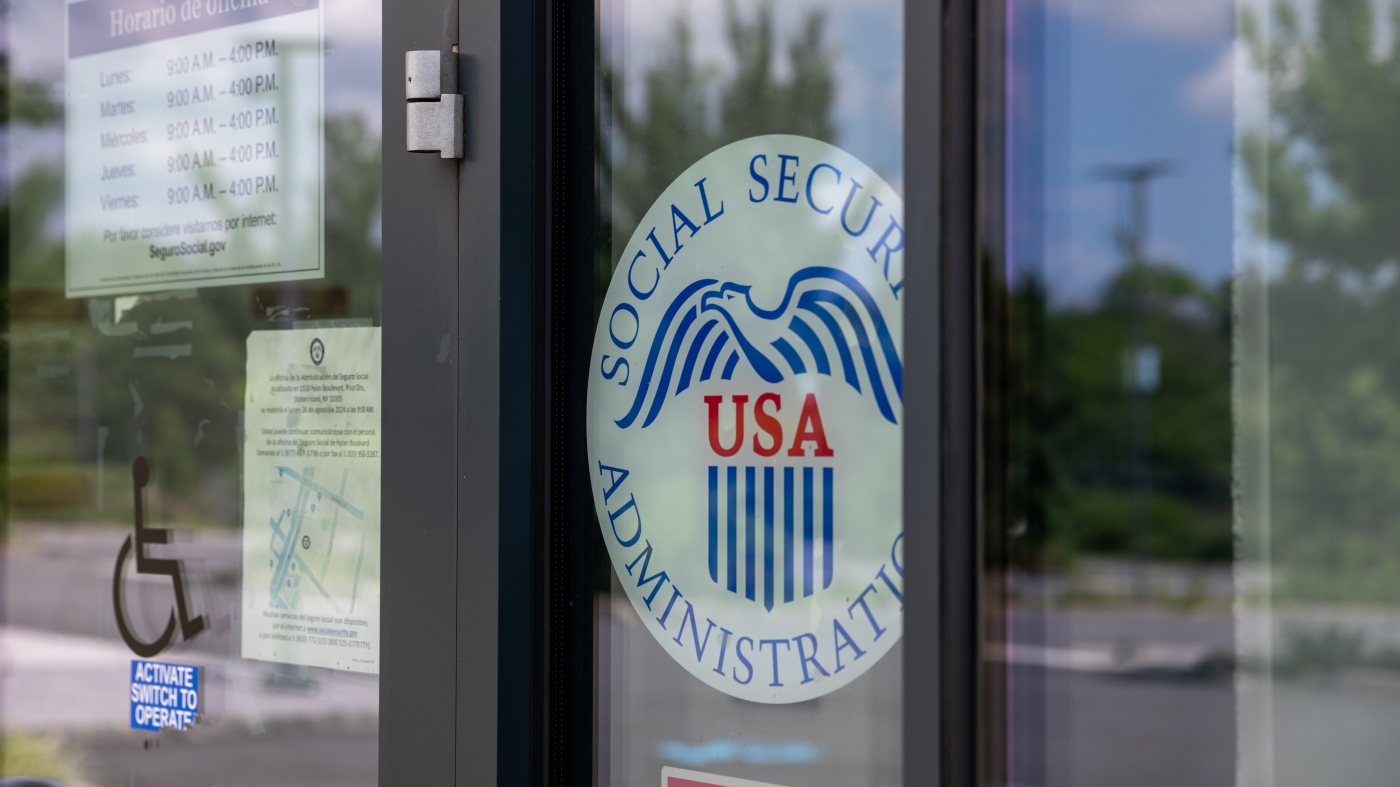

There is an current endowment to the social Security Administration. Here is one of the agency’s offices, on Staten Island, NY
Olga Ginzburg for NPR
hide
tilting legend
Olga Ginzburg for NPR
The Social Security Administration (SSA) recently reassured a small part of its employees of the field office in order to reduce long waiting times for the agency’s national telephone number 800.
Local offices workers across the country say that these reallocates have disrupted staff and increase waiting times for other services.
Experts claim that compromise is a by-product of a decreasing social security personnel dealing with thousands of other Americans who qualify every day for the advantages. Thousands of employees have left the government agency in recent months.
“They are in a deep hole in their own creation on the staff and you simply do not have enough people to serve the public,” said Kathleen Romig, a former SSA official who is now director of social policy and disability policy at the center of the left on the budget and political priorities (CBPP). “And so all you can really do at this stage is reorganizing the Pont Chairs of the Titanic.”


Earlier this month, approximately 4% of front-line workers were temporarily reassigned to cover the national number 800, according to the SSA, which added that the telephone service has improved accordingly.
“Thanks to a new telephone platform, most appellants are now served quickly thanks to reminders or automated options, and response times have already improved considerably in field offices,” the agency said in a statement at NPR. “By temporarily assigning a small percentage of field office staff to help 800 number calls, we can improve the 800 [number] Average response speed without disturbing local services. “”
“The stress level is probably a maximum for everyone”
But Nicole Morio, an employee of the field office of Staten Island and union representative, said that these reallocations had forced leading staff to do more work.
“The level of stress is probably a maximum for everyone,” said Morio. “At one point, I think we were doing the work of 1.8 people. Now it seems that we do work from 10 to 15 years.”
Monique Buchanan, president of a section of employees of the US Federation of Employees (AFGE) who represents workers in the TV center, told NPR that the agency had also started to reallocate specialists in vital affirmations of number 800.
Buchanan, who works in a Detroit field office, said that the temporary abolition of specialists in front -line positions is “directly harmful to the public”. She said these workers finalize applications for people looking for help for access to services, such as payments for disabled children.
“These requests are taken by an interview in which the complaint specialist is committed,” she said. “So the start is the interview with the complaint specialist.”
The CBPP Romig said that the staff endowment of the national hotline may not be really faster for beneficiaries, as so much work is carried out by complaints and other staff members in campaign offices.
“Often customers cannot really end their business on the phone,” she said. “They will have to end up in a field office anyway, or an employee of the field office will have to deal with this assertion that has been taken on the phone or solve the problem that was raised on the phone.”
The agency recently presented that this had reduced the average response speed on the number of 800 to “13 minutes, a reduction of 35% compared to the period last year and more than one reduction of 50% compared to the annual average of last year”.
But experts say it is more difficult to follow if the agency does better in other measures. Recently, the agency has eliminated various real -time measures from its website.
Romig said it is possible that waiting times decrease as more and more people are transferred to 800 numbers, but this will surely be at the expense of other vital services.
“Of course, you can get a boost in a particular metric such as time to maintain the phone by making a massive change of staff members to respond to phones,” she said. “But you do this by creating a new hole in field offices, and that’s what they do.”

A Social Security Administration Office in Staten Island, NY
Olga Ginzburg for NPR
hide
tilting legend
Olga Ginzburg for NPR
Morio, the employee of Staten Island, believes that she and other workers from the field office are “prevented” from serving people who need their help correctly.
“We cannot finish all the things that must be done,” she said. “When you have so few employees and so much work – it’s stressful because we are hired to help the applicants. We are hired to help the American public. We are civil servants. This is what we do.”
Thousands have already left the SSA this year
Political experts and front -line workers say that the drop in waiting times for telephone services is a worthy objective, but it cannot be achieved without hiring more staff.
Romig said that social security endowment levels were already at a lower advantage before the Trump administration begins to urge people to resign or retire early.
According to agency officials, around 4,600 employees have left since March.
Romig warned that the staff “the figures are very difficult to identify” because resignations are constantly “in flow”, due to the delayed resignation program of the administration and the first in progress pensions.
During a conference hearing last month, the new SSA commissioner Frank Bisignano told members that he did not think that the increase in staff is necessary to improve the services of the agency.
“I agree that we have to work much better,” he said, “but the increase in staff is not the long-term solution.”


But Jessica Lapointe, who works in a Madison, Wisconsin field office, and is the president of the local AFGE section which represents 25,000 field office employees, said that the staff mixture encourages even more people to leave the agency.
“If they decided not to take the incentives for the takeover that were offered in March, then now they only save their mental health because their work continues to accumulate,” said Lapointe. “It is really a manufactured crisis following past changes that continue to worsen everything, unfortunately.”
Some local fields have only a few employees, so the loss of a can have a big impact.
Juan Daniel Vasquez, who is a general technical expert in a field office in Monroe, Michigan, said that his office had an employee who covered phones that have recently been transferred to the 800 number. He said that since then, all the staff has been responsible for covering phones, which added a large amount of work to the plate of each.
“It’s much more difficult,” said Vasquez. “I am approaching the retirement age and … if you had asked me last year, I would have said that I wanted to stay five to seven years. Now, I look one by two.”
The agency told NPR that Bisignano had “visited offices in the field and processing centers to hear directly on front line employees”, from its confirmation audience.
“He is committed to giving ASA employees the tools they need to provide the best class customer service to the American public and succeed in their role,” the agency said in a statement. “SSA monitors all workload measures in field offices that help respond to 800 number calls.
But Lapointe said that working conditions for workers from the field office in recent months were only getting worse.
“Nothing indicates that it improves,” she said. “We have an agency that does not listen to workers.”


