Stranded Chinese Astronauts Return to Earth, but Space Junk Threats Remain


November 14, 2025
1 min reading
Stranded Chinese astronauts return to Earth, but space debris threats remain
THE Shenzhou 20 The spacecraft was too damaged to bring its crew back from China’s Tiangong space station. These astronauts have now returned via the Shenzhou 21 spaceship, leaving its crew with no return until the nation sends a new spaceship to the station
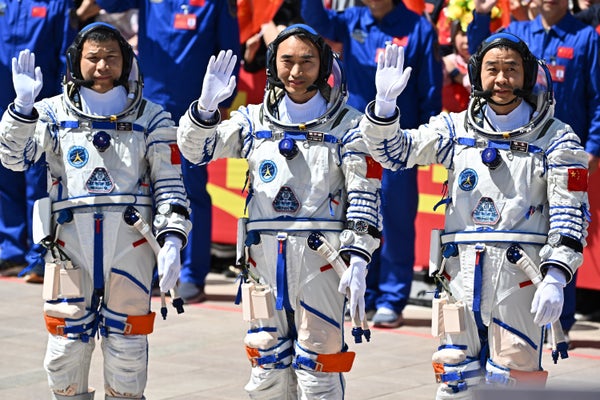
Astronauts from China’s Shenzhou-20 space mission, Wang Jie, Chen Zhongrui and Chen Dong, salute before boarding a bus to take them to the Shenzhou-20 spacecraft, April 24, 2025.
Pedro Pardo/AFP via Getty Images
Three Chinese astronauts, stranded for several days in space after a suspected piece of space debris hit their spacecraft, are back on Earth, the Chinese Manned Space Engineering Office (CMSE) announced on Friday.
The agency also revealed that it discovered tiny cracks in one of the windows of the crew’s boat. Shenzou20 return capsule, rendering it unusable.
The astronauts returned to the Shenzhou 21 spacecraft, which had initially been used by Shenzou20The replacement crew. China had planned to keep the Shenzhou 21 capsule docked with its Tiangong space station to bring these astronauts back at the end of their mission, currently scheduled for April 2026.
On supporting science journalism
If you enjoy this article, please consider supporting our award-winning journalism by subscription. By purchasing a subscription, you are helping to ensure the future of impactful stories about the discoveries and ideas shaping our world today.
“I’m very happy that they returned home, but it’s a little disconcerting that the replacement crew apparently doesn’t have a vehicle to return to Earth,” says Victoria Samson, chief director of space security and stability at the Secure World Foundation, a Colorado-based nonprofit.
CMSE told China’s Xinhua news agency that a new spacecraft, Shenzhou 22, will be launched at an “appropriate time in the future”, meaning that the remaining three people of the Tiangong crew currently have no way to return to Earth in the event of an emergency.
It’s unclear exactly what type of debris hit Shenzhou 20but Samson speculated that it was probably tiny – perhaps between one and 10 centimeters in diameter – which is too small for astronomers to track.
“This again highlights the argument for not deliberately creating debris in orbit,” Samson said.
It’s time to defend science
If you enjoyed this article, I would like to ask for your support. Scientific American has been defending science and industry for 180 years, and we are currently experiencing perhaps the most critical moment in these two centuries of history.
I was a Scientific American subscriber since the age of 12, and it helped shape the way I see the world. SciAm always educates and delights me, and inspires a sense of respect for our vast and beautiful universe. I hope this is the case for you too.
If you subscribe to Scientific Americanyou help ensure our coverage centers on meaningful research and discoveries; that we have the resources to account for decisions that threaten laboratories across the United States; and that we support budding and working scientists at a time when the value of science itself too often goes unrecognized.
In exchange, you receive essential information, captivating podcasts, brilliant infographics, newsletters not to be missed, unmissable videos, stimulating games and the best writings and reports from the scientific world. You can even offer a subscription to someone.
There has never been a more important time for us to stand up and show why science matters. I hope you will support us in this mission.


