Some gifted dogs can learn new toy names by eavesdropping on owners

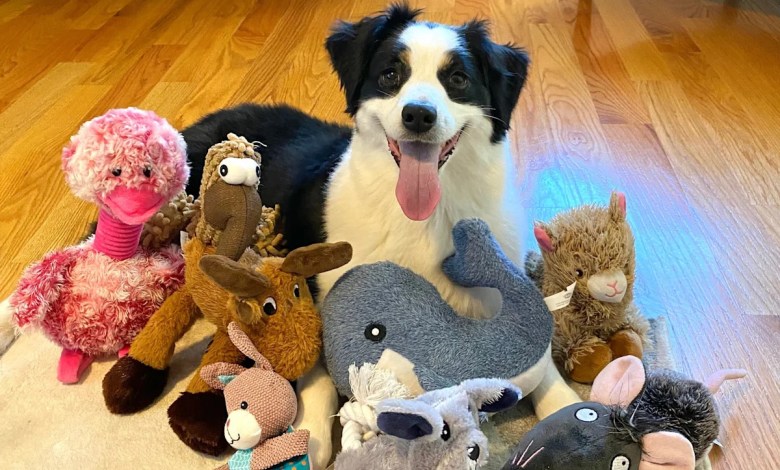
NEW YORK (AP) — Dogs are good at learning action commands like “sit” and “stay.” They are less good at remembering the names of things, like the names of their squeaky or stuffed toys.
Only an elite group of dogs gifted at learning words can remember the names of hundreds of toys. Scientists know of about 50 such dogs, but they don’t yet know what’s behind their wordy skills.
Now, new research is pushing the boundaries of what dogs can do.
Scientists already knew that these extraordinary puppies could learn the names of their stuffed pizzas and donuts while playing with their owners. In the latest study, they found that puppies can also understand new names by listening at doors.
Ten gifted dogs – including a Border Collie named Basket and a Labrador named Augie – watched their owners hold a new toy and tell another person about it. Then the puppies were asked to go to another room and retrieve that specific toy from a pile of many others.
Seven of ten dogs successfully learned the names of their new toys, stingrays and armadillos, by passively listening to their owners.
“This is the first time we have seen a specific group of dogs able to learn labels by hearing interactions,” said study author Shany Dror of Eötvös Loránd University in Hungary and the University of Veterinary Medicine in Austria.
Puppies even succeeded when owners put the toy in an opaque box and then told another person about it, creating a gap between seeing the object and hearing its name.
Only a few other animals, such as parrots and monkeys, have demonstrated a talent for this type of eavesdropping. It’s also essential to human development: children under 2 can learn new words by listening, including ones their parents may not have anticipated.
However, these special dogs are adults, so the brain mechanisms that allow them to listen are likely different from those of humans, Dror said.
The new work shows that “animals have a lot more going on cognitively than you think,” said Heidi Lyn, an animal cognition expert at the University of South Alabama. She played no role in the study published Thursday in the journal Science.
Not all dogs feel this way, so it’s unlikely that your four-legged friend will learn names by munching on scraps under the table.
Dror hopes to continue studying gifted dogs and determining what signals they pick up on. They are among his most enthusiastic – and most complicated – research subjects.
“We sometimes have dogs come into the lab, which is really nice,” she said, “but often someone pees on the couch. So it happens.”
___
The Associated Press Health and Science Department receives support from the Howard Hughes Medical Institute’s Department of Science Education and the Robert Wood Johnson Foundation. The AP is solely responsible for all content.


