Some stinkbugs’ legs carry a mobile fungal garden


Many species of insects hear thanks to the tympanal organs, membranes roughly resembling our eardrums but located on their legs. Grasshoppers, mantises, and moths all have them, and for decades we thought that female bugs of the genus Dinidorids The family has them too, although they are located somewhat unusually on their hind legs rather than their front legs.
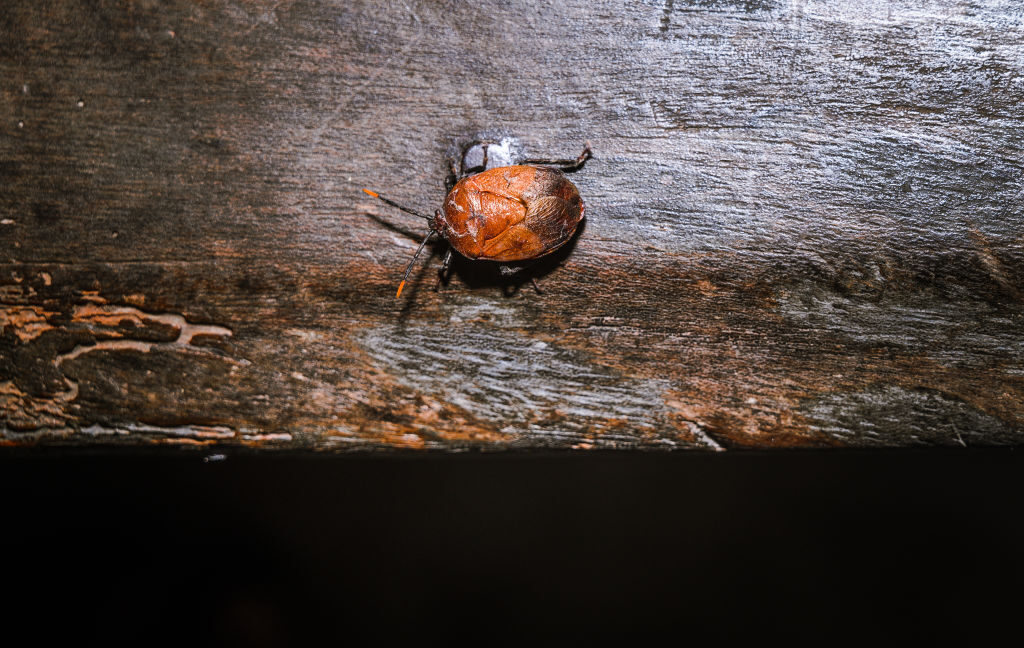
Suspecting that they use the tympanal organs of their hind legs to listen to the courtship songs of males, a team of Japanese researchers took a closer look at the organs of Megymenum gracilicorneA Dinidorids species of bug native to Japan. They discovered that these “tympanal organs” were not what they appeared to be. They’re actually mobile fungal nurseries of a type we’ve never seen before.
Portable Gardens
Dinidorids is a small family of bedbugs that lives exclusively in Asia. The bug has attracted some scientific attention, but not as much as its larger relatives like Pentatomidae. Previous work focusing specifically on the organs developing on the hind legs of the Dinidorids women were therefore somewhat limited. “Most research relied on taxonomic and morphological approaches. Some taxonomists described that female Dinidoridae bugs have an enlarged part on the hind legs that resembles the tympanal organ that can be found, for example, in crickets,” said Takema Fukatsu, an evolutionary biologist at the National Institute of Advanced Industrial Science and Technology in Tokyo.
Based on this appearance, these parts were classified as tympanic organs: the case was closed, and it remained closed until Fukatsu’s team began examining them more closely. Most insects have tympanal organs on their front legs, not on their hind legs, nor on the abdominal segments. The initial goal of Fukatsu’s study was to determine the impact of this unusual position on the ability of female Dinidoridae to hear sounds.
At the beginning of the study, it turned out that no matter Dinidorids females have on their hind legs, these are not tympanal organs. “We found no tympanal membrane or sensory neurons, so the enlarged parts of the hind legs had nothing to do with hearing,” Fukatsu explained. Instead, the organ had thousands of tiny pores filled with benign filamentous fungi. The pores were connected to secretory cells that released substances that Fukatsu’s team believed were nutrients that allowed the fungi to grow.


