
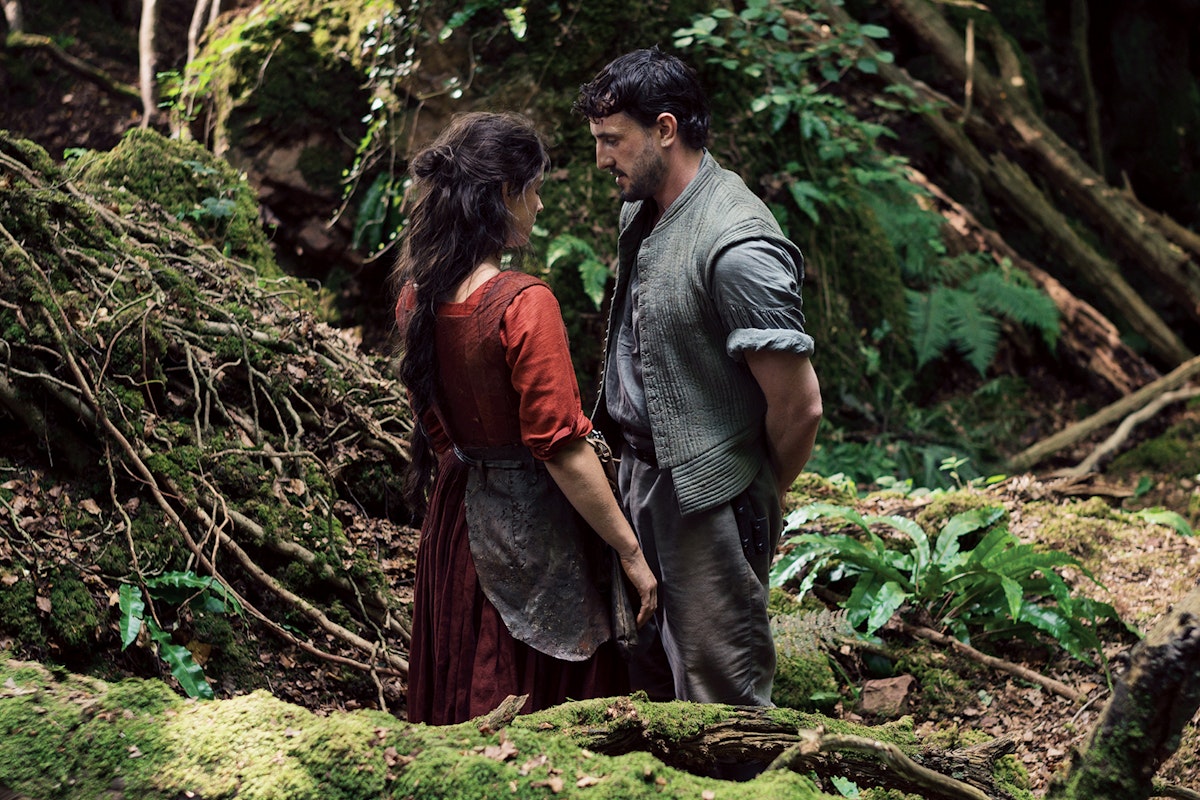
Hamnet is the director’s first period piece, and while the glancing, magic-hour lyricism of the cinematography (by the excellent Łukasz Żal, who shot The Zone of Interest) connects it to its predecessors, Mescal’s and Buckley’s performances exist in a new register. Instead of trying to penetrate the hardened exteriors of amateur actors—or coaxing an old pro to act natural—Zhao means to steer two thoroughbred thespians through the cinematic equivalent of the Preakness. Buckley’s Agnes is first seen curled up in a muddy hollow—literally tree-hugging—linking her in the film’s meticulously on-the-nose imagery with capital-N Nature; if it’s possible to overact lonely repose, Buckley’s body language fits the bill. It’s not her fault: Hamnet is so determined to establish Agnes as an elemental presence—with quasi-uncanny psychic abilities, a gorgeous pet falcon, and a nasty fairy-tale stepmother to match—that it pushes a technically brilliant actress perilously into the realm of Gaia-ish caricature.
What makes Buckley remarkable in her best roles is her quality of emotional translucence, the way her feelings seem to burn through her skin. Here, though, the temperature has been jacked up so that her gestures and line readings all more or less melt together, while Mescal—after Aftersun, the millennial patron saint of on-screen Sad Dads—tries to compensate with a coolness that, while exquisitely shaded in places, succeeds mainly in making Will a sloe-eyed cipher. Both actors make something of the aftermath of Hamnet’s death, reproducing the stark and telling contrasts of behavior in O’Farrell’s novel, with Buckley inhabiting the omniscient narrator’s observation that “there are many different ways to cry … the sudden outpouring of tears, the deep, racking sobs, the soundless and endless leaking of water from the eyes” and Mescal deftly approximating Will’s reaction upon seeing the body: “the sound that comes out of him is choked and smothered, like that of an animal forced to bear a great weight.”
It’s hard not to be affected by moments like these, or by how Zhao visualizes the dying Hamnet in limbo: wandering a bare stage, wondering aloud where he’s gone, before exiting through a darkened portal. The sheer ferocity of Hamnet’s assault is an achievement of sorts, and yet the boundary between humane empathy and award-baiting shamelessness—a tightrope walked by many great artists, and also plenty of dubious ones—keeps blurring. Part of the problem is that Will and Agnes’s odd-couple, star-crossed courtship and subsequent bucolic family life are presented with such rib-nudging ominousness—the kids arrayed playfully as the witches from Macbeth; the death of the aforementioned family falcon—that things feel heightened (and phony) before the arrival of a paradigm-shifting trauma. Meanwhile, on a formal level, Zhao never stops pummeling us. The use of Max Richter’s luminous composition “On the Nature of Daylight” gives the game away; the piece is such a musical cheat code that pretty much any auteur with a Spotify account has used it, so that when we’re supposed to be gripped by the climactic-performance-within-the-film of Hamlet, we’re remembering money shots from Arrival and The Last of Us instead.


