Postcode lottery for new cancer treatments, doctors warn


Philippa RoxbyHealth journalist And
Jim ReedHealth journalist

 Getty images
Senior cancer doctors warn that excessive administrative formalities mean that some patients in England find it difficult to access the latest cancer treatments.
The Royal College of Radiologists (RCR) claims that bureaucracy is “stifling innovation” and that the request for funding to pay new treatments can be “heavy” for certain cancer centers.
He indicates that the situation leads to an unacceptable postal code lottery with certain cutting -edge treatments available only in larger and better funded units.
The government claims that a new cancer strategy, later due this year, “will put the NHS at the forefront of global cancer care”.
Doctors and scientists say that we live through a golden age of cancer treatment, the new pierced now changing the way patients are taken care of.
Survival rates for many current cancers have increased, partly caused by new technologies such as immunotherapy drugs and more advanced radiotherapy.
But the body representing the two radiologists, which analyze the analyzes and treat patients, and doctors’ cancer says that the Bureaucracy of the NHS means that some people lack the latest rescue treatments.
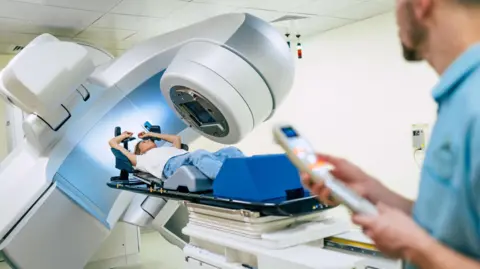
The RCR says that even certain well -established advances, such as stereotaxic ablative bodily therapy – or sabr – can always be difficult to access.
SABR is a means of targeting the disease more precisely with a precise dose of high -resistance radiation, and is generally used to treat very small tumors in the lungs, the liver, lymph nodes and the brain.
The RCR says that individual cancer units must still apply to NHS England to finance its use, leading to a postal code lottery where some patients lose.
“It is inequitable and unfair and not compatible with the National Health Service,” said Dr. Nicky Thorp, cancer doctor and vice-president of clinical oncology at the RCR.
“We would like the administrative formalities to be cut and the commissioners to listen to clinicians who really understand the impact on patient care,” she added.
The RCR and the Society of Radiographers both wrote to the government to ask that Sabr be more easily available, as well as other advanced treatments such as certain immunotherapy drugs and molecular radiotherapy, which uses radioactive drugs to target cancer cells.
The NHS in England says that each hospital trust offers radiotherapy is able to offer SABR, and it has committed to a “rationalized approach” to extend its use.
 Family document
“Vital” treatments
Ray Bowen, 76, from Middlesborough, had one of his kidneys removed in 2019 after receiving a cancer diagnosis.
In 2022, a scan showed that the disease had returned to its second kidney and that it was told that surgery would not be possible.
“At best, it meant that I should have been put on dialysis, which I really would not have imagined,” he said.
Instead, the former soldier and worker of shipyards received SABR radiotherapy to treat cancer with high -dose radiation and, three years later, he says that he is fine.
“I just feel very lucky,” he said. “Not long ago, something like that wouldn’t even have existed.
“It is a magical treatment and undoubtedly, it must be more available.”
New cancer strategy
The Cancer Doctors call intervenes while the government is preparing to publish its long -awaited cancer strategy for England, now expected later this fall.
Cancer Research UK (Cruk) charity has said that it should include a new commitment to diagnose cancer earlier after a new report revealed that only half of people diagnosed with cancer after an urgent reference get the news in the 28 target days.
For certain cancers, such as bones, bladder, kidneys and head and neck, only about a third of people receive a diagnosis within the target time.
Between 2021 and 2024, the situation for people diagnosed with cancer has worsened, according to the charity.
But, on the other hand, those who do not have cancer after an urgent reference – which is the vast majority of people – are informed more quickly, with 75% of the good news in target time.
“It is promising that more people have cancer excluded in time, helping to make their mind at ease,” said Michelle Mitchell, director of Cancer Research UK.
“However, it is unacceptable that only half of people who have cancer are diagnosed within the target time.”
Follow -up tests to confirm the presence of cancer, in particular the complexes, and of which type it can lead to diagnostic delays. This can also lead to delays in the start of treatment.
Jon Shelton, head of Cancer Intelligence in Cruk, says that this process “takes too long” and that tests must be carried out “as quickly as possible”.
An NHSE spokesperson in England said that the health service saw and treats more patients with cancer than ever before, while deploying new initiatives, such as home tests and mobile scanning trucks, to diagnose disease earlier.
The Ministry of Health has described cancer care as an urgent priority and said that its next national cancer strategy would give patients “the most sharp” care “.
“Our change plan has already had an impact, 148,000 additional people with cancer diagnosed or excluded in the 28 days from July 2024 to June 2025 compared to the previous year,” said a spokesperson.


.gif?w=390&resize=390,220&ssl=1 "No Matter What, I Will Always Get My Nails Done")

