South Africa’s Coast Is Rising—And Scientists Have a New Explanation Why


October 7, 2025
4 Min read
The South African coast increases – and scientists have a new explanation why
Human water management helps flow from land around the world, and it can also be responsible for an unexpected rise
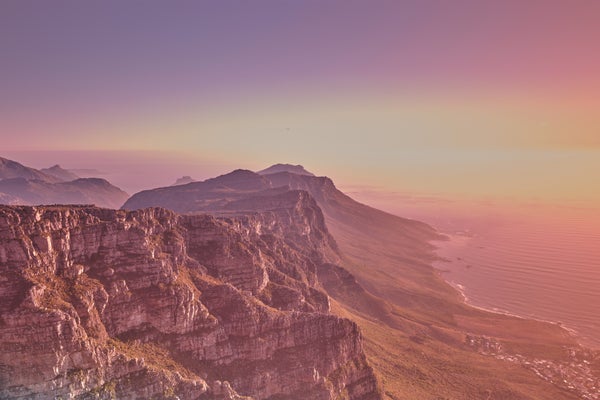
The land that launches along the South African coast can be closely linked to the use of water by humans.
For decades, geologists have thought that the slow rise in power of the southern coast of South Africa was driven by forces deeply below – molten rock plumes mounted through the mantle of the earth and lifting the crust up over millions of years. But now, satellite data and precise GPS measures are incumbent up on these hypotheses of their axis. A study in the Journal of Geophysical Research: Solid Earth suggests that this increase in land could have less to do with deep tectonic forces and more to do with missing grounds just under our feet.
Human activity has long exhausted the groundwater from South Africa. In 2018, after having fought on severe droughts for years, the country approached a full -fledged water emergency when the CAP was almost the first major world city to run out of water – a scenario nicknamed “Zero day”. For several months that year, the city residents had to face the very real perspective of having regularly tailoring for seriously limited water supplies, a result marked only by timely precipitation and intensive water saving campaigns. The extreme shortage results from a combination of climate change and the use of unsustainable water, which has drained the surface tanks and has placed the mounting pressure on aquifers across the region.
The recent study hypothesizes that the soil, formerly compressed by the pure weight of surface water and groundwater above, is now developing as a pressure-relieved foam mattress. Using GPS data and satellite severity between 2000 and 2021, the researchers detected an increase of approximately six millimeters in the surface of the field – a change that coincides with the exhaustion of humans of water reserves and periods of drought by humans.
On the support of scientific journalism
If you appreciate this article, plan to support our award -winning journalism by subscription. By buying a subscription, you help to ensure the future of striking stories about discoveries and ideas that shape our world today.
“Sometimes the first explanation is not necessarily the right one,” explains the geodesist at the University of Bonn, Christian Mielke, the main author of the study. “It may not be the tectonics of the plates after all.”
This misunderstanding, not necessarily the land up itself, can be the most striking thing about the situation in South Africa. What has once been rising to the next day, the grooming of the mysterious and inaccessible interior of the earth can rather reflect human activity, in particular our management – or mismanagement – of water.
“The presence of water, either as an ice cream and snow, on the surface of the ground, or like the groundwater below, and the elimination of this water is intimately linked to the deformation of the ground surface,” explains the geophysicist of the University of Stanford, Rosemary Knight. In most places in the world, this process generally leads to a shipwreck, called subsidence, to fill the gap.
But in South Africa, suggests the new study, that the link between water and earthly movement is surprisingly. During the rainy season, rivers and tanks are filled, adding weight that presses the crust. During the dry months, a large part of this water evaporates or is pumped, and the land bounces upwards. Over time, the long -term loss of groundwater advances the balance towards uprising rather than sink.
This “seasonal breathing” is the gift that the cause is probably not only a mantle plume. If the molten rock pushed up, the movement would be stable, not linked to the cycles of precipitation. Expansion, if verified, could be another example of how the use of human water reshapes the planet.
From 1945 to 1970, more than 13,000 square kilometers from the San Joaquin Valley in California, formerly greeted like a “land of milk and honey” for migrants in the dust bowl, sank at least 30 centimeters – and in certain places of almost nine meters. The sinking of San Joaquin has only accelerated since then, and certain parts of the valley drop more than 30 centimeters per year during severe droughts. On average, the pace accelerated by 70% compared to the middle of the 20th century.
Something similar is happening at Chesapeake bay, which, with its radical estuaries and lush tide wetlands, is one of the most important regions of the east coast of the United States. Here, the sagging of the land – led both by the extraction of the groundwater from the aquifers and the persistent effects of the old glacial changes – accelerates the risk of flooding and the relative elevation of the sea level. Satellite data, recordings and projections of the tide of the intergovernmental panel on climate change suggest that sea level could flood up to 1,100 square kilometers from the coastal coast of Chesapeake.
Mielke notes that these results highlight the complexity of the planet’s response to environmental change induced by man. The consequences are still gradually discovered and the implications can be deep. As climate change accelerates, land movements could exacerbate other challenges, especially in coastal areas with rising seas.
To monitor these hidden changes on a global scale, scientists use the Grace satellite mission (Gravity recovery and climate experience) to detect changes in the mass of the earth by measuring the tiny variations of severity. Because water has weight, exhausting or reconstructing the groundwater subtly modifies the gravitational field of the planet, which grace can detect from the orbit.
Knight and other researchers are looking for ways to prevent land from moving on such a scale by maintaining a meticulous balance. “Basically, you get a collapse when the water exceeds water,” says Knight. “And for water, the term used is” recharge “.”
A recharge occurs naturally as the rain or the melting snow penetrates the soil, but this precipitation is not enough to compensate for decades of extraction of groundwater and current demand. This is why places like California are now turning to the recharging of managed aquifers: strategically distribute excess surface water (such as winter flood waters) through the land where it can infiltrate the ground and rebuild exhausted reserves, or inject water directly into the aquifers. The estimates suggest that there is an underground space for a total amount of water 30 times the volume of Lake Shasta in California, enough to start reversing the descent from the ground.
As Knight says, the solution cannot be simply reducing the pumping of groundwater. Reappoiring must be involved: restoring water on the ground from which it was drawn.
It’s time to defend science
If you enjoyed this article, I would like to ask for your support. American scientist has been a defender of science and industry for 180 years, and at the moment can be the most critical moment of this two -centuries story.
I was a American scientist The subscriber since the age of 12, and that helped shape my way of looking at the world. Sciam Educates me and always delights me, and inspires a feeling of fear for our vast and magnificent universe. I hope that does this for you too.
If you subscribe to American scientistYou help make sure that our cover is focused on significant research and discoveries; that we have the resources necessary to report the decisions that threaten laboratories in the United States; And that we support the budding scientists who work at a time when the value of science itself does not become often again.
In return, you get essential news, Captivating podcasts, brilliant infographics, Maybe not miss newsletters, videos to watch, Difficult games and the best writings and reports in the scientific world. You can even Give someone a subscription.
There has never been more time for us to get up and show why science counts. I hope you will support us in this mission.